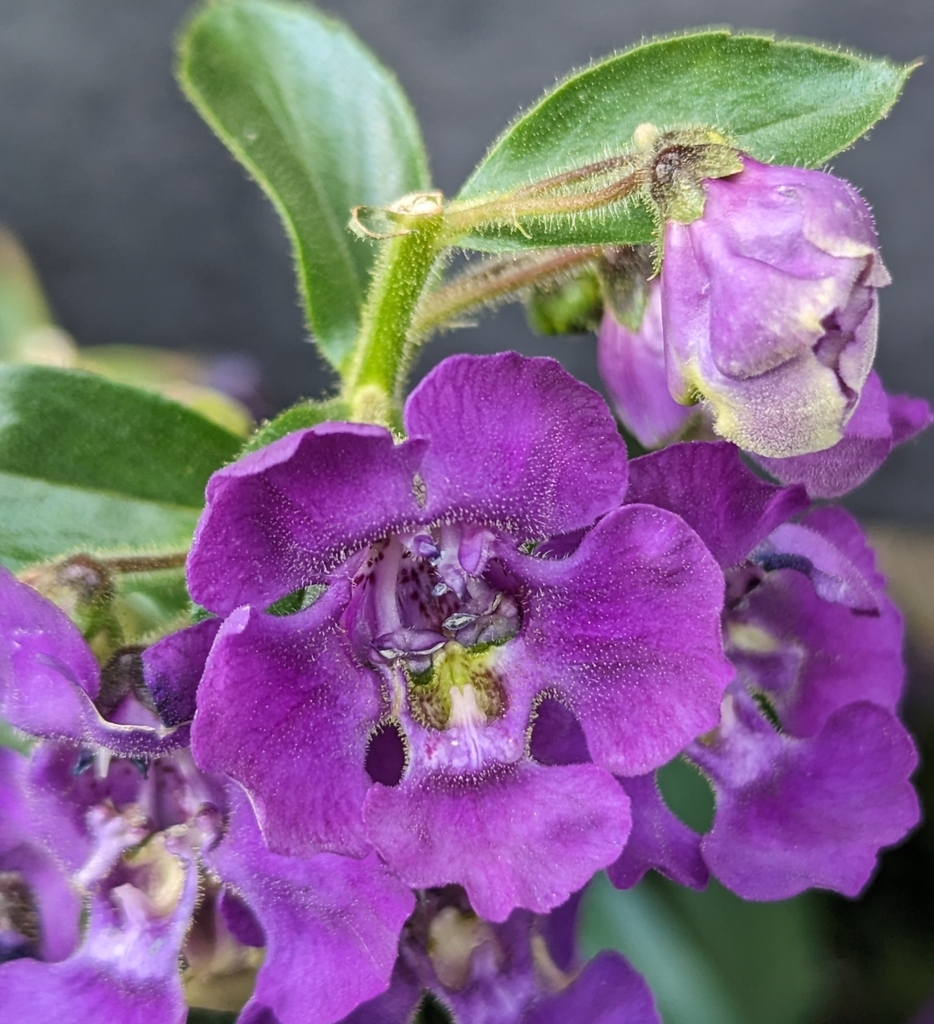
Photo: GooseSpoon, CC BY-SA 4.0 · source

Annual · Plantaginaceae
Summer snapdragon
Angelonia angustifolia
In other languages: Angelonia (Nederlands) · Angélonia (Français)
Angelonia comes from Mexico and the Caribbean. It is a perennial that we grow as an annual bedding and container plant, because it cannot take frost. It forms upright, branching stems with narrow leaves and long spikes of small, two-lipped flowers in purple, lilac, pink, white or bicolours. Because the flowers look a little like those of a snapdragon, it is called summer snapdragon. Gardeners value it because it flowers non-stop from June into October, copes well with hot summers and stays tidy without deadheading.
Light
Full sun
warm and bright
Moisture
Normal
no wet feet
Legal basis
Sand or loam
acid to neutral
Hardiness
down to 5 °C
protect in harsh winters
Size
0.45 m
tall, 0.3 m wide
Flowering
June–October
| Pruning months | July–August |
|---|---|
| Height | 0.45 m |
| Native to Belgium | No, planted |
| Good for bees, butterflies and birds | Yes, for bees |
| Poisonous to people and pets | Not known to be poisonous |
| Flowering | June–October |
Identify
Summer snapdragon: how do you recognise it?
- Habit
- Upright, branching plant 30–45 cm tall and 25–30 cm wide.
- Leaves
- Narrow and lance-shaped, 5–7 cm long, opposite and fresh green.
- Flower
- Small, two-lipped flowers 1.5–2 cm across in long, straight spikes at the tips of the stems, from June to October.
- Colour
- Purple, lilac, pink, white or bicoloured, depending on the variety.
- Roots
- A finely branched root system that likes moisture-retentive but open soil.
Flowering: June–October · Plants: May–June · Pruning: July–August
In your garden
Why grow it?
- Flowers for four to five months, from June into October.
- Copes with heat and full sun, even in pots and planters on a hot terrace.
- Little work: no deadheading needed.
- The straight, slender spikes add height and structure among rounded bedding plants.
- Bees visit the flowers.
Summer snapdragon: where does it grow best?
- Full sun in a warm, sheltered spot; the warmer, the better it flowers.
- Humus-rich sandy or loamy soil, acid to neutral, free-draining.
- Moderately moist: do not let it dry out, but avoid wet feet.
- Plant 25–30 cm apart in a border, or in pots, planters and window boxes.
- Light
- Sun
- Soil type
- Sand or loam
- Acidity
- Acid or neutral
- Moisture
- Normal
- Size
- 0.45 m tall, 0.3 m wide
- Hardiness
- Frost tender: plant out after the last frost (mid-May)
Goes well with
- Zinnia: Round, brightly coloured flowers next to the upright spikes, for the same sunny spot.
- Mealy sage: Blue spikes that go well with purple or white angelonia.
- Silver ragwort: Silver-grey leaves that make the flower colours glow.
- Purpletop vervain: Airy purple heads above the angelonia, also loved by butterflies and bees.
Maintenance
Summer snapdragon: when and how to plant it?
Plant in May–June.
- Only plant out after mid-May, when there is no more risk of night frost and the nights are mild.
- Harden young plants off for a week first: outside by day, indoors at night.
- Dig a hole slightly larger than the pot and mix in some compost.
- Set the plant at the same depth as it was in its pot, 25–30 cm apart.
- Water well straight away and keep the soil moist for the first few weeks.
- In a pot or planter: use good potting compost and a pot with a drainage hole.
Care
- Watering
- Keep the soil lightly moist. In open ground it copes with short dry spells; in pots, water often daily in summer.
- Feeding
- In pots, a liquid feed for flowering plants every two weeks; in open ground, compost at planting time is enough.
- Pinching out
- Pinch out the tips after planting: it then branches better and you get more spikes.
- Deadheading
- Not needed: the plant stays tidy on its own and keeps flowering.
- Support
- Not needed; the stems are sturdy.
Tip: Grow it in a pot in the sunniest, warmest spot on the terrace and feed it regularly with liquid fertiliser: the warmer the summer, the more freely it flowers.
Summer snapdragon: when to prune it?
Pruning months: July–August.
When: Deadheading is not needed. If the plant becomes long and untidy in July–August, cut it back by a third.
How:
- Cut the longest stems back by a third, just above a pair of leaves.
- Within a few weeks new side shoots appear with fresh flower spikes.
- Pinch out the tips right after planting for a bushier plant.
Propagation
- Cuttings
- In August–September take 5–8 cm cuttings from non-flowering shoots, in moist cutting compost, indoors in a warm, light spot. They root within a few weeks; overwinter them indoors.
- Overwintering
- A parent plant in a pot can be overwintered indoors, then cut back and repotted in spring.
Summer snapdragon: how does it get through the winter?
Hardy to 5 °C: protect in harsh winters.
- Not hardy: it cannot take frost and barely grows in cold weather. It is usually treated as an annual.
- Overwintering is possible: bring the plant indoors before the first night frost, to a light spot at 10–15 °C, and water sparingly.
- Cut it back in March, repot in fresh compost and put it back outside after mid-May.
Diseases and pests
- Aphids: On young shoots and buds. Spray them off with water or leave them to the ladybirds.
- Grey mould: Grey fluff on flowers and leaves in cold, wet weather. Do not plant too close, water at the base and remove affected parts.
- Root rot: The plant wilts even though the soil is wet. Provide free-draining soil and a pot with a drainage hole.
- Stalled growth: On cold nights it barely grows or flowers. Do not plant out too early and choose a warm spot.
Through the year
- March: Cut back and repot overwintered plants.
- May: Plant out after mid-May. Pinch out the tips.
- June: Flowering begins. Feed pots every two weeks.
- July: Full flower. Water in dry spells. Shorten long stems.
- August: In flower. Cut back by a third if needed. Take cuttings.
- September: In flower. Take cuttings.
- October: Last flowers. Bring indoors before the first frost or clear away.
- November: Overwinter in a light spot at 10–15 °C.
Use
Good for wildlife
- Bees
- Nectar and pollen for honeybees and wild bees.
You and this species
Did you know?
- In its native range it is pollinated by bees that collect oil rather than nectar: the flowers produce a plant oil in small pouches.
- The name angustifolia means ‘narrow-leaved’.
- It belongs to the plantain family, like foxglove and snapdragon.