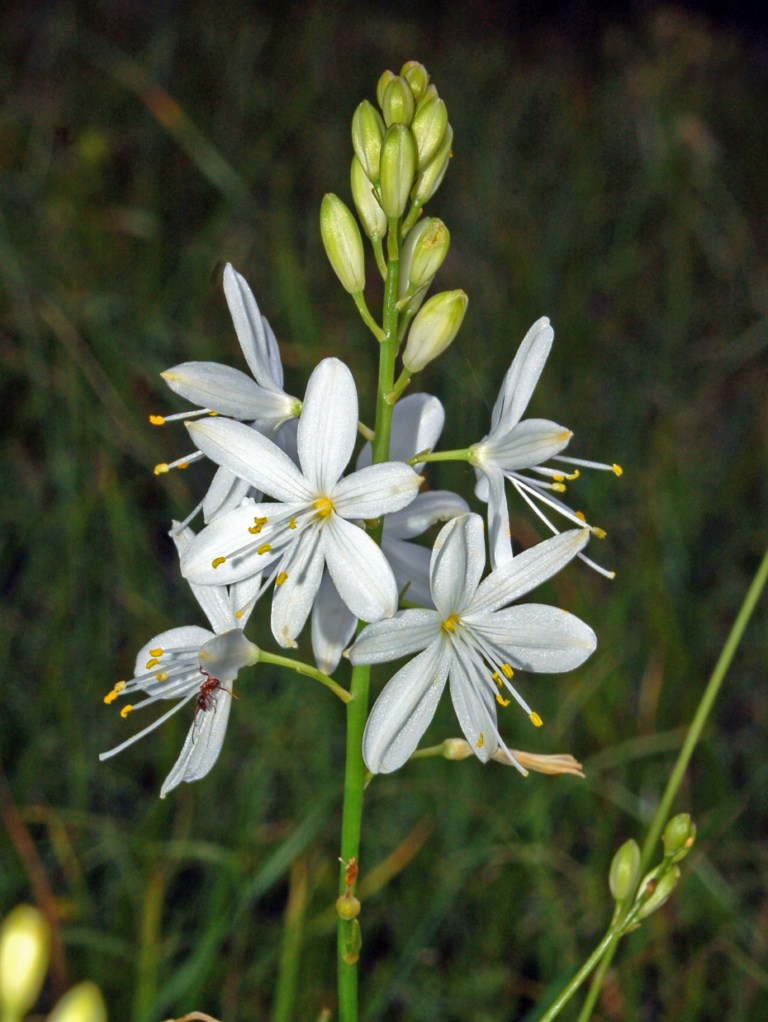
Photo: Hectonichus, CC BY-SA 3.0 · source

Perennial · Asparagaceae
Branched St Bernard’s lily
Anthericum ramosum
In other languages: Kleine graslelie (Nederlands) · Phalangère rameuse (Français)
Branched St Bernard’s lily is a perennial from much of Europe as far as Turkey, where it grows on dry limestone slopes, in poor grassland and along woodland edges. It forms a clump of narrow, grassy leaves, above which branched stems up to 60 cm rise from June to August, carrying dozens of small, white star-shaped flowers about 2 cm across. So it flowers later than St Bernard’s lily, with smaller but more numerous flowers. The overall effect is airy, like a white veil above the border. Gardeners value it in a gravel garden, a rock garden or a dry prairie border, because it copes well with drought and chalk and lasts for years.
Light
Full sun
warm and bright
Moisture
Dry
tolerates drought
Legal basis
Sand or loam
neutral to chalky
Hardiness
Fully hardy
down to -30 °C
Size
0.6 m
tall, 0.3 m wide
Flowering
June–August
| Pruning months | March and September |
|---|---|
| Height | 0.6 m |
| Native to Belgium | No, planted |
| Good for bees, butterflies and birds | Yes, for bees |
| Poisonous to people and pets | Not known to be poisonous |
| Flowering | June–August |
Identify
Branched St Bernard’s lily: how do you recognise it?
- Habit
- Clump of grassy leaves 20–30 cm tall, with branched, upright flower stems up to 60 cm.
- Leaves
- Narrow and strap-like, up to 40 cm long, grass green.
- Flower
- Small white stars about 2 cm across with six petals and yellow stamens, dozens together in a branched, airy spray, from June to August.
- Fruit
- Small, round capsules with black seeds.
- Roots
- A short rhizome with fleshy roots that store water.
Flowering: June–August · Plants: March–April and September–October · Pruning: March and September
In your garden
Why grow it?
- A long flowering season from June to August, like a white veil above the grassy foliage.
- Drought-tolerant: ideal for dry, sunny spots where many other plants give up.
- Bees visit the many small flowers.
- Fits perfectly in a gravel garden, a rock garden or a natural prairie border.
- Long-lived and low-maintenance once established.
Branched St Bernard’s lily: where does it grow best?
- Full sun: in shade it flowers poorly.
- Poor to moderately fertile, well-drained sandy or loamy soil, neutral to chalky.
- Dry: it copes well with long droughts, but not with wet feet.
- Ideal in a gravel garden, a rock garden or on a sunny slope.
- Allow 25–30 cm between plants, preferably in a small group.
- Light
- Sun
- Soil type
- Sand or loam
- Acidity
- Neutral or chalky
- Moisture
- Dry
- Size
- 0.6 m tall, 0.3 m wide
- Hardiness
- Hardy (to -30 °C)
Goes well with
- Wild marjoram: Pink flower heads in July–August, also for dry chalky soil, and a magnet for bees and butterflies.
- Globe thistle: Blue globes at the same time, for the same dry soil.
- Feather grass: A fine ornamental grass that sways in the wind with the little white stars.
- Thyme: A low, fragrant edging at the front.
Maintenance
Branched St Bernard’s lily: when and how to plant it?
Plant in March–April and September–October.
- Plant in March–April or September–October.
- Choose a permanent spot straight away: it bulks up slowly and dislikes disturbance.
- Mix heavy soil with plenty of coarse sand or fine gravel; add no fertiliser.
- Set the plant at the same depth as in the pot and spread the fleshy roots out gently.
- Keep 25–30 cm between plants.
- Water in moderately and spread a little gravel around the base instead of a mulch.
Care
- Watering
- Only during long dry spells in the first year; not needed after that.
- Feeding
- Best avoided: in rich soil the stems become floppy.
- Faded stems
- Cut them off in September, or leave them for a while for the seed.
- Foliage
- Cut away the old, withered leaves in March, before the new ones appear.
- Leave alone
- Leave the clump undisturbed; it gets better with age.
Tip: Combine it with fine ornamental grasses in a gravel garden: from June into August the little white stars then seem to float above the grass.
Branched St Bernard’s lily: when to prune it?
Pruning months: March and September.
When: In September, after flowering, cut off the faded stems. In March, remove the old, withered leaves.
How:
- Cut the flower stems low, just above the leaves.
- Leave a few stems if you want to collect seed.
- In March, cut or pull away the dead leaves before the new shoots appear.
Propagation
- Seed
- Sow fresh seed in autumn in a pot left outdoors: it germinates in spring after a cold spell. Seedlings flower after 2–3 years.
- Division
- In March or September, carefully lift a large clump and split it into pieces, each with a few buds and roots.
Branched St Bernard’s lily: how does it get through the winter?
Hardy to −30 °C.
- Fully hardy, to about −30 °C: no protection is needed in Belgium.
- Wet soil is more dangerous than frost: make sure drainage is good.
- In a pot or trough: use a gritty mix and stand it against a wall in winter, out of the worst of the rain.
Diseases and pests
- Slugs: They eat young leaves in spring. Pick them off in the evening and spread sharp grit around the plant.
- Root rot: In wet, heavy soil the fleshy roots rot. Plant in a well-drained spot or a raised bed.
- Floppy stems: In rich or moist soil the stems grow long and flop. Do not feed and choose a dry, poor spot.
- Few flowers: Caused by too much shade or a young plant. Give it a sunny spot and some patience.
Through the year
- March: Cut away old leaves. Plant or divide.
- April: Plant. Watch for slugs.
- June: Flowering begins.
- July: Full flower. Bees visit the flowers.
- August: Last flowers.
- September: Cut off faded stems. Plant or divide.
- October: Sow fresh seed in a pot. Plant.
Use
Good for wildlife
- Bees
- Nectar and pollen for honeybees and wild bees.
You and this species
Did you know?
- You can tell it from St Bernard’s lily by its branched spray, smaller flowers and the straight style at the heart of the flower.
- The species name ramosum means ‘branched’, after the flower stems.
- It belongs to the asparagus family, like the spider plant grown as a houseplant.