Photo: Wikimedia Commons, CC BY-SA 3.0 · source

Perennial · Plumbaginaceae
Thrift
Armeria maritima
In other languages: Engels gras (Nederlands) · Armérie maritime (Français)
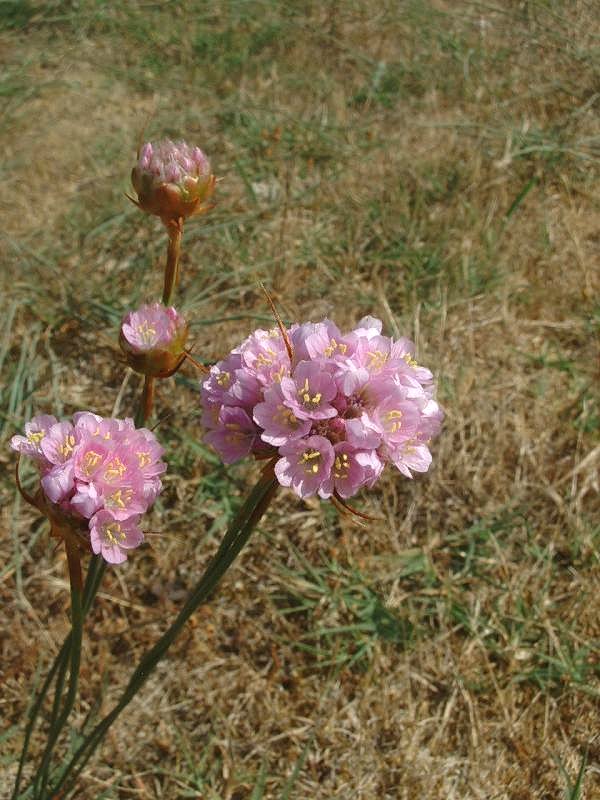
Thrift is a native, evergreen perennial that grows wild along the coasts of Europe, including on the Belgian coast in dunes and salt marshes. It forms dense, grassy cushions of narrow, dark green leaves. From May to July, bare stems 15–25 cm tall carry rounded heads of small pink, lilac or white flowers above them. Gardeners love it because it tolerates salt, wind, drought and poor sandy soil while still flowering freely for bees and butterflies. Well-known cultivars include the deep pink ‘Düsseldorfer Stolz’ and the white ‘Alba’.
Light
Full sun
warm and bright
Moisture
Dry to normal
no wet feet
Legal basis
Sand or loam
any pH
Hardiness
Fully hardy
down to -35 °C
Size
0.2 m
tall, 0.3 m wide
Flowering
May–July
| Pruning months | June–August |
|---|---|
| Height | 0.2 m |
| Native to Belgium | Yes |
| Good for bees, butterflies and birds | Yes, for bees and butterflies |
| Poisonous to people and pets | Not known to be poisonous |
| Flowering | May–July |
Identify
Thrift: how do you recognise it?
- Habit
- Dense, low cushion 10–15 cm tall and 20–30 cm wide; 15–25 cm in flower.
- Leaves
- Narrow, grass-like and dark green, in tight rosettes; evergreen.
- Flower
- Rounded heads 2–3 cm across, packed with tiny flowers, on bare, upright stems, from May to July.
- Colour
- Pink to lilac; there are also white and deep pink cultivars.
- Roots
- A sturdy taproot with a woody base, which helps it cope well with drought.
Flowering: May–July · Plants: March–April and September–October · Pruning: June–August
In your garden
Why grow it?
- Flowers from May to July, and often a little more if you remove the spent stems.
- Native and loved by bees and butterflies.
- Evergreen cushions that look good as an edging in winter too.
- Tolerates salt, wind and drought: ideal by the sea, in a gravel or rock garden and in pots.
- Small and compact: perfect for edging, between paving or on a low wall.
Thrift: where does it grow best?
- Full sun; in shade the cushion becomes loose and it flowers poorly.
- Poor, well-drained sandy or loamy soil, from acid to chalky; also in gravel.
- Dry to normally moist: wet soil in winter makes the clump rot.
- Tolerates wind and salt, ideal by the sea or in an open, windy spot.
- Plant 20–25 cm apart for a continuous edging.
- Light
- Sun
- Soil type
- Sand or loam
- Acidity
- Not fussy
- Moisture
- Dry or normal
- Size
- 0.2 m tall, 0.3 m wide
- Hardiness
- Hardy (to -35 °C)
Goes well with
- Thyme: A fragrant cushion for the same dry, sunny spot.
- Blue fescue: Blue-grey tufts beside the pink pompoms.
- Biting stonecrop: A low, yellow ground cover for the same dry, sandy soil.
- Maiden pink: Also native, with small pink flowers on dry, sunny ground.
Maintenance
Thrift: when and how to plant it?
Plant in March–April and September–October.
- Plant in March–April or in September–October.
- Loosen the soil and, on heavy ground, mix in some coarse sand or fine gravel; no manure or compost is needed.
- Set the plant at the same depth as in the pot, not deeper, so the crown is not buried.
- Keep 20–25 cm apart; slightly closer for a neat edging.
- Water in, and again in dry spells during the first weeks.
- Use a layer of gravel rather than an organic mulch around the base: it keeps the crown dry.
Care
- Water
- Rarely needed once established. In pots, water during long dry spells.
- Feeding
- Not needed. On rich soil the cushion becomes loose and it flowers less.
- Deadheading
- Cut spent stems off just above the cushion; it often flowers a little again.
- Rejuvenating
- If the cushion goes bare in the middle, divide the clump in spring.
- In a pot
- Use a shallow pot with a drainage hole and a mix of potting compost and coarse sand.
Tip: Plant it in a gravel garden or between stones: the gravel keeps the crown dry and prevents rot, its worst enemy.
Thrift: when to prune it?
Pruning months: June–August.
When: No real pruning is needed. From June to August, cut off the spent flower stems.
How:
- Cut spent stems off just above the cushion of leaves.
- After the last flowers, cut all the stems off in one go for a tidy cushion.
- In spring, cut brown, dead rosettes out of the cushion.
Propagation
- Division
- In March–April, lift the clump, split it into pieces each with roots and a few rosettes, and replant at once.
- Cuttings
- In summer, take a rosette with a short piece of stem and insert it in a pot of gritty cutting compost. Keep it barely moist until it roots.
- Seed
- Sow in a pot in spring. Seedlings from cultivars do not always resemble the parent.
Thrift: how does it get through the winter?
Hardy to −35 °C.
- Fully hardy, to about −35 °C: in Belgium no protection is needed.
- Evergreen: the cushion stays in place all winter.
- Wet soil is the only real danger; stand pots on pot feet so water can drain away.
Diseases and pests
- Rot: Brown, rotting patches in the cushion due to wet soil or overwatering. Ensure good drainage and cut out rotten parts.
- Bare centre: Old clumps go bare in the middle. Divide them in spring and replant the young outer pieces.
- Few flowers: Too much shade or soil that is too rich. Move it to full sun and do not feed.
- Rust: Brown or orange pustules on the leaves. Cut off affected leaves and give it an airy spot.
Through the year
- March: Plant. Divide old clumps.
- April: Plant. Cut out dead rosettes.
- May: Flowering begins.
- June: Full bloom. Remove spent stems.
- July: Last flowers. Remove spent stems. Take cuttings.
- August: Cut off all flower stems. Sometimes a second flush.
- September: Plant.
- October: Plant.
- December: Rest; the cushion stays green.
Use
Good for wildlife
- Bees
- Nectar and pollen for honeybees and wild bees.
- Butterflies
- Nectar for butterflies.
You and this species
Did you know?
- In eastern Belgium it also grows wild on zinc-rich soils, where very few plants survive.
- In the 1940s it appeared on the reverse of the British threepenny coin.
- The species name maritima means ‘of the sea’, after its natural home along the coast.