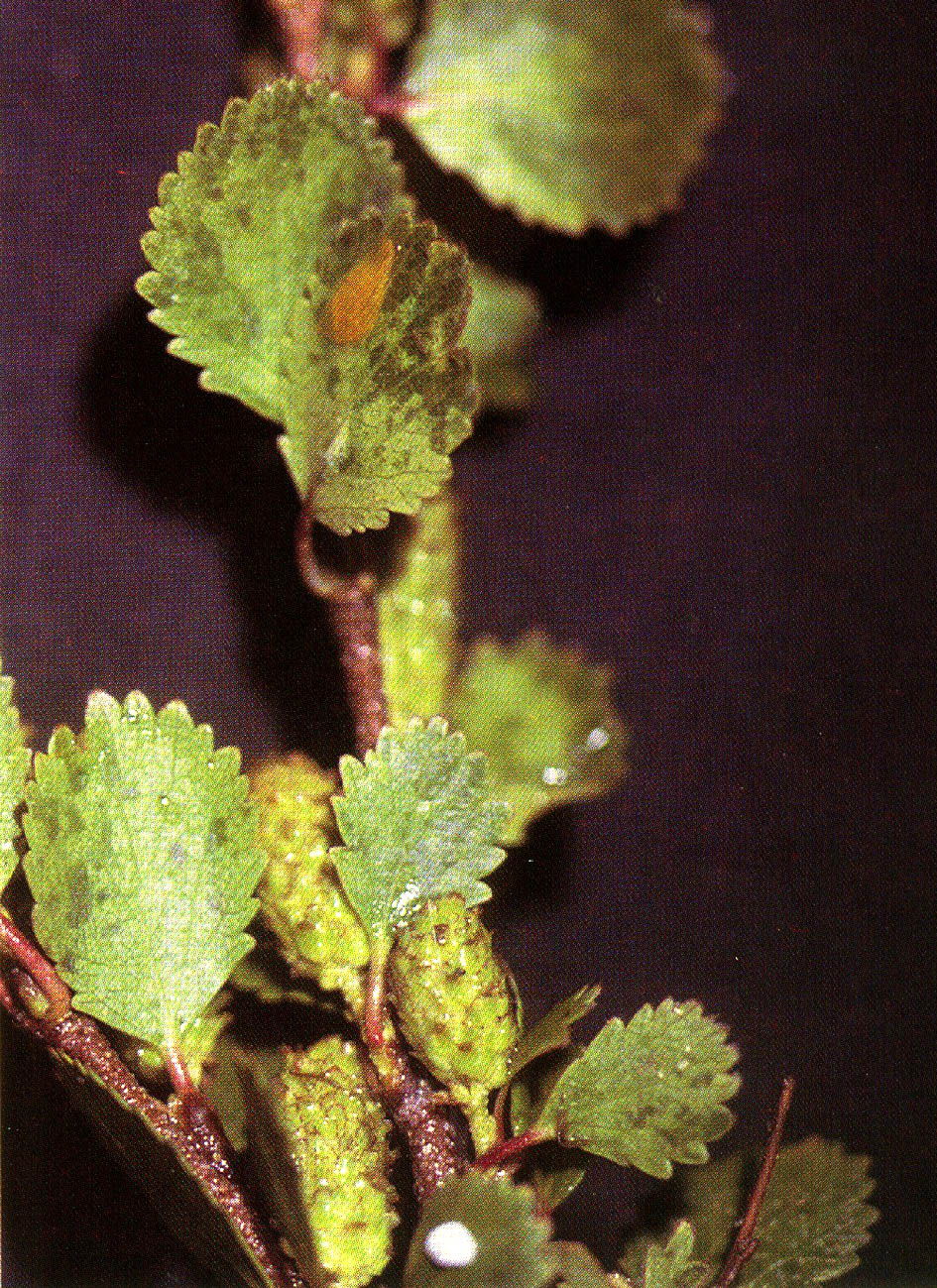
Photo: USDA photo, uploader user:MPF, Public domain · source

Shrub · Betulaceae
Dwarf birch
Betula nana
In other languages: Dwergberk (Nederlands) · Bouleau nain (Français)
Dwarf birch is a low, shrubby birch from the tundra and bogs of the far north: Scandinavia, Scotland, Iceland, Greenland, Siberia and North America, as well as from bogs in the Alps. In the wild it often creeps along the ground; in the garden it becomes a dense, broad shrub of 0.5–1 m. It has small, almost round, scalloped leaves that are glossy dark green and turn yellow to orange-red in autumn. Gardeners plant it in a heather or rock garden, by a pond or in a large container of acid, moist soil. It is extremely hardy but dislikes heat and drought.
Light
Sun or partial shade
preferably some sun
Moisture
Normal to wet
must not dry out
Legal basis
Sand or peat
acid
Hardiness
Fully hardy
down to -40 °C
Size
1 m
tall, 1 m wide
| Pruning months | November–December |
|---|---|
| Height | 1 m |
| Native to Belgium | No, planted |
| Poisonous to people and pets | Not known to be poisonous |
Identify
Dwarf birch: how do you recognise it?
- Habit
- Low, broad, densely branched shrub 0.5–1 m high and wide; often creeping in the wild.
- Leaves
- Almost round, 0.5–2 cm, with a scalloped margin; glossy dark green, yellow to orange-red in autumn. Deciduous.
- Flowers
- Small, inconspicuous catkins in April–May, male and female on the same plant; wind-pollinated.
- Twigs
- Thin, reddish-brown and slightly hairy.
- Roots
- Shallow and finely branched: they dry out quickly in summer.
Plants: March–April and October–November · Pruning: November–December
In your garden
Why grow it?
- A pocket-sized birch: it fits the smallest garden, a rockery or a large container.
- Neat, round leaves and lovely autumn colours in yellow, orange and red.
- Extremely hardy: frost is never a problem.
- A natural partner for heathers, bog plants and other plants of acid, moist soil.
- Thin, reddish-brown twigs give a fine outline in winter too.
Dwarf birch: where does it grow best?
- Sun or partial shade; inland, ideally a spot with some afternoon shade.
- Acid soil: sand or peat, poor and humus-rich. It will not tolerate chalk.
- Moist to wet: drying out is its worst enemy. A pond edge or a damp heather garden is ideal.
- Cool and airy: it dislikes a hot spot against a wall or on a stone patio.
- Allow 0.8–1 m per plant.
- Light
- Sun and partial shade
- Soil type
- Sand or peat
- Acidity
- Acid
- Moisture
- Normal or wet
- Size
- 1 m tall, 1 m wide
- Hardiness
- Hardy (to -40 °C)
Goes well with
- Heather: Flowers in late summer in the same acid, poor soil.
- Cross-leaved heath: Like dwarf birch, it loves moist, acid soil.
- Lingonberry: A creeping evergreen with red berries at the foot of the shrub.
- Cottongrass: White tufts in a wet spot of the heather garden.
- Purple moor grass: An airy grass of damp heaths, turning golden in autumn.
Maintenance
Dwarf birch: when and how to plant it?
Plant in March–April and October–November.
- Plant in March–April or October–November, when the soil is not frozen.
- Dig a hole twice as wide as the root ball. If your soil is not acid enough, mix in ericaceous compost or composted pine needles.
- Set the plant at the same depth as in the pot and firm the soil well.
- Water generously, preferably with rainwater: tap water is often limy.
- Mulch with pine needles, bark or leaf mould to keep the soil cool and moist.
Care
- Water
- Keep the soil moist at all times, especially in warm summers. Use rainwater where possible.
- Feeding
- Hardly needed. At most a thin layer of leaf mould or a little ericaceous fertiliser in April.
- Mulching
- A layer of pine needles or bark keeps the roots cool and the soil acid.
- In a pot
- Can be grown in a large pot of ericaceous compost. Stand it in partial shade and never let it dry out.
Tip: Give it a cool spot with moist, acid soil, for example on the north side of a heather garden or by a pond, and water with rainwater: it will stay fresh even in warm summers.
Dwarf birch: when to prune it?
Pruning months: November–December.
When: Pruning is rarely needed. Remove dead or crossing shoots in November–December, after leaf fall.
How:
- Cut out dead, damaged or crossing twigs back to healthy wood or to the base.
- Keep the natural, slightly irregular shape as far as possible.
- If the shrub gets too wide, shorten a few of the longest shoots to a side branch.
Caution: Do not prune in late winter or spring: birches ‘bleed’ heavily from pruning cuts at that time.
Propagation
- Layering
- In spring, bend a low branch to the ground and peg it down; shoots touching the soil sometimes root by themselves. Sever after a year and transplant.
- Seed
- Sow fresh seed in autumn on acid, moist seed compost and do not cover it: birch seed needs light to germinate. Leave the tray outdoors over winter.
Dwarf birch: how does it get through the winter?
Hardy to −40 °C.
- Extremely hardy, to about −40 °C: no protection is ever needed in Belgium.
- Even in a pot it can stay outdoors all winter.
- Its weak point is not cold but summer heat: make sure the soil stays cool and moist in summer.
Diseases and pests
- Drying out: Brown leaf edges and early leaf fall in hot, dry summers. Water with rainwater, mulch and find a cooler spot.
- Yellow leaves: Yellow leaves with green veins point to chalky soil. Move it into acid soil and water with rainwater.
- Aphids: On young shoots in spring. Natural predators usually deal with them; otherwise hose them off.
- Birch rust: Orange pustules under the leaves in late summer. Usually harmless: clear up fallen leaves.
Through the year
- March: Plant. Top up the mulch.
- April: Plant. New leaves and small catkins.
- May: Watch for aphids. Check the mulch.
- June: Water in dry weather, preferably with rainwater.
- July: Keep the soil cool and moist.
- August: Water in hot weather.
- October: Plant. Yellow to orange-red autumn colour. Sow seed.
- November: Plant. Remove dead or crossing twigs.
- December: Dormant. Light pruning if needed.
You and this species
Did you know?
- In the tundra, dwarf birch is often only a few tens of centimetres tall and creeps along the ground, protected under the snow.
- During the last ice age dwarf birch also grew in the Low Countries; its pollen and leaves have been found in ancient soil layers.
- In the wild it hybridises readily with downy birch.