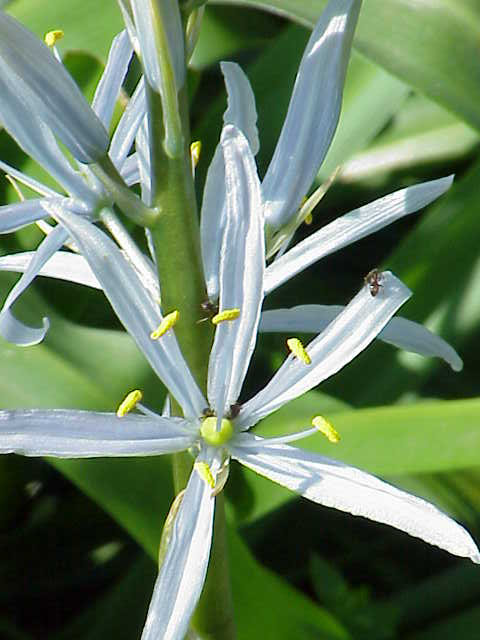
Photo: Kurt Stüber [1], CC BY-SA 3.0 · source

Bulb or tuber · Asparagaceae
Cusick's camas
Camassia cusickii
In other languages: Camassia cusickii (Nederlands) · Camassia cusickii (Français)
Cusick’s camas, Camassia cusickii, is a bulb from the damp mountain meadows of Oregon and Idaho in the north-western United States. In May, sturdy stems 60–80 cm tall rise above broad, blue-green leaves, carrying dozens of pale blue, starry flowers that open from the bottom up. The large bulbs are strong and hardy, and the plants are happy in moist soil where many other bulbs rot. In grass, at the edge of a pond or among perennials, it makes a cloud of sky blue just after the tulips.
Light
Sun or partial shade
preferably some sun
Moisture
Normal to wet
must not dry out
Legal basis
Loam, clay or peat
any pH
Hardiness
Fully hardy
down to -25 °C
Size
0.8 m
tall, 0.2 m wide
Flowering
May
| Height | 0.8 m |
|---|---|
| Native to Belgium | No, planted |
| Good for bees, butterflies and birds | Yes, for bees |
| Poisonous to people and pets | Not known to be poisonous |
| Flowering | May |
Identify
Cusick's camas: how do you recognise it?
- Habit
- Bulb with stems 60–80 cm tall and a clump 20 cm wide.
- Leaf
- Broadly strap-shaped, blue-green, up to 40 cm long, at the base of the plant.
- Flower
- Pale blue, starry flowers 3–4 cm across in a long spike, with yellow stamens.
- Flowering
- May, for about three weeks.
- Bulb
- Large, up to 5–6 cm, often with a cluster of offsets.
Flowering: May · Plants: September–November
In your garden
Why grow it?
- Sky-blue flower spikes in May, after the tulips and before the summer flowers begin.
- A rich bee plant: the open, starry flowers are full of pollen.
- Tolerates moist, heavy soil better than most bulbs.
- Lovely for naturalising in grass or a wildflower meadow.
- A strong, long-lived bulb that returns every year and slowly spreads.
Cusick's camas: where does it grow best?
- Sun to light shade.
- Loam, clay or peaty soil rich in humus.
- Moist in spring; tolerates a wet spot, even at the edge of a pond.
- In grass, a wildflower meadow, a moist border or among perennials.
- Plant 10–15 bulbs per m² in loose groups.
- Light
- Sun and partial shade
- Soil type
- Loam, clay or peat
- Acidity
- Not fussy
- Moisture
- Normal or wet
- Size
- 0.8 m tall, 0.2 m wide
- Hardiness
- Hardy (to -25 °C)
Goes well with
- Tulip: Flowers just before; together they give a long spring display.
- Meadowsweet: Fills the damp spot later in summer.
- Yellow flag: Yellow beside the blue at the edge of a pond.
- Hardy geranium: Flowers shortly after the camassia and hides the dying leaves.
- Cuckooflower: A native spring flower for a damp meadow.
Maintenance
Cusick's camas: when and how to plant it?
Plant in September–November.
- Plant the bulbs in September–November.
- Set them about 15 cm deep and 15 cm apart.
- Mix compost into heavy soil; extra drainage is not needed.
- Plant in natural, irregular groups for the best effect.
- In grass: make holes with a bulb planter and drop the bulbs in.
Care
- Water
- Rarely needed; make sure the soil stays moist in April–May.
- Feeding
- Some compost or well-rotted manure in autumn.
- Leaves
- Let the leaves turn yellow after flowering before removing them.
- Mowing
- In grass: mow only once the leaves have died back, usually late June–July.
- Dividing
- After a few years the clumps become crowded; you can then divide them.
Tip: Plant them in a strip of grass that you do not mow until July: in May you will have a blue flower meadow, just as in their homeland.
Cusick's camas: when to prune it?
When: No pruning is needed.
How:
- Cut off the faded stems if you do not want seed.
- Remove the leaves when they are completely yellow, usually in July.
Caution: Do not cut the leaves while still green: the bulb needs them to flower next year.
Propagation
- Offsets
- Lift crowded clumps in summer after the leaves have died back, separate the bulbs and replant at once.
- Sowing
- Sow ripe seed in autumn in a pot outdoors; seedlings flower after 3–4 years.
Cusick's camas: how does it get through the winter?
Hardy to −25 °C.
- Very hardy, to −25 °C.
- No protection needed.
- The bulbs cope with wet winter soil better than most other bulbs.
- In winter there is nothing to see above ground.
Diseases and pests
- Few flowers: Too much shade or crowded clumps. Give more light or divide the clump.
- Slug damage: On the young leaves in spring; usually limited.
- Flopping stems: Too much shade or soil that is too rich. Choose a sunnier spot and feed less.
Through the year
- March: Leaves appear.
- April: Flower buds.
- May: Full flower. Bees.
- June: Seed ripens. Leaves turn yellow.
- July: Remove the leaves. Mow the grass. Divide crowded clumps.
- September: Plant bulbs.
- October: Plant bulbs.
- November: Last bulbs.
Use
Good for wildlife
- Bees
- Nectar and pollen for honeybees and wild bees.
You and this species
Did you know?
- The bulbs of related Camassia species were an important food for the Indigenous peoples of north-west America; they were slow-cooked for hours in pits.
- The name Camassia comes from ‘camas’ or ‘quamash’, the word the Nez Perce and other peoples used for the plant.