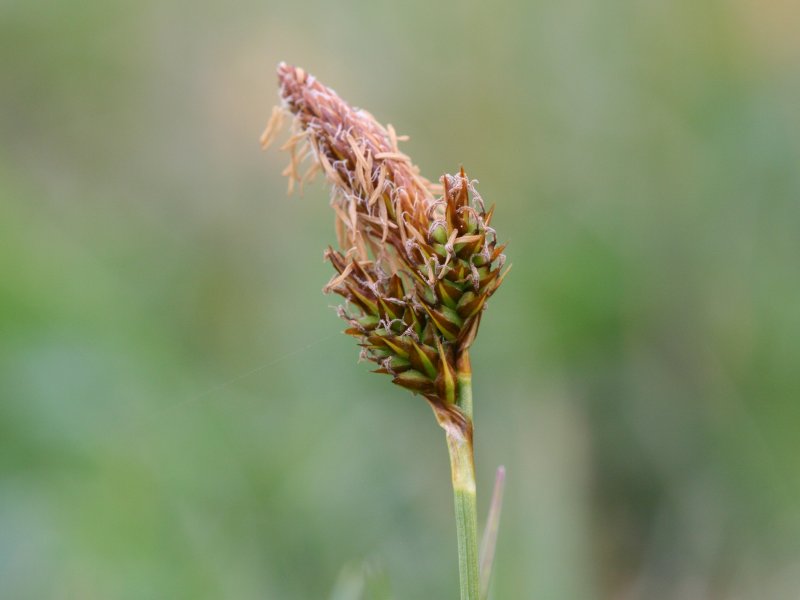
Photo: Kristian Peters -- Fabelfroh 08:36, 20 May 2007 (UTC), CC BY-SA 3.0 · source

Ornamental grass · Cyperaceae
Spring sedge
Carex caryophyllea
In other languages: Voorjaarszegge (Nederlands) · Laîche printanière (Français)
Spring sedge is a low, native sedge of dry, poor grassland, dunes and chalk slopes across much of Europe, including Belgium. It forms small tufts or loose mats of narrow, evergreen leaves about 10–15 cm long. As early as April–May the flower spikes appear: at the top a brown male spike with yellow stamens, below it a few small female spikes. Gardeners know it mainly through the cultivar ‘The Beatles’, which forms round, hair-like mops, just like a little wig. It is ideal for a gravel garden, rock garden or between paving on a dry, sunny spot.
Light
Full sun
warm and bright
Moisture
Dry to normal
no wet feet
Legal basis
Sand, loam or clay
neutral to chalky
Hardiness
Fully hardy
down to -30 °C
Size
0.15 m
tall, 0.2 m wide
Flowering
April–May
| Pruning months | March |
|---|---|
| Height | 0.15 m |
| Native to Belgium | Yes |
| Poisonous to people and pets | Not known to be poisonous |
| Flowering | April–May |
Identify
Spring sedge: how do you recognise it?
- Habit
- Low tuft or loose mat 10–15 cm tall and about 20 cm wide; it spreads slowly by short rhizomes.
- Leaves
- Narrow, stiff and slightly curved, green to grey-green and evergreen. Very fine and hair-like in ‘The Beatles’.
- Flowers
- In April–May: at the top a club-shaped, brown male spike with yellow stamens, below it 1–3 small female spikes.
- Stems
- Three-sided, as in most sedges.
- Roots
- Fibrous, with short rhizomes; it does not run.
Flowering: April–May · Plants: March–May and September–October · Pruning: March
In your garden
Why grow it?
- One of the first sedges to flower: by April the brownish-yellow spikes stand above the leaves.
- Evergreen: the gravel garden keeps some green even in winter.
- Native and at home on poor, dry soil, so ideal for a naturalistic planting.
- Small and neat: suitable for a rock garden, gravel garden, container or between paving.
- Little work: no fertiliser, hardly any water and at most a comb-through in spring.
Spring sedge: where does it grow best?
- Full sun: in shade it becomes floppy and open.
- Poor, well-drained soil: sand, loam or clay with added grit, neutral to chalky.
- Dry to normally moist; it dislikes wet soil, especially in winter.
- Space plants 15–20 cm apart; between paving or in gravel, small tufts are enough.
- Light
- Sun
- Soil type
- Sand, loam or clay
- Acidity
- Neutral or chalky
- Moisture
- Dry or normal
- Size
- 0.15 m tall, 0.2 m wide
- Hardiness
- Hardy (to -30 °C)
Goes well with
- Thyme: A low, fragrant mat on the same dry, poor soil.
- Stonecrop: Fleshy little leaves and summer flowers beside the fine sedge foliage.
- Harebell: A native blue summer flower of poor grassland.
- Carthusian pink: Small pink flowers on sturdy stems, at home on dry, chalky soil.
- Crocus: Early flowers in spring between the low tufts.
Maintenance
Spring sedge: when and how to plant it?
Plant in March–May and September–October.
- Plant in March–May or in September–October, when the soil is not too wet.
- Loosen the soil and, on heavy ground, mix plenty of gravel or coarse sand into the top layer.
- Set the clump at the same depth as it was in the pot; between paving, plant small tufts in wide joints or open gaps.
- Keep 15–20 cm between plants.
- Water in straight away and during dry spells in the first weeks.
- Mulch with gravel or grit: it keeps the base dry and weeds away.
Care
- Watering
- Only until established; after that it is very drought-tolerant. In a pot or trough, during long dry spells.
- Feeding
- Do not: it likes poor soil.
- Tidying
- In March, comb out the dead leaves with gloved fingers or a small rake.
- Weeding
- Keep vigorous grasses and weeds away: among larger plants it is soon swamped.
- Renewing
- Divide old clumps that become bare in the centre in spring.
Tip: Plant ‘The Beatles’ in a small group in gravel or in a shallow bowl: that is where its round, hair-like mops look their best. Give them a quick comb every spring.
Spring sedge: when to prune it?
Pruning months: March.
When: Hardly any pruning is needed, as it is evergreen. In March, comb out the dead leaves.
How:
- Comb dead and brown leaves out of the clump with gloved fingers or a small rake.
- At most, trim off brown tips; do not cut the green leaves short.
- You can simply leave the spent flower spikes; they are barely noticeable.
Caution: Do not cut the clump back hard like an ornamental grass: an evergreen sedge recovers from that only slowly.
Propagation
- Division
- In March–April or in September: pull small pieces with roots from the edge and replant them straight away. This is also how ‘The Beatles’ is propagated.
- Seed
- Sow seed of the species in autumn or early spring in a seed tray outdoors; germination is often slow and erratic. Cultivars do not come true from seed.
Spring sedge: how does it get through the winter?
Hardy to −30 °C.
- Very hardy, to about −30 °C: no protection needed.
- Evergreen; after a severe winter the leaf tips may be brown, but it grows away again in spring.
- Wet soil is more dangerous than frost: make sure water drains away quickly.
- In a pot or trough: stand it on pot feet and give hardly any water in winter.
Diseases and pests
- Root rot: On wet soil the clump turns brown and soft. Plant in a well-drained spot with gravel.
- Swamped: Among stronger plants or in grass it disappears. Give it an open spot and weed regularly.
- Brown leaves in the centre: Dead leaves build up in the clump. Comb them out in March and divide old clumps.
- Drying out in a pot: In a small pot it dries out quickly in summer. Water when the compost is completely dry.
Through the year
- March: Comb out dead leaves. Plant. Divide.
- April: Flowering with small brownish-yellow spikes. Plant.
- May: Flowering. Plant. Water young plants in dry spells.
- June: Weed around the clumps.
- July: Water pots during long dry spells.
- September: Plant. Divide.
- October: Plant.
- December: Evergreen leaves in the gravel garden.
You and this species
Did you know?
- You can recognise sedges by their three-sided stems; hence the saying ‘sedges have edges’.
- The name spring sedge refers to its early flowering: it is one of the first sedges to bloom in spring.
- In the wild it grows on dry, poor grassland, a habitat that has declined sharply because of fertilisers and building.