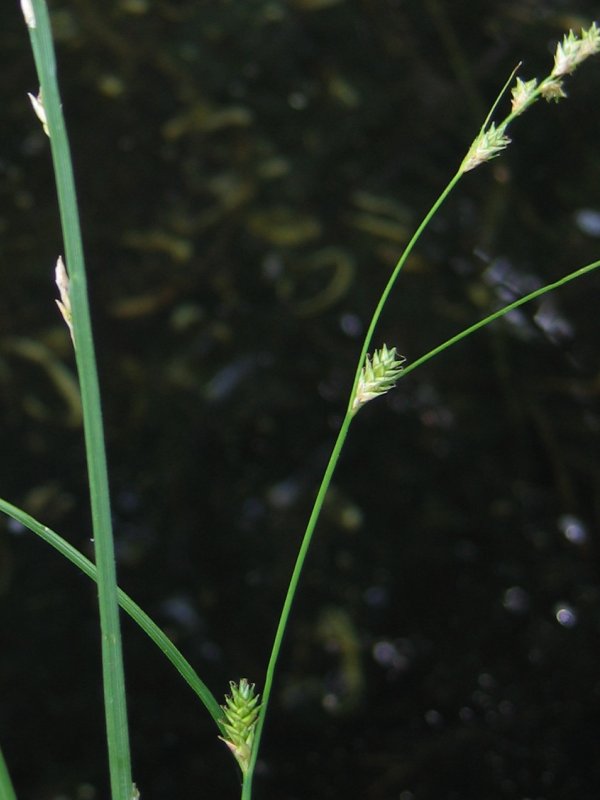
Photo: Kristian Peters -- Fabelfroh 09:56, 23 July 2006 (UTC), CC BY-SA 3.0 · source

Ornamental grass · Cyperaceae
Remote sedge
Carex remota
In other languages: IJle zegge (Nederlands) · Laîche espacée (Français)
Remote sedge (Carex remota) is a native sedge that grows in Flanders in damp woods, along streams and at woodland edges. It forms a loose, arching clump of fine, light green foliage 40–60 cm tall, which often stays green through winter. In June and July slender spikes appear, spaced at regular intervals along the stem, just as the species name remota (‘far apart’) suggests. It is an easy plant for shady, damp places under trees and beside ponds, and it also self-seeds to fill bare patches.
Light
Partial shade or shade
tolerates little sun
Moisture
Normal to wet
must not dry out
Legal basis
Loam, clay or peat
any pH
Hardiness
Fully hardy
down to -25 °C
Size
0.5 m
tall, 0.4 m wide
Flowering
June–July
| Pruning months | March |
|---|---|
| Height | 0.5 m |
| Native to Belgium | Yes |
| Poisonous to people and pets | Not known to be poisonous |
| Flowering | June–July |
Identify
Remote sedge: how do you recognise it?
- Habit
- Loose, arching clump 40–60 cm tall and 30–40 cm wide.
- Leaves
- Narrow, soft, light green and arching; usually evergreen.
- Flowers
- Slender spikes spaced apart along the stem, with long bracts; in June–July.
- Seed
- Small nutlets in the spikes, ripe in summer; they self-seed easily.
- Roots
- Fibrous and dense; the clump grows slowly and does not send out long runners.
Flowering: June–July · Plants: March–May and September–October · Pruning: March
In your garden
Why grow it?
- Clumps of fine, light green foliage that give a soft, natural feel in the shade.
- A native species that fits well in a natural or wild garden.
- Grows in damp to wet places where many other plants struggle.
- Evergreen and low-maintenance: no pruning, no feeding.
- Self-seeds and fills gaps under trees and shrubs.
Remote sedge: where does it grow best?
- Part shade, also shade; in full sun the foliage dries out.
- Damp to wet soil: loam, clay or peaty soil, acid to chalky.
- At the edge of a pond or stream, at a woodland edge or under trees.
- Allow 30–40 cm between plants.
- Light
- Partial shade and shade
- Soil type
- Loam, clay or peat
- Acidity
- Not fussy
- Moisture
- Normal or wet
- Size
- 0.5 m tall, 0.4 m wide
- Hardiness
- Hardy (to -25 °C)
Goes well with
- Ferns: The same damp shade and a nice contrast in leaf shape.
- Marsh marigold: Yellow flowers in spring at the damp edge.
- Hosta: Large leaves beside the fine sedge foliage.
- Meadowsweet: Fluffy cream-white plumes on damp soil.
Maintenance
Remote sedge: when and how to plant it?
Plant in March–May and September–October.
- Plant in March–May or September–October, when the soil is not frozen.
- Dig a hole twice as wide as the root ball and mix in some compost or leaf mould.
- Set the plant at the same depth as in its pot and firm the soil well.
- Water in generously straight away, even if it is raining.
- Spread leaf mould or wood chips around the clump and keep the soil moist.
Care
- Water
- Keep the soil moist at all times. In dry weather water generously, especially in the first year.
- Feeding
- A layer of compost in spring is enough; on rich, damp soil it is usually unnecessary.
- Mulching
- Leaf mould or wood chips in autumn keep the soil moist and suppress weeds.
- Tidying
- In March remove brown and damaged leaves.
- Seedlings
- Seedlings you do not want are easy to pull out when they are small.
Tip: Plant it in a damp spot in part shade and let it self-seed: the seedlings fill bare patches under shrubs by themselves.
Remote sedge: when to prune it?
Pruning months: March.
When: In March, before the new leaves come through. Pruning is not really necessary.
How:
- Pull or cut off brown and damaged foliage at the base.
- If the clump looks very tatty, cut it back to 5–10 cm; the foliage regrows quickly.
- Only cut off spent spikes if you do not want self-sown seedlings.
Propagation
- Division
- In March–April or September–October, cut a clump into pieces with a sharp spade, each with roots and leaves. Replant at once and water.
- Seed
- The seed ripens in summer. Sow it fresh in pots of damp soil and keep them cool, or let the plant self-seed.
Remote sedge: how does it get through the winter?
Hardy to −25 °C.
- Hardy down to about −25 °C: no protection is needed, even in hard winters.
- The foliage usually stays green; in severe winters it can turn brown. Cut it off in March.
- In a pot: stand it against a wall and wrap the pot in hessian so the roots do not freeze.
Diseases and pests
- Drying out: Brown tips and shrivelling foliage in dry weather. Water generously and mulch the soil.
- Seedlings everywhere: It self-seeds freely. Pull out unwanted seedlings or cut off the spikes before the seed ripens.
- Yellowing in the sun: In full sun the foliage fades. Move it to part shade.
- Tatty winter foliage: Normal after a cold winter. Cut it off in March; new leaves will grow.
Through the year
- March: Remove brown leaves. Plant or divide.
- April: Plant. Apply compost.
- May: Plant. Water in dry spells.
- June: Flowering starts.
- July: Flowering. Water in dry spells.
- August: Seed ripens. Water in dry spells.
- September: Plant or divide. Move seedlings.
- October: Plant. Mulch with leaf mould.
You and this species
Did you know?
- The name remota means ‘far apart’ and refers to the spikes that stand apart along the stem.
- Sedges are wind-pollinated, which is why their flowers have no petals.
- In the wild it grows in damp woods and along woodland streams in Flanders.