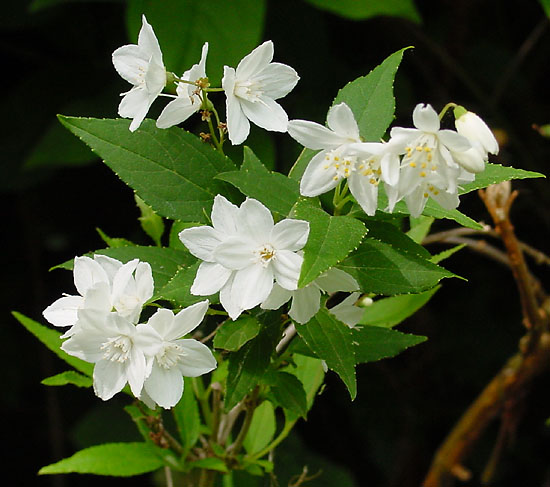
Photo: Wouter Hagens, Public domain · source

Shrub · Hydrangeaceae
Slender deutzia
Deutzia gracilis
In other languages: Deutzia (Nederlands) · Deutzia grêle (Français)
Slender deutzia is a compact, deciduous shrub from Japan. In May and June it is completely covered in snow-white, star-shaped flowers in upright clusters. It stays small, about 80 cm high and 1 m wide, so it fits into any garden: at the front of a border, in a large pot or as a low, informal hedge. Gardeners love it because it flowers so freely and reliably and is hardly ever troubled by disease. It is hardy and only needs one prune straight after flowering.
Light
Sun or partial shade
preferably some sun
Moisture
Normal
no wet feet
Legal basis
Sand, loam or clay
any pH
Hardiness
Fully hardy
down to -25 °C
Size
0.8 m
tall, 1 m wide
Flowering
May–June
| Pruning months | June–July |
|---|---|
| Height | 0.8 m |
| Native to Belgium | No, planted |
| Good for bees, butterflies and birds | Yes, for bees |
| Poisonous to people and pets | Not known to be poisonous |
| Flowering | May–June |
Identify
Slender deutzia: how do you recognise it?
- Habit
- Compact, rounded shrub 60–80 cm high and up to 1 m wide, with thin, slightly arching stems.
- Leaves
- Narrow and lance-shaped, 3–6 cm, finely toothed and in opposite pairs; fresh green.
- Flowers
- White, star-shaped flowers of 1.5–2 cm with five petals, in upright clusters along the stems.
- Flowering time
- May into June, on the previous year’s stems.
- Bark
- Older stems have light brown bark that peels in thin strips.
Flowering: May–June · Plants: March–April and October–November · Pruning: June–July
In your garden
Why grow it?
- Abundant flowers in May–June: the stems almost disappear under the white blooms.
- Compact: suits small gardens, the front of a border or a large pot.
- Bees readily visit the open flowers.
- Lovely as a low, informal hedge or as an edging along a path.
- Hardy and rarely troubled by disease.
- The graceful, slightly arching stems give it a soft, loose shape.
Slender deutzia: where does it grow best?
- Sun or partial shade; it flowers most freely in full sun.
- Ordinary garden soil: sand, loam or clay, acid to chalky.
- Moist but not wet: neither too dry nor waterlogged.
- Space plants 80–100 cm apart; for a low hedge, 2 plants per metre.
- Light
- Sun and partial shade
- Soil type
- Sand, loam or clay
- Acidity
- Not fussy
- Moisture
- Normal
- Size
- 0.8 m tall, 1 m wide
- Hardiness
- Hardy (to -25 °C)
Goes well with
- Hardy geranium: Low blue or pink flowers at its feet, also in June.
- Lady’s mantle: Soft green leaves and yellow flower sprays as an edging in front of the white shrub.
- Roses: They take over in June and extend the season.
- Tulips: Spring colour among the young stems.
Maintenance
Slender deutzia: when and how to plant it?
Plant in March–April and October–November.
- Plant in March–April or October–November, when the soil is neither frozen nor too wet.
- First stand the pot in a bucket of water until no more air bubbles rise.
- Dig a hole twice as wide as the root ball and mix in a few spadefuls of compost.
- Set the plant at the same depth as it was in the pot and firm the soil well.
- Water in thoroughly straight away, even if it is raining.
- Spread a mulch of leaf mould or wood chips around the base.
Care
- Watering
- Weekly in dry spells during the first year. Later only in prolonged drought; regularly in a pot.
- Feeding
- In March, some compost or organic feed for flowering shrubs. Do not feed after July.
- Mulching
- A layer of mulch in spring keeps the soil cool and moist.
- In a pot
- Choose a pot at least 40 cm wide with a drainage hole and good potting compost. Repot every 2–3 years.
- Faded stems
- Cut them back straight after flowering: this keeps it compact and free-flowering.
Tip: Prune straight after flowering and never later than July: over the summer the shrub makes the stems that will flower next year.
Slender deutzia: when to prune it?
Pruning months: June–July.
When: Straight after flowering, from late June to early July. It flowers on the previous year’s wood.
How:
- Cut flowered stems back to just above a strong, young side shoot.
- Every other year, remove a few of the oldest stems at the base so that young ones can take their place.
- Remove dead, weak and inward-growing twigs.
- Renovate a neglected shrub over three years by taking out a third of the old stems each year.
Caution: Do not prune in winter or early spring: you would cut off this year’s flower buds.
Propagation
- Softwood cuttings
- In June: cuttings of 8–10 cm from non-flowering shoots, lower leaves removed, in moist cutting compost under plastic. They root within a few weeks.
- Hardwood cuttings
- From November to February: woody cuttings of 15–20 cm, pushed two thirds of their length into the soil in a sheltered spot. Transplant them the following autumn.
Slender deutzia: how does it get through the winter?
Hardy to −25 °C.
- Hardy to about −25 °C: no protection is needed in Belgian winters.
- A late night frost in April can damage young shoots and buds; the shrub soon recovers. Fleece helps when frost is forecast.
- In a pot: stand it against a wall and wrap the pot in hessian so the roots do not freeze.
Diseases and pests
- Few flowers: Usually caused by pruning at the wrong time or too much shade. Prune only after flowering.
- Aphids: On young shoots in spring. Hose them off with water; ladybirds do the rest.
- Frosted shoots: Brown, shrivelled shoot tips after a late frost. Cut them back to healthy wood.
- Drought: Drooping leaves or early leaf fall in a dry summer, especially in a pot. Water generously and mulch.
Through the year
- February: Rest. Take hardwood cuttings.
- March: Planting. Spread compost.
- April: Planting. Keep fleece ready for late frosts.
- May: Flowering. Keep an eye out for aphids.
- June: Flowering. Prune straight after flowering. Take softwood cuttings.
- July: Cut back the last flowered stems. Water in dry spells.
- August: Water in dry spells, especially in a pot.
- October: Planting.
- November: Planting. Take hardwood cuttings.
- December: Rest.
Use
Good for wildlife
- Bees
- Nectar and pollen for honeybees and wild bees.
You and this species
Did you know?
- The genus is named after Johan van der Deutz, an Amsterdam alderman who supported the botanist Carl Peter Thunberg’s travels to Japan.
- Deutzia belongs to the hydrangea family and is related to mock orange.
- Gracilis is Latin for ‘slender’ or ‘graceful’, after its thin, elegant stems.