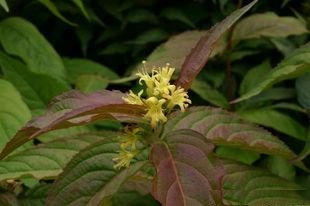
Photo: Sten at Danish Wikipedia, CC BY-SA 3.0 · source

Shrub · Caprifoliaceae
Southern bush honeysuckle
Diervilla sessilifolia
In other languages: Diervilla (Nederlands) · Diervilla (Français)
Southern bush honeysuckle is a low, deciduous shrub from the south-eastern United States, where it grows on rocky slopes and woodland edges in the Appalachians. It reaches about 1 m tall and spreads by underground suckers into a dense, wide clump of 1.5 m or more. From June to August it bears small clusters of sulphur-yellow, tubular flowers at the tips of the new shoots, which are busy with bumblebees and bees. The young leaves are bronze, and in autumn they turn red to purple. Gardeners like to use it as a tough ground cover on a bank or in a difficult corner, as it is hardy, tolerates drought and grows in both sun and shade. The cultivar ‘Butterfly’ is well known; the related hybrid Diervilla × splendens is also widely planted.
Caution: It spreads strongly by underground suckers and can smother smaller neighbours. Do not plant it in a small border among delicate perennials, or install a root barrier at least 30 cm deep.
Light
Sun to shade
not fussy
Moisture
Dry to normal
no wet feet
Legal basis
Sand, loam or clay
any pH
Hardiness
Fully hardy
down to -30 °C
Size
1 m
tall, 1.5 m wide
Flowering
June–August
| Pruning months | March |
|---|---|
| Height | 1 m |
| Native to Belgium | No, planted |
| Good for bees, butterflies and birds | Yes, for bees |
| Poisonous to people and pets | Not known to be poisonous |
| Flowering | June–August |
Identify
Southern bush honeysuckle: how do you recognise it?
- Habit
- Low, dense shrub about 1 m tall that spreads by suckers to 1.5 m wide or more.
- Leaves
- Opposite, lance-shaped, 5–15 cm long, toothed and stalkless; bronze-red when young, later dark green, red to purple in autumn.
- Flower
- Small, two-lipped tubular flowers about 1 cm long in clusters at the shoot tips, from June to August.
- Colour
- Sulphur yellow, standing out well against the dark foliage.
- Roots
- Shallow and branching, with underground suckers that send up new shoots.
Flowering: June–August · Plants: March–April and October–November · Pruning: March
In your garden
Why grow it?
- A tough ground cover whose suckers bind a bank or slope.
- Yellow flowers from June to August, busy with bumblebees and bees.
- Interest over three seasons: bronze young leaves, summer flowers and red to purple autumn colour.
- Grows almost anywhere: in sun and shade, on dry and moist soil, acid or chalky.
- Very hardy and rarely troubled by disease.
Southern bush honeysuckle: where does it grow best?
- Sun to shade: in sun it flowers best and colours best in autumn; in shade it stays greener and looser.
- Sand, loam or clay, acid, neutral or chalky: it is undemanding.
- Dry to moist soil; once established it copes well with drought.
- Ideal on a bank, along a drive or as a low, informal hedge; allow 1.5 m per plant, or plant 60–80 cm apart for ground cover that closes quickly.
- Give it a spot where it may spread, or keep it in check with a root barrier or a hard edge.
- Light
- Sun, partial shade and shade
- Soil type
- Sand, loam or clay
- Acidity
- Not fussy
- Moisture
- Dry or normal
- Size
- 1 m tall, 1.5 m wide
- Hardiness
- Hardy (to -30 °C)
Goes well with
- Cranesbill: A flowering ground cover that is just as easy.
- Michaelmas daisy: Flowers after the bush honeysuckle, with blue and purple next to the autumn colour.
- Dogwood: Red or yellow stems in winter, when the bush honeysuckle is bare.
- Fountain grass: Airy plumes as a contrast to the dense shrub.
- Lady’s mantle: Soft leaves and small yellow flowers for the edge.
Maintenance
Southern bush honeysuckle: when and how to plant it?
Plant in March–April and October–November.
- Plant in March–April or October–November, when the soil is not frozen or too wet.
- Dig a hole twice as wide as the root ball and mix in a little compost.
- Set the plant at the same depth as in its pot and firm the soil well.
- Leave 60–80 cm between plants for ground cover, or 1–1.5 m for single shrubs.
- Water in generously straight away and regularly in dry spells during the first year.
- Mulch between young plants with wood chips so weeds do not get a chance before the plants close up.
Care
- Water
- In dry spells during the first year; after that rarely needed, except in a pot or in long hot periods.
- Feeding
- A little compost in March, after pruning. Nothing more is needed.
- Mulching
- Wood chips between young plants suppress weeds until the shrubs take over.
- Suckers
- In spring or autumn, chop off unwanted suckers with a spade; you can replant them elsewhere straight away.
- Faded flowers
- No need to remove them: they drop by themselves.
Tip: On a bank, plant 60–80 cm apart and mulch in between: after a few years the suckers knit together into a dense carpet that holds the soil.
Southern bush honeysuckle: when to prune it?
Pruning months: March.
When: In March, before new growth starts. It flowers on this year’s wood, so spring pruning costs no flowers.
How:
- Every year, cut some of the oldest stems down to the ground to encourage young, free-flowering shoots.
- If the shrub becomes thin or untidy, cut all stems back to 15–20 cm above the ground in March; it reshoots quickly and densely.
- Remove dead wood and suckers that come up where you do not want them.
Caution: Do not prune in summer: you would cut off the flowering shoot tips.
Propagation
- Division of suckers
- In spring or autumn, sever a sucker with roots from the parent plant and replant it elsewhere at once. The easiest method.
- Softwood cuttings
- In June: take 10 cm cuttings from young shoots, strip the lower leaves and insert them in moist cutting compost under plastic. They root easily.
Southern bush honeysuckle: how does it get through the winter?
Hardy to −30 °C.
- Very hardy, to about −30 °C: no protection needed in Belgium.
- It drops its leaves in autumn after colouring red to purple; leave pruning the bare stems until March.
- It is hardy in a pot too, but make sure the water drains away well.
Diseases and pests
- Too many suckers: It quickly takes over its surroundings. Remove suckers every year or install a root barrier when planting.
- Thin, bare shrub: After a few years without pruning. Cut it back hard in March; it reshoots densely in spring.
- Few flowers and little autumn colour: Too much shade. It grows in shade, but flowers and colours better with a few hours of sun.
- Powdery mildew: A white coating on the leaves in dry summers. Rarely serious: water and cut out affected shoots.
Through the year
- March: Prune: remove old stems at the base, or cut the whole shrub back. Add compost. Plant.
- April: Plant. Mulch. Bronze young leaves.
- May: Remove unwanted suckers.
- June: Flowering begins. Take softwood cuttings.
- July: Flowering. Water in dry spells, especially young plants.
- August: Last flowers.
- October: Red to purple autumn colour. Plant. Lift and replant suckers.
- November: Plant. The leaves fall.
Use
Good for wildlife
- Bees
- Nectar and pollen for honeybees and wild bees.
You and this species
Did you know?
- The genus is named after the French surgeon Dièreville, who stayed in Acadia, now Nova Scotia in Canada, around 1700 and brought a related species back to Europe.
- Sessilifolia means ‘with stalkless leaves’: the leaves sit directly on the stem.
- Weigela is a close relative; weigelas were once even included in the genus Diervilla.