Photo: Wikimedia Commons, CC BY-SA 3.0 · source

Houseplant · Asparagaceae
Madagascar dragon tree
Dracaena reflexa var. angustifolia
In other languages: Dracaena (Nederlands) · Dragonnier de Madagascar (Français)
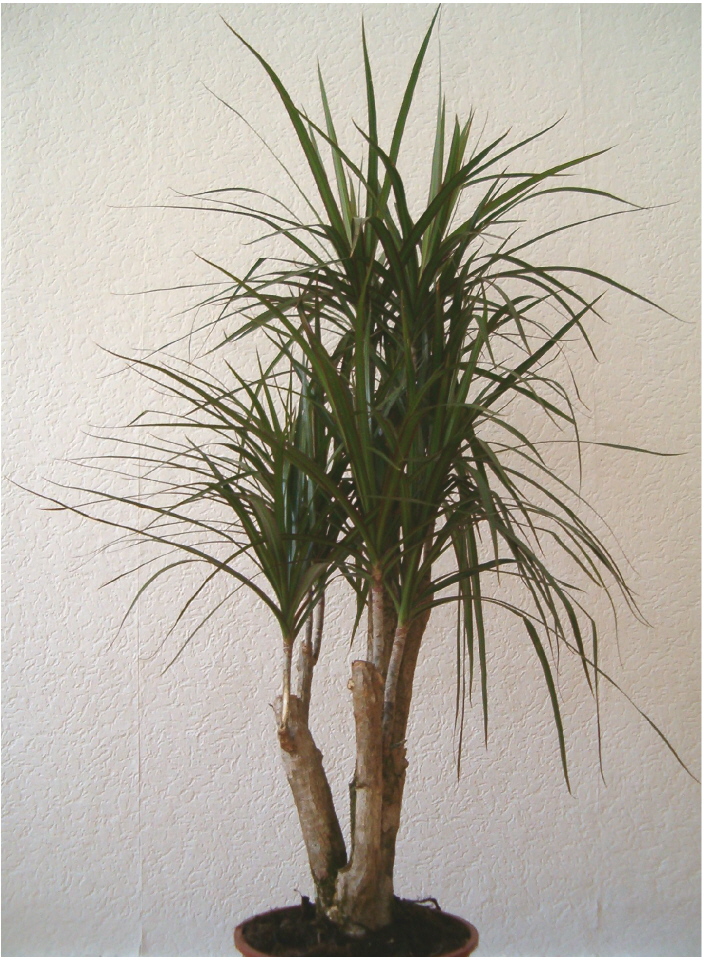
This dracaena comes from Madagascar and is better known by its old name, Dracaena marginata. It is a slender, tree-like houseplant with thin, woody stems topped with a tuft of narrow, leathery leaves, green with a red or purplish red edge. Growers like it because it asks for little, copes with less light and gives a clean, graphic silhouette. Well-known cultivars are ‘Tricolor’, with cream and red stripes, and ‘Colorama’, with a lot of pinkish red in the leaf. Indoors it grows up to 2 m tall over the years.
Caution: Toxic to cats and dogs: the leaves contain saponins, which can cause vomiting and drooling if nibbled. Keep the plant out of their reach and out of reach of young children. The sap can irritate the skin; wear gloves when pruning.
Light
Partial shade or shade
tolerates little sun
Moisture
Dry to normal
no wet feet
Legal basis
Potting soil
Hardiness
Houseplant
min. 12 °C
Size
2 m
tall, 0.6 m wide
| Pruning months | April–May |
|---|---|
| Height | 2 m |
| Poisonous to people and pets | Yes, take care with children and pets |
Identify
Madagascar dragon tree: how do you recognise it?
- Habit
- Tree-like with one or more thin, often curving stems; up to 2 m tall indoors and about 60 cm wide.
- Leaves
- Narrow and strap-like, 30–50 cm long and 1–2 cm wide, leathery, green with a red edge; in tufts at the tips of the stems.
- Stem
- Greyish brown and woody, with the scars of fallen leaves in a regular pattern.
- Flowering
- Indoors it hardly ever flowers.
- Roots
- Orange-yellow roots that do not cope well with wet compost.
Plants: March–May · Pruning: April–May
In your garden
Why grow it?
- A slender, clean silhouette that suits a modern interior.
- Little work: it tolerates some drought and a spot with less light.
- Evergreen and slow-growing, so it stays attractive in the same spot for a long time.
- Cultivars with red, pink or cream striped leaves bring colour without flowers.
- Easy to propagate from tip or stem cuttings.
Madagascar dragon tree: where does it grow best?
- Bright light to partial shade, out of fierce midday sun, which scorches the leaves. In a dark spot it grows more slowly and the leaves become narrower.
- Room temperature, 18–24 °C; never below 12 °C and not in a draught.
- Ordinary room air is fine; very dry air gives brown leaf tips.
- Out of reach of cats and dogs: they like to nibble the narrow leaves.
- Light
- Bright, out of direct sun or low light
- Potting soil
- Multi-purpose compost or airy, humus-rich compost
- Acidity
- Acid or neutral
- Watering
- Sparingly or moderately
- Size
- 2 m tall, 0.6 m wide
- Temperature
- Minimum 12 °C
Goes well with
- Snake plant: Also a tough, architectural plant that needs little water.
- ZZ plant: Glossy leaves, just as easy and for the same partial shade.
- Swiss cheese plant: Large, rounded leaves as a contrast to the narrow foliage.
- Kentia palm: Graceful green fronds for a bright corner.
Maintenance
Madagascar dragon tree: when and how to plant it?
Plant in March–May.
- Repot in March–May, every 2–3 years or when roots grow out of the pot.
- Choose a sturdy, heavy pot 2–4 cm wider than the old one, with a drainage hole: otherwise a tall plant will topple over.
- Use light houseplant compost mixed with a little perlite or coarse sand for good drainage.
- Set the plant at the same depth as before and firm the compost.
- Water until it runs out of the bottom, then empty the saucer.
Care
- Water
- Only water when the top half of the pot is dry. Too much water makes the stem rot. Even less in winter.
- Water quality
- Preferably rainwater or soft water at room temperature: hard water causes brown leaf tips.
- Feeding
- From April to September, houseplant feed at half strength once a month.
- Leaves
- Wipe off dust with a damp cloth or put the plant under a lukewarm shower now and then.
- Old leaves
- It is normal for the lower leaves to yellow and drop: that is how the bare stem forms.
Tip: Only water when the top half of the pot is dry: too much water makes the stem rot. Brown leaf tips usually come from dry air or hard water, so use rainwater if you can.
Madagascar dragon tree: when to prune it?
Pruning months: April–May.
When: In April–May, when the plant becomes too tall or too sparse. Otherwise pruning is not needed.
How:
- Cut or saw through a stem at the height you want with a sharp, clean knife or small saw; usually 2–3 new tufts grow from below the cut.
- Use the removed top as a cutting.
- Trim brown leaf tips at an angle, within the brown part, without cutting into the green.
- Gently pull dry, yellow lower leaves off the stem.
Caution: The sap can irritate the skin: wear gloves and keep prunings away from pets.
Propagation
- Tip cuttings
- In spring or summer, cut off a tip of 15–20 cm, remove the lower leaves and put it in water or moist cutting compost at 20–25 °C. Roots appear after 4–8 weeks.
- Stem sections
- Saw a bare stem into pieces of 5–10 cm and push them, bottom end down, into moist cutting compost. Keep warm under plastic; they sprout after a few weeks.
Madagascar dragon tree: how does it get through the winter?
- Indoors all year: it does not tolerate frost and suffers below 12 °C.
- Water sparingly in winter and do not feed; let the pot dry out well between waterings.
- Keep it in a bright spot, away from cold windows, draughts and hot radiators.
- Dry air from central heating gives brown leaf tips: a tray of water and pebbles helps.
Diseases and pests
- Stem rot: A soft, brown stem and a drooping tuft, from too much water or cold. Water less; if the stem has rotted, take the healthy top as a cutting.
- Brown leaf tips: Usually from dry air or hard water. Use rainwater and raise the humidity.
- Red spider mite: Fine webbing and pale speckles on the leaves, especially in dry, warm air. Rinse the plant off under the shower.
- Mealybug: White, woolly tufts in the leaf axils. Remove them with a cotton bud dipped in a little alcohol.
- Yellow lower leaves: A few at a time is normal; many at once points to too much water.
Through the year
- January: Little water, no feeding. Away from cold windows.
- March: Repot if the pot is full of roots.
- April: Repot or cut back. Start feeding monthly again. Take tip cuttings.
- May: Prune or repot. Feed.
- June: Feed. Only water when the top half of the pot is dry.
- July: Feed. Rinse the leaves under a lukewarm shower.
- August: Feed. Watch out for red spider mite.
- September: Last feed of the year.
- October: Water less.
- December: Little water. Trim brown leaf tips.
Use
Edible and useful
Not edible. These dragon trees, the snake plant, lucky bamboo and the ti plant are mildly poisonous: the leaves contain saponins, which cause drooling, vomiting and sometimes diarrhoea and lethargy in cats and dogs; cats can also get dilated pupils. They like to chew the long, narrow leaves, which look like blades of grass: keep the plant out of their reach and clear up fallen or trimmed leaves. Do not let animals drink from the vase or bowl of lucky bamboo. A bit of leaf gives a child an upset stomach at most, but do not let children chew it. Call your vet if an animal has eaten a lot or falls ill. If any is swallowed, call a poison centre (in Belgium 070 245 245) or your doctor at once.
You and this species
Did you know?
- The name Dracaena comes from the Greek drakaina, ‘female dragon’.
- Botanists now treat it as a variety of Dracaena reflexa, but in the trade it is still often sold as Dracaena marginata.
- It is related to the dragon tree of the Canary Islands, whose red resin is known as ‘dragon’s blood’.