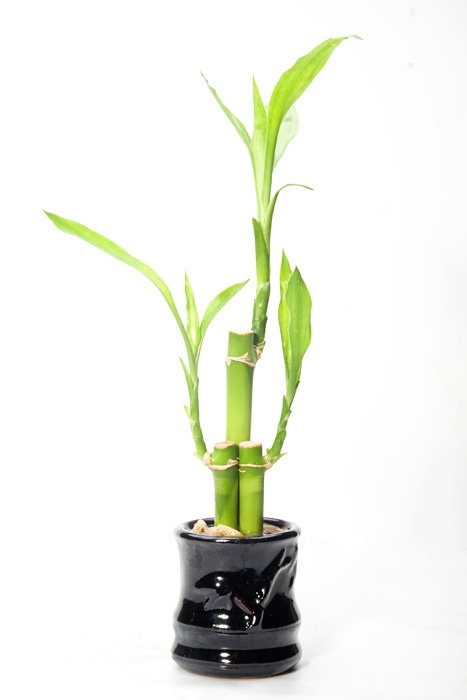
Photo: Champlax, CC BY-SA 3.0 · source

Houseplant · Asparagaceae
Lucky bamboo
Dracaena sanderiana
In other languages: Geluksbamboe (Nederlands) · Bambou de la chance (Français)
Lucky bamboo is not a bamboo at all but a small dracaena from tropical Africa, including Cameroon, which makes it a relative of the dragon tree and of asparagus. It forms thin, green, ringed stems that look like bamboo, with narrow, lance-shaped leaves that are often slightly twisted. In the shops you usually see it as a bundle of straight stems in a vase of water, or with stems grown into spirals or tied into a braid or tower. There are also forms with white- or yellow-edged leaves. People love it because it needs little light, grows for years in plain water and is said to bring good luck in Chinese tradition.
Caution: Lucky bamboo is toxic to cats and dogs: chewing the leaves can cause vomiting, drooling and lethargy. Keep it out of reach of pets and young children, and do not let animals drink from the vase.
Light
Partial shade or shade
tolerates little sun
Moisture
Moist to wet
must not dry out
Legal basis
Potting soil
Hardiness
Houseplant
min. 15 °C
Size
1 m
tall, 0.3 m wide
| Pruning months | April–July |
|---|---|
| Height | 1 m |
| Poisonous to people and pets | Yes, take care with children and pets |
Identify
Lucky bamboo: how do you recognise it?
- Habit
- Thin, upright stems 1–2 cm thick, up to 1 m tall; leafy side shoots grow along and at the top of the stem.
- Stem
- Green, smooth and ringed like bamboo. A stem that has been cut does not grow any taller, but produces side shoots.
- Leaves
- Narrow and lance-shaped, 15–25 cm long, fresh green and often slightly twisted; some forms have white or yellow edges.
- Roots
- Fine, orange-red roots in water; a sign of a healthy plant.
- Flowers
- Hardly ever flowers indoors; it is grown only for its stems and leaves.
Plants: March–May · Pruning: April–July
In your garden
Why grow it?
- Grows for years in a vase of water: no compost and no mess.
- Copes with a spot with little light, such as a shelf, a desk or a bathroom.
- Clean and simple: a few stems in a glass vase with pebbles suit any interior.
- Easy to propagate: a side shoot roots in a glass of water.
- A popular gift, as it stands for luck and prosperity in Asian cultures.
- Evergreen and the same all year, with very little work.
Lucky bamboo: where does it grow best?
- Bright light to partial shade without direct sun: a few metres from a window, or by a north-facing window. Fierce sun scorches the leaves and makes algae grow in the water.
- It also tolerates fairly dark spots, but grows more slowly there; if the new leaves turn pale, move it somewhere a little brighter.
- Warmth: 18–28 °C, never below 15 °C. No cold draughts and no spot directly above a radiator.
- In water: a sturdy vase with pebbles or glass beads to hold the stems upright. In compost: a pot with a drainage hole.
- Light
- Bright, out of direct sun or low light
- Potting soil
- Multi-purpose compost or airy, humus-rich compost
- Acidity
- Acid or neutral
- Watering
- Generously
- Size
- 1 m tall, 0.3 m wide
- Temperature
- Minimum 15 °C
Goes well with
- Devil’s ivy: Also grows in water and tolerates low light; its trails hang prettily over the edge of a shelf.
- Peace lily: Also likes partial shade and moist compost, with white flowers as a bonus.
- Chinese evergreen: Patterned leaves for the same bright to partly shaded spot.
- Heartleaf philodendron: A trailing or climbing plant that also needs little light and roots in water.
Maintenance
Lucky bamboo: when and how to plant it?
Plant in March–May.
- Set new stems in a vase or pot preferably in March–May, when they root fastest.
- In water: fill a vase with pebbles or glass beads and wedge the stems firmly between them. The water should cover the roots and 2–5 cm of the stem.
- Use rainwater, filtered water or tap water that has stood for a day, at room temperature.
- In compost: choose a pot with a drainage hole and open houseplant compost, set the stems 3–5 cm deep and firm in. Then water until it runs out of the bottom.
- Preferably use an opaque vase or keep it out of the sun: with light and water, algae grow fast.
Care
- Watering
- Change the water every week or two, rinsing the vase and pebbles at the same time. Always keep the roots under water. In compost: evenly moist, never dried out.
- Water quality
- Use rainwater or filtered water: lime, chlorine and fluoride in tap water cause brown leaf tips.
- Feeding
- Very little: every one to two months, a few drops of liquid feed for hydroculture or houseplants in the water. Too much feed causes yellow leaves and algae.
- Leaves
- Wipe off dust with a damp cloth.
- Repotting
- In compost, every two to three years in spring. In water, replace dirty pebbles and move a bundle that has grown too big into a wider vase.
- Ties
- Loosen wires or ribbons around tied stems as soon as they start to cut into the stem.
Tip: Change the water every week or two with rainwater or filtered water and rinse the vase at the same time. That keeps the stems green and gives algae no chance.
Lucky bamboo: when to prune it?
Pruning months: April–July.
When: Pruning is not needed, but from April to July you can cut off side shoots that are too long or crooked. Preferably do not cut the main stems.
How:
- Cut side shoots with clean, sharp scissors, leaving a 1–2 cm stub on the stem; a new shoot may grow from it.
- Use the shoots you cut off as cuttings: they root in water.
- You can shorten a stem that is too tall; it will not grow any taller, but will produce side shoots below the cut.
- Remove yellow leaves, and take yellow, soft stems out of the vase straight away.
Caution: A yellow, soft stem will not recover: remove it immediately so the rot does not spread to the other stems through the water.
Propagation
- Cuttings
- From April to July: cut off a side shoot or a stem tip, remove the lower leaves and stand it in a glass of water. Roots appear after a few weeks; then add it to the other stems.
- Stem sections
- A bare stem can be cut into sections of 10–15 cm with at least one node. Stand them upright in water or moist compost, bottom end down: they only root in their original direction of growth.
Lucky bamboo: how does it get through the winter?
- A houseplant that stays indoors all year: below 15 °C it stops growing and the stems can turn yellow and rot.
- In winter, give it a slightly brighter spot because the days are short, but still out of fierce sun.
- Change the water using water at room temperature, never ice-cold water from a cold shed or water butt.
- Do not feed from October to March, and do not stand it against a cold window or above a radiator.
Diseases and pests
- Yellow stem: Often starts at the bottom and turns soft: rot caused by dirty water, cold or too much feed. Remove the stem, rinse the vase and pebbles and add fresh water.
- Yellow leaves: Too much sun, too much feed or an old leaf dying off. Cut off the leaf and move the plant out of the sun.
- Brown leaf tips: Lime, chlorine or fluoride in the water, or dry air. Use rainwater or filtered water.
- Algae: Green slime in the water and on the pebbles, especially in a clear vase in the light. Change the water more often, rinse everything and choose an opaque vase.
- Spider mite and mealybug: Webbing or white fluff in the leaf axils. Rinse under the tap and wipe the leaves with a damp cloth.
Through the year
- January: Rest. Change the water every two weeks. No feed.
- February: Rest. Clean the vase and pebbles.
- March: Set new stems or repot. A few drops of feed.
- April: Cut back side shoots. Put cuttings in water.
- May: Growth. Change the water. Keep out of fierce sun.
- June: Take cuttings. Watch for algae in the water.
- July: Trim side shoots. A few drops of feed.
- August: Growth. Change the water more often in hot weather.
- September: Last feed.
- October: Stop feeding. Move somewhere slightly brighter.
- November: Rest. Use room-temperature water when changing it.
- December: Rest. Keep away from cold windows.
Use
Edible and useful
Not edible. These dragon trees, the snake plant, lucky bamboo and the ti plant are mildly poisonous: the leaves contain saponins, which cause drooling, vomiting and sometimes diarrhoea and lethargy in cats and dogs; cats can also get dilated pupils. They like to chew the long, narrow leaves, which look like blades of grass: keep the plant out of their reach and clear up fallen or trimmed leaves. Do not let animals drink from the vase or bowl of lucky bamboo. A bit of leaf gives a child an upset stomach at most, but do not let children chew it. Call your vet if an animal has eaten a lot or falls ill. If any is swallowed, call a poison centre (in Belgium 070 245 245) or your doctor at once.
You and this species
Did you know?
- Lucky bamboo is not a bamboo: true bamboo is a grass, while this is a dracaena, in the asparagus family.
- The spirals are made by turning the plant very gradually in relation to the light: the tip always grows towards the light and so slowly forms a curl.
- In Chinese tradition the number of stems has a meaning. Four stems are best avoided as a gift, because the word for four sounds like the word for death.