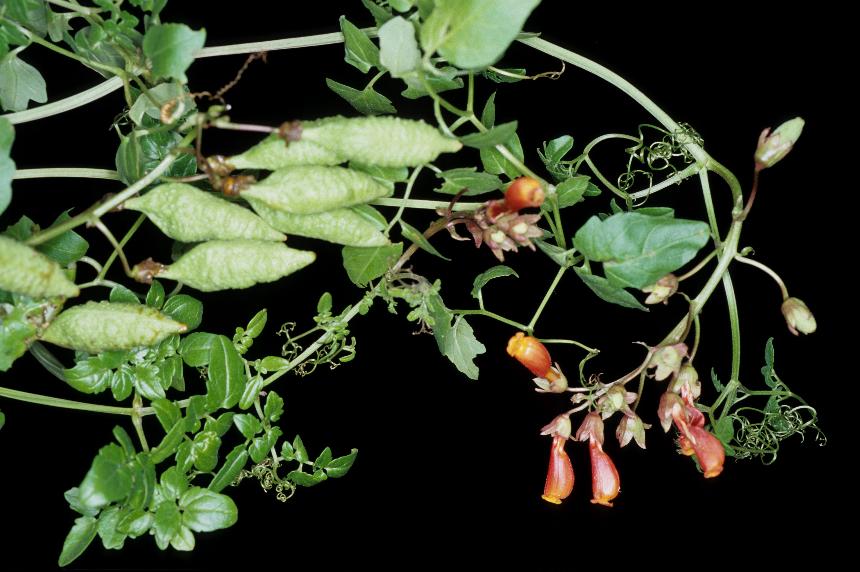
Photo: Murray Dawson, CC BY-SA 4.0 · source

Annual · Bignoniaceae
Chilean glory flower
Eccremocarpus scaber
In other languages: Eccremocarpus (Nederlands) · Eccremocarpus (Français)
Chilean glory flower, Eccremocarpus scaber, comes from Chile, where it scrambles over shrubs and rocks. It is a fast-growing climber with tendrils that can reach 2–3 m in a single season. From June to October it carries clusters of tubular flowers of 2–3 cm, usually orange-red with a yellow rim, though there are also yellow, pink and red varieties. The fine, divided leaves give the plant a light, airy look. In our climate we usually grow it as an annual, but against a sunny, sheltered wall it sometimes survives a mild winter. A cheerful climber for a trellis, obelisk or wire netting.
Light
Full sun
warm and bright
Moisture
Normal
no wet feet
Legal basis
Sand or loam
any pH
Hardiness
down to -5 °C
protect in harsh winters
Size
3 m
tall, 1 m wide
Flowering
June–October
| Pruning months | April |
|---|---|
| Height | 3 m |
| Native to Belgium | No, planted |
| Good for bees, butterflies and birds | Yes, for bees |
| Poisonous to people and pets | Not known to be poisonous |
| Flowering | June–October |
Identify
Chilean glory flower: how do you recognise it?
- Habit
- Climber with thin stems that cling by leaf tendrils; 2–3 m tall and about 1 m wide.
- Leaves
- Twice divided, fresh green, with a tendril at the tip of each leaf that it uses to cling.
- Flower
- Tubular, 2–3 cm, in loose clusters at the tips of the shoots, from June to October.
- Colour
- Orange-red with a yellow rim; there are also yellow, pink and red varieties.
- Fruit
- Inflated, pod-like fruits containing winged seeds.
- Roots
- Fleshy and branching; they like free-draining soil and rot with wet feet.
Flowering: June–October · Sowing: February–March · Plants: May · Pruning: April
In your garden
Why grow it?
- Grows at lightning speed and covers a fence, obelisk or pergola post in a single season.
- Flowers from June to October with orange-red tubular blooms.
- Attracts bees and bumblebees; in Chile the flowers are visited by hummingbirds.
- Fine, divided foliage gives an airy effect, even when there are no flowers.
- Easy to grow from seed: the plant is quick and cheap to propagate.
Chilean glory flower: where does it grow best?
- Full sun, preferably against a warm, south-facing wall or fence.
- Humus-rich, well-drained soil: sandy or loamy, acid to chalky.
- Normally moist: water regularly, without wet feet.
- Sheltered from cold wind; a wall or hedge helps it through the winter.
- Plant 40–50 cm apart and provide support of netting, wires or a trellis.
- Light
- Sun
- Soil type
- Sand or loam
- Acidity
- Not fussy
- Moisture
- Normal
- Size
- 3 m tall, 1 m wide
- Hardiness
- Tolerates light frost (to -5 °C)
Goes well with
- Clematis: Blue or purple flowers next to the orange clusters, on the same support.
- Sweet pea: An annual climber in blue or purple for a colourful contrast.
- Climbing rose: A sturdy climber with a longer flowering season on the same wall.
- Lavender: A low, fragrant edge at the foot, in the same sunny soil.
- Honeysuckle: Fragrant flowers and a natural companion against a hedge or fence.
Maintenance
Chilean glory flower: when and how to plant it?
Plant in May.
- Plant out in May, once the last night frosts have passed.
- Harden off home-grown plants first for a week: outside by day, inside at night.
- Dig a hole twice as wide as the rootball and mix in a little compost.
- Set the plant at the same depth as in its pot, 15–20 cm from the wall or support.
- Water in well straight away and gently guide the first shoots towards the support.
- Spread a mulch of leaf mould or bark around the base.
Care
- Water
- Water regularly, especially in dry weather and in pots; make sure the soil never dries out completely.
- Feeding
- Every three weeks use a feed for flowering plants; too much nitrogen gives lots of leaves and few flowers.
- Support
- Gently guide the stems against the trellis, netting or wires; the tendrils only grip thin supports.
- Deadheading
- Cut off finished clusters to prolong flowering.
- Mulching
- A layer of compost or bark keeps the roots cool in summer and protected in winter.
Tip: Sow indoors in February–March and plant against a sunny wall: there it sometimes survives a mild winter. In autumn cover the base with a thick layer of mulch.
Chilean glory flower: when to prune it?
Pruning months: April.
When: In April, once it has overwintered and the new shoots are starting.
How:
- Cut frosted or dead stems back to healthy, green wood.
- Cut the plant back to about 30 cm above the ground if it is very bare.
- In summer you can shorten finished clusters and shoots that are too long.
Caution: Do not cut too early: wait until it no longer freezes, otherwise freshly sprouted shoots may be frosted.
Propagation
- Seed
- Sow indoors in February–March at 15–20 °C. The seed is winged and germinates fairly readily. Pot the seedlings on and plant them out in May.
- Softwood cuttings
- In summer: take 8–10 cm cuttings from non-flowering shoots and insert in damp compost under plastic. Overwinter them frost-free.
Chilean glory flower: how does it get through the winter?
Hardy to −5 °C: protect in harsh winters.
- Hardy to about −5 °C, but in cold winters it usually dies back to the ground.
- Against a sheltered, sunny wall with a thick mulch of 10–15 cm of leaves or bark, it often regrows from the base.
- Bring a potted plant indoors, frost-free, and water sparingly.
- Always keep some seed or a few cuttings as insurance.
Diseases and pests
- Aphids: Small green insects on young tips. Rinse off with water or let ladybirds clear them.
- Slugs: They eat young plants just after planting out. Hand-pick or put down a slug barrier.
- Frost damage: Black, limp shoots after a late frost. Wait and cut off damaged parts; often it regrows.
- Few flowers: Usually too much nitrogen or too little sun. Feed less and give it a sunnier spot.
Through the year
- February: Sow indoors at 15–20 °C.
- March: Keep sowing. Prick out seedlings.
- April: Cut back overwintered plants. Put up the support.
- May: Plant out after the last frost. Guide the first shoots towards the support.
- June: First flowers. Feed.
- July: Full flower. Water in drought.
- August: Flowering. Take cuttings. Cut off finished clusters.
- September: Flowering. Let seed ripen for next year.
- October: Last flowers. Mulch or clear the plant after frost.
Use
Good for wildlife
- Bees
- Nectar and pollen for honeybees and wild bees.
You and this species
Did you know?
- The name Eccremocarpus comes from the Greek and means ‘hanging fruit’, after the pod-like fruits that dangle from the plant.
- It belongs to the trumpet-vine family (Bignoniaceae), like the trumpet vine and the catalpa.
- In Chile the tubular flowers are visited by hummingbirds, which reach the nectar with their long beaks.