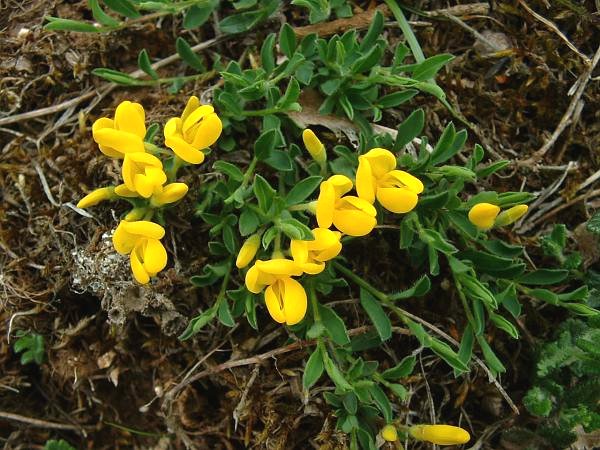
Photo: Wikimedia Commons, CC BY-SA 3.0 · source

Shrub · Fabaceae
Hairy greenweed
Genista pilosa
In other languages: Kruipbrem (Nederlands) · Genêt poilu (Français)
Hairy greenweed is a low, spreading shrub that grows naturally on heaths and on poor, sandy or rocky soil in western and central Europe. Its thin green stems creep over the ground and form a dense mat about 30 cm high and 1 m wide. In May and June the plant is covered in small yellow pea-like flowers, finely hairy on the outside; the small leaves are silky-hairy underneath. The well-known cultivar ‘Vancouver Gold’ stays low and flowers freely. It is very hardy, loves sun and poor, acid, sandy soil and needs hardly any care.
Caution: Like other brooms, the plant can be harmful if eaten, especially the pods and seeds. Keep children, dogs and grazing animals away from the seeds and pods.
Light
Full sun
warm and bright
Moisture
Dry
tolerates drought
Legal basis
Sand
acid to neutral
Hardiness
Fully hardy
down to -25 °C
Size
0.3 m
tall, 1 m wide
Flowering
May–June
| Pruning months | June |
|---|---|
| Height | 0.3 m |
| Native to Belgium | Yes |
| Good for bees, butterflies and birds | Yes, for bees |
| Poisonous to people and pets | Not known to be poisonous |
| Flowering | May–June |
Identify
Hairy greenweed: how do you recognise it?
- Habit
- Low, creeping to spreading shrub about 30 cm tall and 1 m wide, with thin green stems.
- Leaves
- Small, 1–2 cm long, obovate to lance-shaped, green above and silvery-hairy beneath; deciduous in winter.
- Flower
- Small yellow pea-like flowers, finely hairy on the outside, in May and June.
- Fruit
- Small hairy pods containing the seeds; self-seeding often happens by itself under good conditions.
- Roots
- Deep root system with nodules that fix nitrogen from the air; resents being moved.
Flowering: May–June · Plants: March–April and September–October · Pruning: June
In your garden
Why grow it?
- A blanket of yellow flowers in May and June that almost completely covers the plant.
- Creeps over low walls, banks and stones, covering bare or dry spots.
- Native and suited to a natural garden; the flowers are visited by bees.
- Very drought tolerant and feeds the soil with nitrogen itself, so it never needs fertiliser.
- Goes well with heather and other plants that like acid, poor soil.
Hairy greenweed: where does it grow best?
- Full sun in a warm, open spot; in shade it hardly flowers and becomes open.
- Poor, sandy, well-drained soil, acid to neutral. Not suited to chalky soil.
- Dry: once established it needs no water; wet, heavy soil is fatal.
- Ideal for a heather or rock garden, dry bank, low wall or gravel garden.
- Allow 80–100 cm per plant; it spreads slowly.
- Light
- Sun
- Soil type
- Sand
- Acidity
- Acid or neutral
- Moisture
- Dry
- Size
- 0.3 m tall, 1 m wide
- Hardiness
- Hardy (to -25 °C)
Goes well with
- Heather: The same acid, poor sandy soil; pink and purple beneath the yellow.
- Bell heather: A small heath shrub that shares the same position.
- Sheep’s fescue: Fine blue-green grass that frames the creeping mat lightly.
- Thyme: Stays low and flowers, with the same need for sun and dry soil.
- Stonecrop: Low, fleshy foliage that fills out the carpet in a dry rock garden.
Maintenance
Hairy greenweed: when and how to plant it?
Plant in March–April and September–October.
- Plant in March–April or in September–October, when the soil is neither frozen nor too wet.
- Choose small, young plants in pots: they settle better than older specimens, because broom resents being moved.
- Dig a hole as deep as the pot and twice as wide; open up heavy soil with sand.
- Set the plant at the same depth as in its pot, with the stem base at soil level, and space 80–100 cm apart.
- Water well after planting, then only during long dry spells in the first year.
- Leave the soil bare or spread a thin layer of grit; no compost or fertiliser.
Care
- Watering
- Only in the first year during long dry spells; after that not needed.
- Feeding
- Do not. As a legume it makes its own nitrogen, and rich soil gives floppy growth and fewer flowers.
- Mulching
- No compost or bark. A thin layer of grit or sand is enough.
- Weeding
- Keep young plants free of weeds until the mat has closed.
- Moving
- Avoid it: the roots resent disturbance. Choose the right spot from the start.
Tip: A creeping broom of the heath, lovely over a low wall or between heathers. It likes poor, acid, sandy soil in full sun. Do not move it and never feed it.
Hairy greenweed: when to prune it?
Pruning months: June.
When: Straight after flowering, in June, if needed. It rarely needs pruning.
How:
- Lightly shorten the flowering shoots, by about a third, to keep the plant compact and dense.
- Remove dead or damaged stems back to just above a healthy shoot.
- Never cut into old, bare wood: broom and its relatives rarely shoot again from it.
Caution: Do not cut into bare wood: it rarely shoots again from it.
Propagation
- Semi-ripe cuttings
- In July–August: take 5–8 cm cuttings with a small heel of the parent plant, insert in sandy compost under plastic in a bright spot. Rooting takes a few weeks to several months.
- Seed
- The seed has a hard coat: soak it overnight in warm water or nick it lightly, then sow in autumn or spring in a tray of sandy compost. Grow the seedlings on in pots before planting them out.
- Layering
- In spring, bend a low stem down, bury a section and pin it in place. Detach it a year later when rooted.
Hairy greenweed: how does it get through the winter?
Hardy to −25 °C.
- Very hardy, down to about −25 °C: no protection is needed in Belgian winters.
- It loses its leaves, but the green stems remain; do not cut anything back in winter.
- In a pot: choose a wide, free-draining pot, put it in a sheltered spot and make sure water drains away.
Diseases and pests
- Root rot: The plant turns yellow and limp in wet, heavy or rich soil. Move it to dry sandy soil or improve drainage.
- No regrowth after pruning: Branches cut back into old wood often do not shoot again. Prune only lightly and only green shoots.
- Aphids: Sometimes on young shoots in spring. A jet of water is usually enough.
- Poor flowering: Usually too much shade or too much feed. Give sun and no fertiliser.
Through the year
- March: Plant in sandy soil. Do not feed.
- April: Plant. Remove weeds.
- May: Flowering begins.
- June: Full flower. Trim lightly after flowering.
- July: Take semi-ripe cuttings.
- August: Take semi-ripe cuttings. Let the pods ripen for seed.
- September: Plant. Sow if you have seed.
- October: Plant. Sow.
Use
Good for wildlife
- Bees
- Nectar and pollen for honeybees and wild bees.
You and this species
Did you know?
- Genista pilosa takes its name from the Latin pilosus, ‘hairy’: the undersides of the leaves and the flowers are finely hairy.
- As a legume it lives with bacteria in root nodules that fix nitrogen from the air; this is why it grows on very poor soil.
- According to tradition, the name of the English royal house of Plantagenet comes from the Latin planta genista, the broom plant.