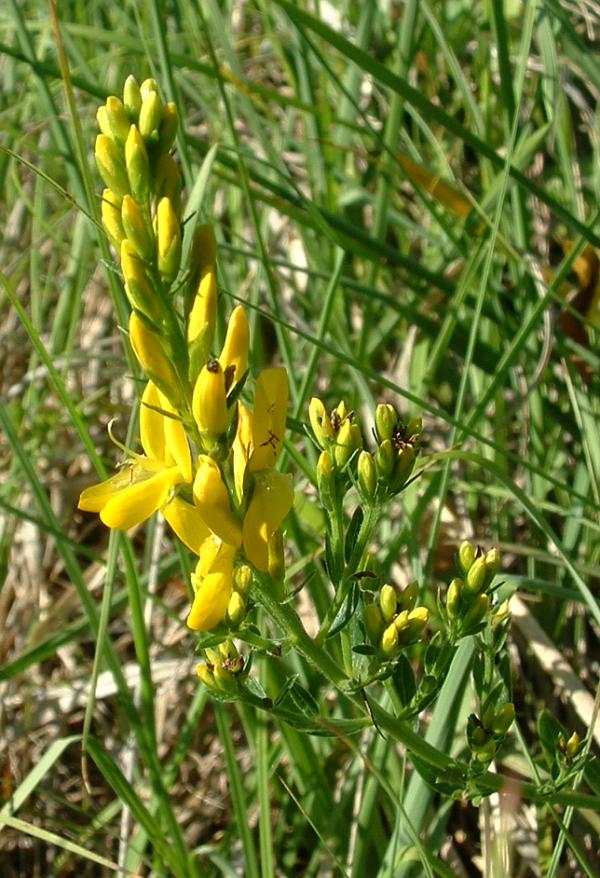
Photo: Jeffdelonge at French Wikipedia, CC BY-SA 3.0 · source

Shrub · Fabaceae
Dyer’s greenweed
Genista tinctoria
In other languages: Verfbrem (Nederlands) · Genêt des teinturiers (Français)
Dyer’s greenweed is a low native shrub found across Europe and western Asia on poor grassland, heaths and road verges. It grows 40–60 cm tall with upright, green, thornless stems and small, narrow leaves. From June to August it carries clusters of small yellow pea-like flowers at the tips of the new shoots. The plant has been known for centuries as a dye plant: the flowering twigs give a yellow colour. In gardens we mostly know the low, double-flowered cultivar ‘Flore Pleno’. It is very hardy, loves sun and poor soil and needs little maintenance.
Caution: Like other brooms, the plant can be harmful if eaten, especially the pods and seeds. Keep children, dogs and grazing animals away from the seeds and pods.
Light
Full sun
warm and bright
Moisture
Dry to normal
no wet feet
Legal basis
Sand, loam or clay
any pH
Hardiness
Fully hardy
down to -25 °C
Size
0.6 m
tall, 0.6 m wide
Flowering
June–August
| Pruning months | March |
|---|---|
| Height | 0.6 m |
| Native to Belgium | Yes |
| Good for bees, butterflies and birds | Yes, for bees |
| Poisonous to people and pets | Not known to be poisonous |
| Flowering | June–August |
Identify
Dyer’s greenweed: how do you recognise it?
- Habit
- Low, upright to spreading shrub 40–60 cm tall and wide, with thornless green stems.
- Leaves
- Small, narrow and lance-shaped, 1–3 cm long, green; falls in winter.
- Flower
- Small yellow pea-like flowers of about 1 cm in clusters at the tips of the shoots, from June to August.
- Fruit
- Flat, hairless pods 2–3 cm long with brown seeds after flowering.
- Roots
- Deep root system with nodules that fix nitrogen from the air; resents being moved.
Flowering: June–August · Plants: March–April and October–November · Pruning: March
In your garden
Why grow it?
- A long flowering season from June to August, with yellow that stays in the garden all summer.
- Native and so valuable for a natural garden; the flowers are visited by bees and other insects.
- Very drought tolerant and feeds the soil with nitrogen itself: never feed or water it.
- Small and compact: suits a rock garden, gravel garden, dry bank or lean border.
- With its history as a dye plant, a nice story for children and nature lovers.
Dyer’s greenweed: where does it grow best?
- Full sun in a warm, open spot; in shade it flowers little and becomes open.
- Poor to moderately fertile, well-drained sandy, loamy or clay soil; acid to chalky.
- Dry to normal moisture: once established it manages without water; soil that stays wet is fatal.
- Suits a rock garden, gravel garden, dry bank, wildflower meadow or lean border.
- Allow 50–60 cm between plants.
- Light
- Sun
- Soil type
- Sand, loam or clay
- Acidity
- Not fussy
- Moisture
- Dry or normal
- Size
- 0.6 m tall, 0.6 m wide
- Hardiness
- Hardy (to -25 °C)
Goes well with
- Common knapweed: Native purple flowers that go nicely with the yellow.
- Ox-eye daisy: White flowers in the same lean, sunny soil.
- Sheep’s fescue: Fine blue-green grass that frames the shrub lightly.
- Thyme: Stays low and flowers, with the same need for sun and dry soil.
Maintenance
Dyer’s greenweed: when and how to plant it?
Plant in March–April and October–November.
- Plant in March–April or in October–November, when the soil is neither frozen nor too wet.
- Choose small, young plants in pots: they settle better than older specimens, because broom resents being moved.
- Dig a hole as deep as the pot and twice as wide; open up heavy clay with sand.
- Set the plant at the same depth as in its pot, with the stem base at soil level, and space 50–60 cm apart.
- Water well after planting, then only during long dry spells in the first year.
- Leave the soil bare or spread a thin layer of grit; no compost or fertiliser.
Care
- Watering
- Only in the first year during long dry spells; after that not needed.
- Feeding
- Do not. As a legume it makes its own nitrogen; rich soil gives floppy growth and fewer flowers.
- Mulching
- No compost or bark. A thin layer of grit or sand is enough.
- Weeding
- Keep young plants free of weeds until they have established well.
- Moving
- Avoid it: the roots resent disturbance. Choose the right spot from the start.
Tip: A low native broom from which yellow dye was once made. Suited to a lean, sunny spot; give no feed and do not move it.
Dyer’s greenweed: when to prune it?
Pruning months: March.
When: In late March, before the new shoots start. It needs little pruning.
How:
- Lightly shorten last year’s shoots, by about a third, to keep the plant compact and full.
- Remove dead or frost-damaged stems back to just above a healthy bud.
- Never cut into old, bare wood: it usually does not shoot again from it.
Caution: Never cut into bare wood: it often does not shoot again from it.
Propagation
- Semi-ripe cuttings
- In July–August: take 5–8 cm cuttings with a small heel of the parent plant and insert them in sandy compost in a bright spot. Rooting can take a few weeks to several months.
- Seed
- The seed has a hard coat: soak it overnight in warm water or nick it lightly, then sow in autumn or spring in sandy soil. Grow the seedlings on in pots before planting them out.
- Self-seeding
- In a suitable spot it seeds itself. Move seedlings only while they are still very small.
Dyer’s greenweed: how does it get through the winter?
Hardy to −25 °C.
- Very hardy, down to about −25 °C: no protection is needed in Belgian winters.
- It loses its leaves, but the green stems remain; wait until March to prune.
- In a pot: choose a wide, free-draining pot, put it in a sheltered spot and make sure water drains away.
Diseases and pests
- Root rot: The plant turns yellow and limp in wet or heavy soil. Move it to a drier spot or improve drainage.
- No regrowth after pruning: Branches cut back into old wood often do not shoot again. Prune only lightly and only green shoots.
- Aphids: Sometimes on young shoots in spring. A jet of water is usually enough.
- Poor flowering: Usually too much shade or too much feed. Give sun and no fertiliser.
Through the year
- March: Light pruning. Plant. Do not feed.
- April: Plant. Remove weeds.
- June: Flowering begins.
- July: Full flower.
- August: Last flowers. Take semi-ripe cuttings.
- September: Let the pods ripen and collect seed.
- October: Plant. Sow.
- November: Plant if the soil is not frozen.
Use
Good for wildlife
- Bees
- Nectar and pollen for honeybees and wild bees.
You and this species
Did you know?
- The species name tinctoria means ‘used for dyeing’: a yellow dye was made from the flowering twigs.
- Wool dyed first yellow with dyer’s greenweed and then blue with woad turned green; in England this colour was known as ‘Kendal green’.
- As a legume it lives with bacteria in root nodules that fix nitrogen from the air; this is why it grows on poor soil.