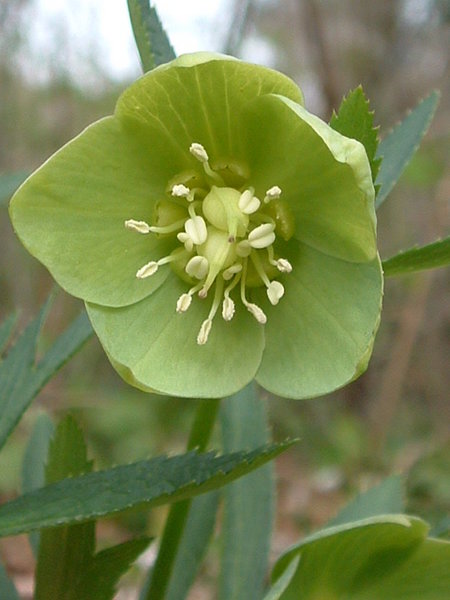
Photo: Wikimedia Commons, CC BY-SA 3.0 · source

Perennial · Ranunculaceae
Green hellebore
Helleborus viridis
In other languages: Wrangwortel (Nederlands) · Hellébore vert (Français)
The green hellebore is a species that grows naturally in calcareous deciduous woods and scrub in western and central Europe, including Belgium. It is a modest perennial of about 40 cm with deeply cut, palmate leaves and nodding green flowers of 3–5 cm. They appear very early in the year, from February to April, when little else is in flower. It is not showy, and that is exactly why lovers of naturalistic gardens prize it. Unlike many of its relatives it loses its leaves in winter and comes back up in spring.
Caution: All parts are poisonous, including the roots and seeds. Children, dogs, cats and grazing animals must not eat any of it. The sap can irritate the skin: wear gloves and wash your hands after working.
Light
Partial shade or shade
tolerates little sun
Moisture
Normal
no wet feet
Legal basis
Loam or clay
neutral to chalky
Hardiness
Fully hardy
down to -30 °C
Size
0.4 m
tall, 0.4 m wide
Flowering
February–April
| Pruning months | February |
|---|---|
| Height | 0.4 m |
| Native to Belgium | Yes |
| Good for bees, butterflies and birds | Yes, for bees |
| Poisonous to people and pets | Yes, take care with children and pets |
| Flowering | February–April |
Identify
Green hellebore: how do you recognise it?
- Habit
- Compact clump 30–40 cm high and wide, which loses its leaves in winter.
- Foliage
- Palmate, deeply cut into 7–11 narrow segments, 15–25 cm across; fresh green, deciduous.
- Flower
- Nodding, cup-shaped flowers 3–5 cm across, yellow-green to green, in small clusters.
- Flowering
- From February to April.
- Roots
- A thick, dark rootstock with fleshy roots; it dislikes being moved.
Flowering: February–April · Plants: March–April and September–October · Pruning: February
In your garden
Why grow it?
- Flowers from February to April, in the depths of winter and early spring.
- A native species that suits a natural garden under shrubs and trees.
- The flowers provide early nectar and pollen for the first bees and bumblebees.
- Does very well in part shade and on chalky soil, where many plants struggle.
- Low maintenance and builds into a strong clump over the years.
Green hellebore: where does it grow best?
- Part shade to light shade, for example under deciduous shrubs or trees; winter and early spring sun is welcome.
- Humus-rich, chalky soil: loam or clay, neutral to chalky; sand is fine if there is enough humus and moisture.
- Average moisture: the soil should not dry out in summer, but avoid wet feet in winter.
- Sheltered from cold, dry wind and from summer sun.
- Space plants 40–50 cm apart and let the clump grow undisturbed.
- Light
- Partial shade and shade
- Soil type
- Loam or clay
- Acidity
- Neutral or chalky
- Moisture
- Normal
- Size
- 0.4 m tall, 0.4 m wide
- Hardiness
- Hardy (to -30 °C)
Goes well with
- Snowdrops: Flower at the same time and make a natural winter scene.
- Lungwort: Blue and pink flowers in the same part shade.
- Ferns: Fresh green underplanting when the hellebore loses its leaves.
- Periwinkle: Evergreen ground cover that flowers blue in spring.
- Wood anemone: White spring flowers that suit the woodland mood.
Maintenance
Green hellebore: when and how to plant it?
Plant in March–April and September–October.
- Plant in March–April or September–October, in moist but not waterlogged soil.
- Dig a hole twice as wide as the root ball and mix in compost and, if needed, a little lime.
- Set the plant at the same depth as in its pot, with the crown at soil level: no deeper.
- Leave 40–50 cm between plants.
- Water thoroughly straight away and keep the soil moist during the first year.
- Spread a layer of leaf mould around the base, leaving the crown free.
Care
- Water
- Regularly in dry weather during the first year. After that mainly in long dry summers, so the soil does not dry out.
- Feeding
- In spring, after flowering, a thin layer of compost or leaf mould; otherwise little.
- Mulching
- A layer of leaf mould in autumn keeps the soil moist and feeds soil life.
- Tidying
- In February, cut off the dead leaves so the flowers show well.
- Leave undisturbed
- Do not move or divide it unless you must: the plant sulks for a long time afterwards.
Tip: Plant the green hellebore under shrubs and trees in a cool spot with chalky, humus-rich soil and leave it alone: after a few years it will self-sow.
Green hellebore: when to prune it?
Pruning months: February.
When: It is not really pruned: in February you simply cut away the dead leaves before the flowers appear.
How:
- Cut dead or damaged leaves and stalks off at the base, using sharp scissors or secateurs.
- Remove faded flower stems after seed set if you do not want self-sown seedlings.
- Wear gloves: the sap can irritate the skin.
Caution: All parts of the plant are poisonous. Wear gloves and wash your hands after working.
Propagation
- Seed
- Sow fresh seed in June–July, directly in a pot or in a sheltered spot. It germinates the following spring; plants flower after 2–3 years. The plant also self-sows.
- Division
- Carefully after flowering, in April, detach a piece with roots from the clump. Replant at once at the same depth and water well. Do this only if really necessary.
Green hellebore: how does it get through the winter?
Hardy to −30 °C.
- Fully hardy to about −30 °C: no protection is needed in Belgian winters.
- The flower buds sit close to the ground; late frosts rarely harm them.
- It is less suited to pots; plant it in the open ground, where the roots stay cool.
Diseases and pests
- Leaf spot: Black spots on the leaves, especially after a wet winter. Cut off affected leaves and do not put them on the compost heap.
- Aphids: On young flower stems in spring. Rinse off with water or wipe them away by hand; ladybirds help.
- Slugs: They eat young shoots and flowers. Pick off slugs or lay a barrier of crushed shells.
- Poor flowering: Usually too much shade, soil that is too acid or too dry, or the plant has just been moved. Give it time and improve the soil with compost.
Through the year
- February: Cut off dead leaves. The first flowers appear.
- March: Flowering. Plant or move.
- April: Flowering ends. Divide if necessary.
- May: Seed set. Water in dry weather.
- June: Seed ripens. Collect and sow fresh seed.
- July: Sowing. Keep the soil moist.
- September: Plant. Apply compost.
- October: Plant. Spread leaf mould.
- November: The leaves die back. Do nothing.
- December: Dormant.
Use
Edible and useful
Not edible. All parts of hellebores and Christmas roses are poisonous, to pets too; the sap can irritate the skin. Wear gloves when cutting off old leaves or dividing the plant, and do not eat any of it. If any is swallowed, call a poison centre (in Belgium 070 245 245) or your doctor at once.
Good for wildlife
- Bees
- Nectar and pollen for honeybees and wild bees.
You and this species
Did you know?
- The ‘petals’ are really sepals; the true petals are small tubular nectaries in the centre of the flower.
- The seeds carry a fatty appendage that ants love: they carry the seeds away and so help to spread them.
- Unlike the Christmas rose (black hellebore) or the stinking hellebore, this species loses its leaves in winter.