Photo: Wikimedia Commons, Public domain · source

Houseplant · Malvaceae
Chinese hibiscus
Hibiscus rosa-sinensis
In other languages: Chinese roos (Nederlands) · Hibiscus de Chine (Français)
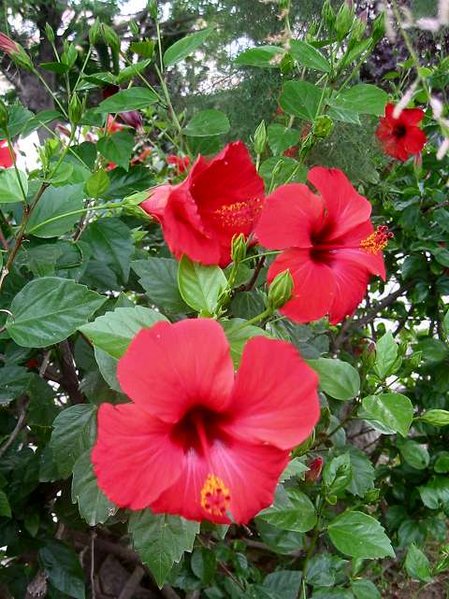
Chinese hibiscus is an evergreen shrub from tropical Asia that has been grown in gardens for centuries. It has glossy dark green leaves and large, funnel-shaped flowers 10–15 cm across, with a striking long column of stamens and style in the centre. There are countless varieties, single or double, in red, pink, orange, yellow, white and two-tone. Each flower lasts only a day or two, but new ones keep coming from April to October. Here it is a houseplant that enjoys spending summer outside on a sunny, sheltered patio.
Light
Full sun
warm and bright
Moisture
Normal
no wet feet
Legal basis
Potting soil
Hardiness
Houseplant
min. 10 °C
Size
1.5 m
tall, 1 m wide
Flowering
April–October
| Pruning months | March |
|---|---|
| Height | 1.5 m |
| Poisonous to people and pets | Not known to be poisonous |
| Flowering | April–October |
Identify
Chinese hibiscus: how do you recognise it?
- Habit
- Upright, branching shrub; in a pot usually 0.5–1.5 m, also sold as a standard.
- Leaves
- Oval, toothed, 5–10 cm, glossy dark green.
- Flowers
- Funnel-shaped, 10–15 cm, with a long column of stamens and style; each flower lasts one or two days.
- Colour
- Red, pink, salmon, orange, yellow and white, often with a dark centre; single or double.
- Flowering time
- From April to October, in a sunny position.
Flowering: April–October · Plants: March–April · Pruning: March
In your garden
Why grow it?
- A long flowering season, from April to October, with large, exotic flowers.
- Many colours and forms: single or double, in red, pink, orange, yellow and white.
- Glossy evergreen leaves that look good outside the flowering season too.
- A tropical showpiece on the patio in summer, a houseplant in winter.
- Takes pruning well, so it is easy to keep in shape.
Chinese hibiscus: where does it grow best?
- Full sun or the brightest spot possible: the more light, the more flowers.
- Warm indoors, 18–24 °C; never below 10 °C.
- From mid-May to mid-September on a sunny, sheltered patio, out of the wind.
- Rich, free-draining potting compost; the roots must never stand in water.
- A permanent spot: do not move or turn it when it has buds.
- Light
- Sunny
- Potting soil
- Multi-purpose compost or airy, humus-rich compost
- Acidity
- Acid or neutral
- Watering
- Moderately
- Size
- 1.5 m tall, 1 m wide
- Temperature
- Minimum 10 °C
Goes well with
- Plumbago: Sky-blue flowers on the patio beside the vivid hibiscus.
- Agapanthus: Blue globes in a pot, also for a sunny patio.
- Lantana: Colourful clusters in the same sun and warmth.
- Bougainvillea: Another tropical patio plant for a warm, sunny spot.
Maintenance
Chinese hibiscus: when and how to plant it?
Plant in March–April.
- Repot in March–April: a young plant every year, an older one every two or three years.
- Choose a pot one size larger, with a drainage hole and a layer of clay pebbles.
- Use good compost for houseplants or patio plants, perhaps with a little perlite.
- Set the plant at the same depth as before and firm lightly.
- Water until it runs out of the bottom of the pot and let it drain well.
- Repot and prune at the same time, before the new buds appear.
Care
- Watering
- Plenty of water in summer: keep the compost moist, outdoors sometimes daily on hot days. Less in winter, but never let it dry out.
- Feeding
- From April to September, a liquid feed for flowering plants every one to two weeks.
- Summer outdoors
- After mid-May move it outside, first letting it adjust in partial shade for a week; bring it back in by mid-September.
- Buds
- Do not move or turn it when it has buds; drought and draughts also make buds drop.
- Faded flowers
- Spent flowers usually fall by themselves; pick them up or snip them off.
Tip: Feed it every week in summer with a feed for flowering plants: producing so many flowers one after another takes a lot of nourishment.
Chinese hibiscus: when to prune it?
Pruning months: March.
When: In March, before new growth starts and before it forms buds.
How:
- Cut the branches back by a third to a half, just above a leaf or bud.
- Remove weak, dead and inward-growing branches.
- Pinch out the tips of young plants a few times in spring so they branch well.
- An old, leggy plant can be cut back hard; it usually regrows well.
Caution: Do not prune in summer: it flowers on new shoots, and what you cut off then are the buds for the coming weeks.
Propagation
- Tip cuttings
- In spring or early summer, take 10 cm cuttings from young shoots, strip the lower leaves and root them in moist compost under plastic at 22–25 °C. Roots form in 4–8 weeks.
- Semi-ripe cuttings
- In July–August, take slightly firmer cuttings in the same way, also kept warm. Special varieties are often grafted by growers.
Chinese hibiscus: how does it get through the winter?
- Not a garden plant: it cannot take frost and must spend winter indoors, above 10 °C.
- Give it the brightest spot in the house, ideally by a south-facing window; at 15–18 °C it rests a little and stays healthier.
- Water less and do not feed from October to March.
- Some leaf drop after bringing it in is normal; keep it away from radiators and draughts.
Diseases and pests
- Bud drop: Buds fall before they open, because of moving, drought, draughts or a sudden change in temperature. Give it a permanent spot and keep the compost moist.
- Aphids: On young shoots and buds. Rinse them off with water or wipe them away; outdoors, ladybirds help.
- Red spider mite: Fine yellow speckling and webbing, especially indoors in dry air. Mist the leaves and raise the humidity.
- Whitefly: Small white flies that rise when you touch the plant. Hang up yellow sticky traps and rinse the undersides of the leaves.
- Yellow leaves: Too much or too little water, too cold or too little feed. Check the compost first: is it wet or dry?
Through the year
- January: Bright and not too warm indoors. Water moderately.
- February: Brightest spot. Water moderately.
- March: Prune. Repot. Water more.
- April: First flowers. Start feeding. Take tip cuttings.
- May: After mid-May move outside, first in partial shade.
- June: Flowering on the patio. Feed every week and water generously.
- July: Flowering. Take semi-ripe cuttings.
- August: Flowering. Watch for aphids and red spider mite.
- September: Bring indoors by mid-September, to a bright spot.
- October: Last flowers. Less water, no more feeding.
- December: Resting. Away from the radiator.
You and this species
Did you know?
- The hibiscus is the national flower of Malaysia, where it is called bunga raya.
- In India it is sometimes called the ‘shoe flower’: the flowers were once used to polish shoes.
- Each flower usually stays open for just one day; a healthy plant keeps producing new ones.