Photo: Cdpanic at English Wikipedia, CC BY-SA 3.0 · source

Houseplant · Crassulaceae
Flaming Katy
Kalanchoe blossfeldiana
In other languages: Vlammend Katje (Nederlands) · Kalanchoé (Français)
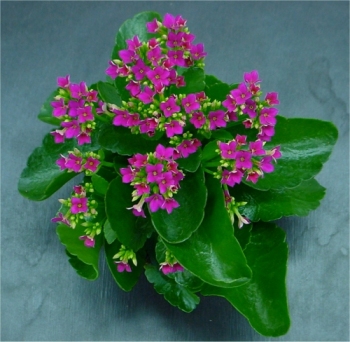
Flaming Katy is a succulent from the mountains of Madagascar and one of the most popular flowering houseplants. It forms a compact little plant 20–30 cm tall with thick, glossy dark green leaves with a scalloped edge, often flushed red. From January to May, dense clusters of small, four-petalled flowers appear above them in red, orange, yellow, pink or white; there are also varieties with double flowers. People love it because it flowers for weeks on end, needs little water and is easy to grow. With a little care you can keep it after flowering and get it to bloom again the following year.
Caution: All parts are poisonous if eaten, especially to cats and dogs, but also to other pets such as rabbits and birds. Keep it out of reach of pets and young children, and if any is swallowed, contact a doctor or vet.
Light
Full sun
warm and bright
Moisture
Dry
tolerates drought
Legal basis
Potting soil
Hardiness
Houseplant
min. 10 °C
Size
0.3 m
tall, 0.3 m wide
Flowering
January–May
| Pruning months | May–June |
|---|---|
| Height | 0.3 m |
| Poisonous to people and pets | Yes, take care with children and pets |
| Flowering | January–May |
Identify
Flaming Katy: how do you recognise it?
- Habit
- A compact, upright little plant 20–30 cm tall and wide, with fleshy stems.
- Leaves
- Thick and fleshy, glossy dark green, oval, with a scalloped edge that is often flushed red.
- Flowers
- Small, four-petalled flowers in dense clusters above the leaves, in red, orange, yellow, pink or white; single or double.
- Flowering
- From January to May; it is a short-day plant that forms flower buds when the nights are long.
- Roots
- Fine and shallow; they rot quickly in wet compost.
Flowering: January–May · Plants: May–June · Pruning: May–June
In your garden
Why grow it?
- Weeks of colour in winter and early spring, when little is flowering outdoors.
- A succulent that copes well with drought: ideal if you sometimes forget to water.
- Flowers in many colours, from white and yellow to orange, pink and fiery red.
- Compact: fits on any windowsill.
- With a simple ‘dark treatment’ in autumn, it flowers again the following year.
- Easy to propagate from cuttings.
Flaming Katy: where does it grow best?
- A bright, sunny windowsill; in winter it can have full sun. In summer, protect it from strong midday sun behind glass.
- A room temperature of 15–22 °C; a slightly cooler spot makes the flowers last longer. Never below 10 °C.
- Dry air is no problem; do avoid draughts and cold windows in winter.
- Choose a spot out of reach of cats, dogs and young children.
- In summer it can go outside in a sheltered, sunny spot from June to the end of August, as long as nights stay above 10 °C.
- Light
- Sunny
- Potting soil
- Cactus compost or multi-purpose compost
- Acidity
- Neutral
- Watering
- Sparingly
- Size
- 0.3 m tall, 0.3 m wide
- Temperature
- Minimum 10 °C
Goes well with
- Christmas cactus: Also flowers in winter and likewise forms its buds when the nights are long.
- Jade plant: Another succulent from the same family, for the same sunny windowsill and little water.
- Aloe: Sturdy, fleshy rosettes beside the rounded flower clusters, with the same need for sun and little water.
- Cacti: The same sunny spot and the same sparing watering; grouped in a bowl they make an attractive display.
Maintenance
Flaming Katy: when and how to plant it?
Plant in May–June.
- Repot after flowering, in May–June, when the roots fill the pot.
- Choose a pot only slightly larger than the old one, with a drainage hole; in a terracotta pot the compost dries out faster.
- Use cactus and succulent compost, or ordinary potting compost mixed with a third of sharp sand or perlite.
- Set the plant at the same depth as before and firm the compost lightly.
- Wait a few days before watering after repotting, so any damaged roots can dry off.
Care
- Watering
- Sparingly: let the compost dry out almost completely between waterings. Water the compost, not the leaves, and do not leave water in the saucer.
- Feeding
- From March to September, once a month with cactus or succulent feed at half strength.
- Deadheading
- Cut off faded clusters just above the first leaves: it keeps the plant tidy and makes room for new buds.
- Reflowering
- In autumn, give it at least 14 hours of complete darkness a day for six weeks, for instance under a cardboard box in the evening or in an unused room with no lamp on. Water sparingly and do not feed. Then simply return it to the windowsill.
- Repotting
- After flowering, in May–June, in succulent compost.
Tip: Want it to flower again? From October, for six weeks, put it under a cardboard box or in a dark room every evening from about 6 pm to 8 am, and water sparingly. The buds then appear by themselves.
Flaming Katy: when to prune it?
Pruning months: May–June.
When: After flowering, in May–June. While it is in flower, just cut off faded clusters.
How:
- Cut faded flower stems back to just above the first pair of leaves.
- Shorten long, bare stems to a few pairs of leaves so the plant stays compact and bushy.
- Use the cut tips as cuttings.
- Stop pruning from September: that is when it forms the buds for the next flowering.
Caution: Wear gloves or wash your hands after pruning, and do not leave prunings lying around where pets can reach them: the plant is poisonous.
Propagation
- Tip cuttings
- In May–July, cut 5–8 cm cuttings, let them dry for 1–2 days and insert them in moist cactus compost or a sandy cutting mix. Keep them light and warm and water sparingly; they root within a few weeks.
- Leaf cuttings
- Snap off a healthy leaf with its stalk, let it dry and push the stalk into sandy compost. It takes longer, but a new little plant grows at the base.
Flaming Katy: how does it get through the winter?
- Indoors all year: it cannot take frost and should never stand below 10 °C.
- Winter is its flowering season: give it a bright windowsill, ideally on the cool side (15–18 °C), so the flowers last longer.
- Water sparingly in winter and do not stand it above a hot radiator.
- Against a cold pane the leaves can get chilled: move it a little away from the glass at night.
Diseases and pests
- Rot: A soft, black stem base and limp leaves, caused by too much water. Let the compost dry out, water less and root healthy tips if the base is already rotting.
- Powdery mildew: White powder or brown patches on the leaves. Remove affected leaves, give it an airy spot and do not water over the leaves.
- Aphids and mealybugs: On the flower buds and in the leaf axils. Rinse aphids off under the tap; remove mealybugs with a cotton bud dipped in a little alcohol.
- Long, floppy stems: Too little light. Move it to a sunnier spot and cut it back after flowering.
- No new flowers: Too much light in autumn, including from lamps in the evening. Give it 14 hours of darkness a day for six weeks.
Through the year
- January: Flowering. Bright, cool spot. Little water.
- February: Flowering. Cut off faded clusters.
- March: Flowering. Start feeding lightly again.
- April: Flowering. Cut off faded clusters.
- May: Last flowers. Cut back and repot. Take cuttings.
- June: Repot or cut back. Possibly outside in a sheltered, sunny spot.
- July: Feed. Take cuttings. Little water.
- August: Feed. Bring it back indoors at the end of August.
- September: Last feed. Stop pruning.
- October: Dark treatment: at least 14 hours a day in darkness for six weeks. Little water.
- November: Finish the dark treatment and return it to the windowsill. Buds appear.
- December: The buds swell. Bright spot, little water.
Use
Edible and useful
Not edible. All parts of kalanchoe are poisonous: they contain bufadienolides, compounds that, like those of foxglove, act on the heart. In cats and dogs, chewing it causes drooling, vomiting and diarrhoea, and in larger amounts a slow or irregular heartbeat; rabbits, rodents and birds are sensitive to it too. Kalanchoes often stand on the windowsill or the coffee table, within reach of animals and children: put them higher up or in a room they do not go into, and clear up fallen or trimmed leaves. Call your vet if an animal has eaten some. If any is swallowed, call a poison centre (in Belgium 070 245 245) or your doctor at once.
You and this species
Did you know?
- It is a short-day plant: it only forms flower buds when the nights are long. Growers control the light in their glasshouses so that it is on sale in flower all year round.
- The species is named after Robert Blossfeld, a German nurseryman who brought it onto the European market in the 1930s.
- In the wild it grows on rocky slopes in the north of Madagascar.