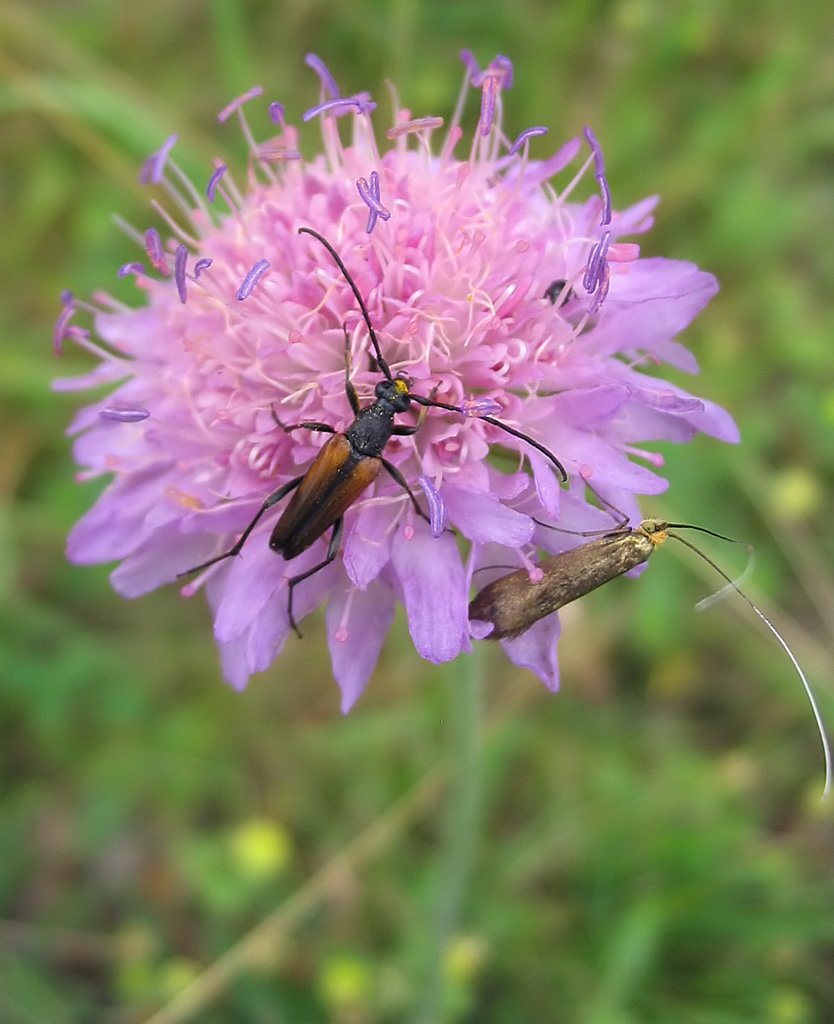
Photo: Darkone, CC BY-SA 2.0 · source

Perennial · Caprifoliaceae
Field scabious
Knautia arvensis
In other languages: Beemdkroon (Nederlands) · Knautie des champs (Français)
Field scabious is a native perennial of sunny grasslands, roadsides and dykes across most of Europe, including Belgium. It forms a rosette of rough, hairy, grey-green leaves, with branching stems up to about 80 cm tall. From June to September it carries domed, lilac-blue flower heads 3–4 cm across that look like little pincushions. Gardeners and nature lovers like it because it is one of the best plants for wild bees and butterflies, and because it tolerates drought and poor soil. A single plant often lives only a few years, but it self-seeds readily and so stays put in a wildflower meadow.
Light
Full sun
warm and bright
Moisture
Dry to normal
no wet feet
Legal basis
Sand, loam or clay
any pH
Hardiness
Fully hardy
down to -35 °C
Size
0.8 m
tall, 0.45 m wide
Flowering
June–September
| Pruning months | March and September |
|---|---|
| Height | 0.8 m |
| Native to Belgium | Yes |
| Good for bees, butterflies and birds | Yes, for bees, butterflies and birds |
| Poisonous to people and pets | Not known to be poisonous |
| Flowering | June–September |
Identify
Field scabious: how do you recognise it?
- Habit
- A loose rosette with branching, hairy stems 50–80 cm tall and about 45 cm wide.
- Leaves
- Grey-green and roughly hairy; the lower leaves are often undivided, the stem leaves deeply cut.
- Flower
- Domed heads 3–4 cm across, made up of many small flowers; the outer ones are larger than those in the centre.
- Colour
- Lilac to pale bluish purple, with pale stamens sticking out of the head.
- Roots
- A sturdy taproot, which makes it very drought-tolerant.
Flowering: June–September · Sowing: March–April and September · Plants: March–April and September–October · Pruning: March and September
In your garden
Why grow it?
- A star for wild bees: the large scabious mining bee collects its pollen almost only from field scabious and close relatives.
- Butterflies, bumblebees and hoverflies visit it all summer.
- A long flowering season, from June to September.
- Native and drought-tolerant: ideal for a poor-soil wildflower meadow or a sunny bank.
- In autumn, birds such as goldfinches eat the seed.
Field scabious: where does it grow best?
- Full sun.
- Poor to moderately fertile soil: sand, loam or clay, acid to chalky; it is happy on chalk.
- Dry to normal, free-draining soil; it does not tolerate wet feet.
- Allow 30–40 cm between plants, or sow it among grasses and other meadow flowers.
- Light
- Sun
- Soil type
- Sand, loam or clay
- Acidity
- Not fussy
- Moisture
- Dry or normal
- Size
- 0.8 m tall, 0.45 m wide
- Hardiness
- Hardy (to -35 °C)
Goes well with
- Ox-eye daisy: White flowers in June–July: together a classic wildflower meadow.
- Common knapweed: Purple heads and another bee magnet, on the same poor soil.
- Wild marjoram: Fragrant, low and loved by butterflies in late summer.
- Bird’s-foot trefoil: Low yellow flowers at its feet and a food plant for butterflies such as the common blue.
Maintenance
Field scabious: when and how to plant it?
Plant in March–April and September–October.
- Plant in March–April or September–October.
- Do not feed or add compost: in rich soil it grows floppy and falls over.
- Make a hole slightly larger than the pot and set the plant at the same depth as before.
- Keep 30–40 cm between plants; in a meadow, plant them in small groups among the grass.
- Water after planting and during the first few weeks in dry spells.
- You can also sow it: in March–April or September, scatter thinly on bare soil and press in lightly.
Care
- Watering
- Not needed once established: it copes well with drought.
- Feeding
- Never: poor soil gives sturdy plants and more flowers.
- Mowing
- Mow a wildflower meadow only after the seed has set, in September, and remove the cuttings.
- Spent flowers
- In a border, deadheading prolongs flowering, but leave seed at the end of summer for the birds and for new plants.
- Support
- On richer soil it may flop: let it lean on grasses or other plants.
Tip: Sow or plant it in a poor-soil wildflower meadow and mow only after the seed has set: it will seed itself and the scabious mining bee will find its food again every year.
Field scabious: when to prune it?
Pruning months: March and September.
When: In September, after the seed has set, mow or cut the plant back. If you leave stems in a border for insects, cut them down in March.
How:
- Mow a wildflower meadow in September, after seed set, and remove the cuttings to keep the soil poor.
- In a border, cut the spent stems back to just above the rosette of leaves.
- Leave a few stems over winter: insects overwinter in them and birds eat the seed.
- Cut away the last dead stems in March, before new growth begins.
Propagation
- Seed
- Sow outdoors in March–April or September, where it is to grow or in a tray. The seed germinates easily and plants often flower the year after sowing.
- Basal cuttings
- In April, cut young shoots from the base and root them in sandy cutting compost.
- Self-sown seedlings
- Let the plant seed itself and move the seedlings to where you want them in spring or autumn.
Field scabious: how does it get through the winter?
Hardy to −35 °C.
- Fully hardy, to about −35 °C: no protection needed.
- In mild winters the rosette of leaves often stays partly green.
- Wet soil in winter is a greater danger than frost.
Diseases and pests
- Powdery mildew: White powder on the leaves, especially in dry late summers. Usually not serious; cut off badly affected stems.
- Flopping: In soil that is too rich, the stems become weak. Do not feed, and let it lean on other plants.
- Disappearing: After a few years a plant sometimes dies. Let it self-seed so that young plants take its place.
- Slugs: They eat seedlings and young rosettes in spring. Pick them off and give hedgehogs and ground beetles a place in the garden.
Through the year
- March: Cut away dead stems. Sow or plant.
- April: Sow or plant. Take basal cuttings.
- June: Flowering begins. Bees and butterflies visit.
- July: Full flower. In a border, deadhead.
- August: In flower. Let seed ripen for the birds.
- September: Mow after seed set and remove the cuttings. Sow.
- October: Plant. Move seedlings.
- November: Leave a few stems for overwintering insects.
Use
Good for wildlife
- Bees
- Nectar and pollen for honeybees and wild bees.
- Butterflies
- Nectar for butterflies.
- Birds
- Berries, seeds or insects as food, or a place to nest.
You and this species
Did you know?
- The large scabious mining bee collects its pollen almost only from field scabious and related species. You can recognise it by the pink pollen loads on its hind legs.
- What looks like one flower is a head of many small flowers; the outer ones are larger than those in the centre and so attract insects.