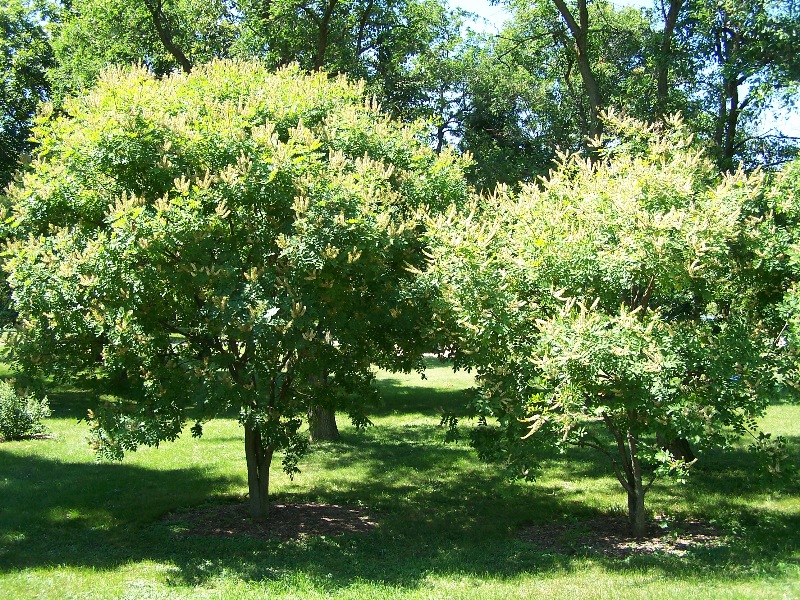
Photo: Bruce Marlin, CC BY-SA 2.5 · source

Tree · Fabaceae
Amur maackia
Maackia amurensis
In other languages: Maackia (Nederlands) · Maackia (Français)
Amur maackia is a compact, tough tree from north-east Asia, from the region around the Amur (Manchuria, Korea and the Russian Far East). It grows 8–12 m tall, with a round to vase-shaped crown, pinnate leaves that are silvery and silky when young and glossy golden-brown bark. In July and August, when almost all other trees have long finished, upright clusters of white to cream pea-like flowers appear. It tolerates drought, poor soil and city air and grows steadily, which makes it ideal for smaller gardens and streets.
Light
Full sun
warm and bright
Moisture
Dry to normal
no wet feet
Legal basis
Sand, loam or clay
any pH
Hardiness
Fully hardy
down to -35 °C
Size
10 m
tall, 8 m wide
Flowering
July–August
| Pruning months | January–February |
|---|---|
| Height | 10 m |
| Native to Belgium | No, planted |
| Good for bees, butterflies and birds | Yes, for bees |
| Poisonous to people and pets | Not known to be poisonous |
| Flowering | July–August |
Identify
Amur maackia: how do you recognise it?
- Habit
- Small tree 8–12 m tall and 6–8 m wide with a round to vase-shaped crown, often multi-stemmed.
- Leaves
- Odd-pinnate, 20–30 cm long, with 7–11 leaflets; silvery and silky when young, later dark green.
- Flower
- Dense, upright clusters 10–15 cm long of white to cream pea-like flowers, in July–August.
- Fruit
- Flat, thin pods 5–8 cm long, brown in autumn.
- Bark
- Glossy golden-brown to coppery, peeling on young trees.
Flowering: July–August · Plants: March–April and October–December · Pruning: January–February
In your garden
Why grow it?
- Flowers in July–August, when most trees have long finished: a late tree for bees.
- A compact, steadily growing tree that suits smaller gardens and streets.
- Very tough: tolerates drought, poor soil, lime and city air.
- Attractive, glossy golden-brown bark and fresh, silvery young leaves.
- Low maintenance: hardly any pruning or diseases.
Amur maackia: where does it grow best?
- Full sun; in shade it flowers little.
- Free-draining soil: sand, loam or clay, acid to chalky. Tolerates poor and dry soil.
- Dry to moderately moist; not in permanently wet soil.
- Tolerates wind, cold and city air.
- Allow 6–8 m of space around the trunk.
- Light
- Sun
- Soil type
- Sand, loam or clay
- Acidity
- Not fussy
- Moisture
- Dry or normal
- Size
- 10 m tall, 8 m wide
- Hardiness
- Hardy (to -35 °C)
Goes well with
- Lavender: Drought tolerant, scented and flowers in the same period in the sun.
- Stonecrop: A tough, late flowerer that attracts bees and suits dry soil.
- Coneflower: Flowers in summer and also attracts bees and butterflies.
- Ornamental grasses: Soft plumes contrast with the upright flower clusters.
- Cranesbill: A tough ground cover for the foot of the tree.
Maintenance
Amur maackia: when and how to plant it?
Plant in March–April and October–December.
- Plant in March–April or from October to December, when the soil is neither frozen nor waterlogged.
- Dig a hole two to three times as wide as the root ball and just as deep. Loosen the bottom and sides.
- Set the tree at the same depth as in its pot or nursery, with the root collar at soil level. Backfill with loose soil; plenty of extra compost is not needed.
- Put in a stake and tie the tree loosely; remove the tie after two to three years.
- Water in with 20–30 litres straight away and spread 5–8 cm of mulch around the base, keeping it off the trunk.
Care
- Water
- For the first two to three years, a good soaking every week in dry weather. After that the tree copes by itself, even in dry summers.
- Feeding
- Not needed; poor soil suits it. Give no nitrogen-rich fertiliser.
- Mulching
- A layer of leaf mould or bark keeps the soil moist; keep the trunk clear.
- Training
- If you want a single trunk, choose the strongest leader early and remove competing stems.
- Pods
- The pods stay on the tree or fall in autumn; clear them away if they bother you.
Tip: Plant the tree in a sunny, free-draining spot: it does not need rich soil and grows sensibly there; water it in the first years.
Amur maackia: when to prune it?
Pruning months: January–February.
When: As little as possible. Formative pruning of young trees in January–February, on a frost-free day.
How:
- Choose one continuous leader if you want a single trunk and remove competing stems.
- Take out dead, damaged and crossing branches.
- Raise the crown gradually by removing the lowest branches if you want a tall trunk.
- Keep cuts small; better a few small branches than one thick one.
Caution: Do not prune hard: the tree grows slowly and recovers slowly from big cuts.
Propagation
- Seed
- The seeds have a hard coat. Pour hot (not boiling) water over them and soak for a day, or file them lightly, and sow in pots in spring. Seedlings grow slowly.
- Softwood cuttings
- In June–July: 10 cm cuttings of young shoots in moist cutting compost under plastic. They root only with difficulty; the success rate is low.
Amur maackia: how does it get through the winter?
Hardy to −35 °C.
- Fully hardy to about −35 °C: no protection is needed in Belgium.
- Young trees: keep stake and tie in order and lay a mulch around the base.
- In winter the tree is bare; the glossy bark and the branch pattern then show up well.
Diseases and pests
- Wet feet: In waterlogged, heavy soil it declines. Choose a free-draining spot or improve drainage.
- Coral spot: Orange-red pustules on dead twigs. Prune affected branches back into healthy wood and dispose of them.
- Aphids: Sometimes on young shoots in spring. Rinse off with water or let ladybirds deal with them.
- Poor flowering: In shade or on a spot that is too wet it flowers little. Choose a sunny, dry spot.
- Several trunks: It often forms several trunks. On a young tree, choose one leader if you want a single trunk.
Through the year
- January: Formative pruning if needed on a frost-free day.
- February: Formative pruning if needed on a frost-free day.
- March: Plant. Apply compost or mulch.
- April: Plant. Top up the mulch. The leaves emerge.
- May: Water young trees in dry weather.
- June: Water in dry weather. Take softwood cuttings.
- July: Flowering begins. Bees visit the flowers.
- August: Full flower. Water in dry weather.
- October: Plant. Pods turn brown; leaves fall.
- November: Plant. Top up the mulch.
- December: Rest. Planting is possible as long as the soil is not frozen.
Use
Good for wildlife
- Bees
- Nectar and pollen for honeybees and wild bees.
You and this species
Did you know?
- The tree is named after Richard Maack, a Russian naturalist who explored the Amur region in the 19th century.
- It flowers in July–August, when most other trees have long finished.
- Maackia belongs to the pea family, like laburnum and false acacia.