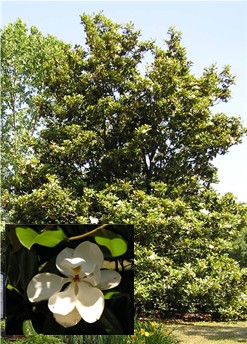
Photo: Jcwf at Dutch Wikipedia, CC BY-SA 3.0 · source

Tree · Magnoliaceae
Southern magnolia
Magnolia grandiflora
In other languages: Groenblijvende magnolia (Nederlands) · Magnolia à grandes fleurs (Français)
Southern magnolia comes from the south-east of the United States, where it grows into a large tree. It has big, glossy, leathery leaves, often with a rusty-brown felt underneath. From July to September it opens huge, creamy-white flowers 15–25 cm across with a fresh, lemony scent. Here it grows slowly and usually stays a large shrub or small tree of 5–10 m, often trained against a wall. The compact cultivar ‘Little Gem’ flowers when young and even suits a large container.
Light
Sun or partial shade
preferably some sun
Moisture
Normal
no wet feet
Legal basis
Sand or loam
acid to neutral
Hardiness
down to -15 °C
protect young plants
Size
10 m
tall, 8 m wide
Flowering
July–September
| Pruning months | April |
|---|---|
| Height | 10 m |
| Native to Belgium | No, planted |
| Poisonous to people and pets | Not known to be poisonous |
| Flowering | July–September |
Identify
Southern magnolia: how do you recognise it?
- Habit
- Broad, pyramidal to rounded tree or large shrub; slow-growing, usually 5–10 m here. Against a wall it can be trained flat.
- Leaves
- Oval, leathery, 12–20 cm long, glossy dark green; undersides often rusty-brown and hairy. The oldest leaves drop in spring.
- Flowers
- Cup-shaped, creamy white, 15–25 cm across, with thick petals. Each flower lasts only a few days, but more follow until September.
- Scent
- Strong and fresh with a hint of lemon; most noticeable on warm days.
- Fruit
- A hairy, cone-like fruit with red seeds; here it does not form every year.
- Roots
- Fleshy, fairly shallow and easily damaged: do not dig under the canopy and avoid moving it.
Flowering: July–September · Plants: April–May and September · Pruning: April
In your garden
Why grow it?
- Evergreen: a glossy, almost tropical canopy all year round.
- Large, lemon-scented flowers in midsummer, when most trees and shrubs have finished.
- A striking feature against a sunny wall or as a specimen in a sheltered garden.
- The rusty-brown leaf undersides contrast beautifully with the dark green upper surface.
- Long-lived and low-maintenance: once established it needs hardly any pruning.
Southern magnolia: where does it grow best?
- Sun to partial shade; for good flowering choose a warm, sunny spot, ideally against a south- or west-facing wall.
- Sheltered from cold east and north winds, which scorch the evergreen leaves.
- Humus-rich, free-draining sandy or loamy soil, acid to neutral; on chalky soil the leaves turn yellow.
- Normal moisture: it should not dry out in summer or sit wet in winter.
- Allow at least 4–5 m; against a wall 3–4 m wide, planted 50 cm from the wall.
- Light
- Sun and partial shade
- Soil type
- Sand or loam
- Acidity
- Acid or neutral
- Moisture
- Normal
- Size
- 10 m tall, 8 m wide
- Hardiness
- Hardy (to -15 °C)
Goes well with
- Agapanthus: Blue globes at the foot of a sunny wall in the same part of summer.
- Hydrangea: Also likes acid to neutral, moisture-retentive soil and flowers at the same time.
- Clematis: A summer-flowering clematis beside the magnolia on the same wall adds colour.
- Ferns: A green underplanting in the shade beneath the canopy.
- Japanese anemone: Flowers in late summer in pink or white, in sun or partial shade.
Maintenance
Southern magnolia: when and how to plant it?
Plant in April–May and September.
- Plant in April–May or in September, so the roots can settle before winter.
- Buy a pot-grown or container plant: magnolias establish poorly from bare roots.
- Dig a hole twice as wide as the root ball and mix leaf mould or ericaceous compost into the soil.
- Set the root ball at the same depth as in the pot, no deeper, and firm the soil gently.
- Water in thoroughly and keep watering in dry spells throughout the first year.
- Mulch around the base with leaf mould or bark, and stake a young tree or tie it to wires on the wall.
Care
- Watering
- For the first two years, water generously every week in dry weather. After that, only in long, dry summers.
- Feeding
- In April, some compost or an organic feed for acid-loving plants. No feeding after July.
- Mulching
- A layer of leaf mould or bark each spring keeps the shallow roots cool and moist.
- Leaf drop
- The oldest leaves fall in spring. That is normal; rake them up, as they rot down slowly.
- Training
- Against a wall, tie the young shoots loosely to horizontal wires or a trellis.
Tip: Buy a plant that has already flowered in the nursery, or a cultivar such as ‘Little Gem’: seedlings can take many years to produce their first flower.
Southern magnolia: when to prune it?
Pruning months: April.
When: In April, when the worst frosts are over and new growth starts. Prune as little as possible.
How:
- Remove only dead, frosted or damaged wood, cutting just above a healthy leaf or side shoot.
- On a wall, cut out shoots growing away from it and tie the rest in along the wires.
- Shorten over-long branches back to a side shoot, without leaving stubs.
- Saw large branches off in stages so the bark does not tear.
Caution: Never prune in autumn or winter: the wounds heal poorly and the plant becomes more prone to frost damage. If it needs cutting back hard, spread the work over two or three years.
Propagation
- Layering
- In spring, nick the underside of a low, flexible branch, bury it and peg it down. After one or two years it has rooted and can be severed.
- Semi-ripe cuttings
- In July–August, take 15 cm cuttings with a heel and root them in moist compost with bottom heat. Success is not guaranteed and it takes patience.
- Seed
- In autumn, take the red seeds from the fruit, remove the fleshy coat and leave them outside in a pot over winter. Seedlings take many years to flower.
Southern magnolia: how does it get through the winter?
Hardy to −15 °C: protect young plants.
- Hardy to about −15 °C: it succeeds in most Belgian gardens in a sheltered spot, ideally against a warm wall.
- In the first winters, protect young plants in hard frost with horticultural fleece over the crown and a mulch over the roots.
- Shake wet snow off the branches: the large leaves hold a lot of snow and branches break easily.
- In a container (for example ‘Little Gem’), move it against the house in winter and wrap the pot in hessian or bubble wrap.
Diseases and pests
- Brown, scorched leaves: Cold wind or hard frost turns leaves brown. Wait until April before cutting out frosted parts; a sheltered spot prevents it.
- Yellow leaves: Many yellow leaves in summer usually mean the soil is too chalky or too wet. Add leaf mould or an ericaceous feed and improve drainage. A few yellow leaves in spring are normal.
- No flowers: Young plants, and seedlings in particular, take some years to flower. Too much shade or too much nitrogen also holds back flowering.
- Scale insects: Small brown bumps on stems and under leaves, often with sticky honeydew and black sooty mould. Brush them off with a soft brush and soapy water.
Through the year
- January: Shake wet snow off the branches. Protect young plants in hard frost.
- February: Dormant. Check the ties on the wall.
- March: Remove the fleece when milder weather arrives. Top up the mulch.
- April: Prune if needed. Plant. Add compost or feed.
- May: Plant. Old leaves drop: rake them up.
- June: Water in dry spells. Tie in new shoots.
- July: First flowers. Water in dry spells.
- August: Flowering. Take semi-ripe cuttings. Water in dry spells.
- September: Last flowers. Plant while the soil is still warm.
- October: Collect seed if fruits have formed. Mulch.
- November: Wrap containers. Prepare young plants for winter.
- December: Keep fleece at hand for hard frosts.
You and this species
Did you know?
- Magnolias are a very ancient genus, probably older than bees. Their flowers have long been pollinated by beetles, which is why they are so tough.
- The genus is named after Pierre Magnol, a French botanist from Montpellier.
- The magnolia is the state flower of Mississippi and Louisiana in the United States.