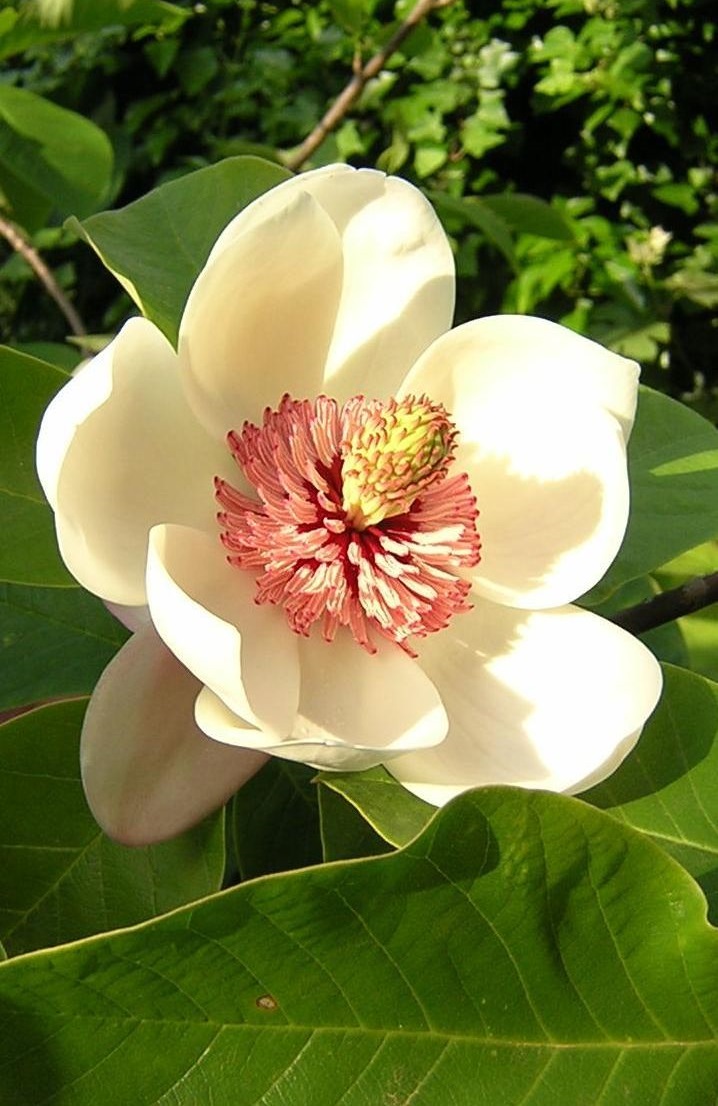
Photo: Magnolia_Watsoni.JPG: WibblyWibby derivative work: Wikiklaas (talk), Public domain · source

Shrub · Magnoliaceae
Star magnolia
Magnolia stellata
In other languages: Stermagnolia (Nederlands) · Magnolia étoilé (Français)
The star magnolia comes from central Japan. It is a slow-growing, rounded shrub or small tree that reaches 2.5–3 m tall and as wide after many years. In March and April, before the leaves appear, it is covered in white, lightly scented flowers with a dozen or more narrow petals arranged in a star. All winter, silvery-grey, velvety buds decorate the bare branches. It flowers when still young and stays compact enough for a small garden; well-known cultivars are ‘Royal Star’ and the pale pink ‘Rosea’.
Light
Sun or partial shade
preferably some sun
Moisture
Normal
no wet feet
Legal basis
Sand, loam or peat
acid to neutral
Hardiness
Fully hardy
down to -25 °C
Size
3 m
tall, 3 m wide
Flowering
March–April
| Pruning months | June–July |
|---|---|
| Height | 3 m |
| Native to Belgium | No, planted |
| Good for bees, butterflies and birds | Yes, for bees |
| Poisonous to people and pets | Not known to be poisonous |
| Flowering | March–April |
Identify
Star magnolia: how do you recognise it?
- Habit
- Rounded, densely branched shrub or small tree, 2.5–3 m tall and wide after many years.
- Leaves
- Oblong, 5–10 cm, fresh green; they appear after flowering and sometimes turn yellow in autumn.
- Flowers
- Star-shaped flowers of 8–10 cm with twelve or more narrow, slightly drooping petals, in March–April on bare branches.
- Colour
- Pure white; flushed pink in some cultivars.
- Scent
- Light and sweet, best noticed on a mild, sunny day.
- Roots
- Fleshy and shallow: they break easily and recover slowly, so do not dig around the shrub.
Flowering: March–April · Plants: March–May · Pruning: June–July
In your garden
Why grow it?
- One of the first shrubs to flower each year: a cloud of white stars in March.
- Compact and slow-growing, so it also suits a small garden or a large pot.
- Flowers young, often in the first year after planting.
- Velvety, silvery-grey buds decorate the bare branches all winter.
- The early flowers provide pollen for bees and bumblebees.
Star magnolia: where does it grow best?
- Sun or partial shade; it flowers most freely in sun.
- Humus-rich soil: sandy, loamy or peaty, acid to neutral. On chalky soil the leaves may turn yellow.
- Average, moisture-retentive soil that drains well; it dislikes drying out in summer.
- A spot without morning sun, for example facing west or sheltered by a wall or hedge: frozen flowers then thaw slowly and turn brown less.
- Allow 2.5–3 m of space, in a spot where it can stay for many years.
- Light
- Sun and partial shade
- Soil type
- Sand, loam or peat
- Acidity
- Acid or neutral
- Moisture
- Normal
- Size
- 3 m tall, 3 m wide
- Hardiness
- Hardy (to -25 °C)
Goes well with
- Glory-of-the-snow: Small blue stars beneath the white stars, at the same time.
- Crocus: An early carpet of colour under the bare branches.
- Lenten rose: Flowers at the same time, in the light shade at the edge of the canopy.
- Grape hyacinth: Blue spikes in April, as the magnolia finishes flowering.
Maintenance
Star magnolia: when and how to plant it?
Plant in March–May.
- Plant in March–May, when the roots are active: that is when it establishes best.
- Dig a wide hole and mix in a few spadefuls of leaf mould or well-rotted compost.
- Set the plant at the same depth as it was in the pot, no deeper, and handle the fleshy roots with care.
- Keep 2.5–3 m from other shrubs and trees.
- Water in thoroughly straight away, even if it is raining, and keep the soil moist in the first year.
- Spread a layer of leaf mould or bark around the base, but not against the stem.
Care
- Watering
- Regularly in dry spells in the first and second year. Later on, also water in dry summers: that is when next year’s buds are formed.
- Feeding
- In April, a layer of compost or a little organic feed for ericaceous plants or flowering shrubs.
- Mulching
- A layer of leaf mould or bark every spring keeps the soil cool and moist and protects the shallow roots.
- Cultivation
- Do not dig or hoe under the canopy: the fleshy roots lie just below the surface.
- In a pot
- A pot of at least 50 cm with drainage holes and humus-rich compost. Water regularly and protect the pot in winter.
Tip: Plant it in spring in humus-rich soil, in a spot without morning sun. That way frozen flowers thaw slowly and are less likely to turn brown.
Star magnolia: when to prune it?
Pruning months: June–July.
When: Hardly ever needed. If you must prune, do it in June–July, when the shrub is in leaf.
How:
- Remove dead, damaged and crossing branches.
- Cut an over-long branch back to a side branch, never halfway along a branch.
- On a congested shrub, take out one or two whole branches rather than shortening every stem.
Caution: Do not prune in winter or early spring: you would remove the flower buds and the cuts bleed heavily.
Propagation
- Layering
- In spring, bend a low stem to the ground, lightly wound the bark underneath and peg it down under some soil. Sever after one to two years.
- Softwood cuttings
- In June: 10–15 cm cuttings from young shoots, under plastic or in a humid propagator. Not always successful; layering is more reliable.
Star magnolia: how does it get through the winter?
Hardy to −25 °C.
- Hardy to about −25 °C: the shrub itself needs no protection in Belgium.
- The flowers, however, are sensitive to night frost: in hard frost during flowering they turn brown. You can cover a young plant with fleece for the night.
- The hairy buds protect the flowers all winter; simply leave them be.
- In a pot: stand it against a wall and wrap the pot in hessian or bubble wrap so the roots do not freeze.
Diseases and pests
- Brown flowers: Caused by night frost during flowering, especially when morning sun thaws the frozen flowers too quickly. Choose a spot without morning sun; the shrub itself does not suffer.
- Yellow leaves with green veins: Chlorosis caused by chalky soil. Mulch with leaf mould or pine needles and use an ericaceous feed.
- Few flowers: Often due to summer drought, when the buds are forming, or too much shade. Water in dry summers and give it more light.
- Wilting leaves: May point to roots damaged by digging or transplanting. Leave the soil under the shrub undisturbed and water in dry spells.
Through the year
- March: Flowering: white stars on bare branches. Plant.
- April: Flowering. Give compost or feed. Plant.
- May: Plant. Mulch. The leaves appear.
- June: Light pruning if needed. Take softwood cuttings.
- July: Water in dry spells. Prune if needed.
- August: Water in dry spells: the flower buds are forming.
- October: Autumn colour, sometimes yellow.
- December: Silvery-grey, hairy buds decorate the bare branches.
Use
Good for wildlife
- Bees
- Nectar and pollen for honeybees and wild bees.
You and this species
Did you know?
- The genus is named after Pierre Magnol, a French botanist from Montpellier.
- Magnolias belong to an ancient group of flowering plants and in the wild are mainly pollinated by beetles.
- The flower buds form as early as the previous summer and spend the winter in a hairy, silvery-grey casing.