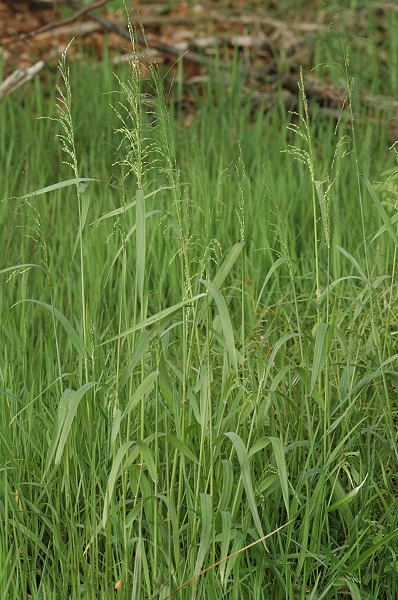
Photo: James K. Lindsey, CC BY-SA 3.0 · source

Ornamental grass · Poaceae
Wood millet
Milium effusum
In other languages: Bosgierstgras (Nederlands) · Millet diffus (Français)
Wood millet is a native grass of moist, humus-rich deciduous woodland in Europe, including Belgium. The wild species forms loose clumps of soft, flat, light green leaves, with very airy panicles of fine, spreading branches and tiny spikelets in May–July. In gardens the cultivar ‘Aureum’ is grown most, with bright yellow leaves that light up dark, shady corners in spring. In summer the leaves turn more lime green. It self-seeds gently and the seedlings of ‘Aureum’ stay yellow, so it spreads naturally through a shady border.
Light
Partial shade or shade
tolerates little sun
Moisture
Normal
no wet feet
Legal basis
Loam or clay
any pH
Hardiness
Fully hardy
down to -30 °C
Size
0.6 m
tall, 0.3 m wide
Flowering
May–July
| Pruning months | March and July |
|---|---|
| Height | 0.6 m |
| Native to Belgium | Yes |
| Poisonous to people and pets | Not known to be poisonous |
| Flowering | May–July |
Identify
Wood millet: how do you recognise it?
- Habit
- Loose clump of leaves about 30 cm tall, with flower stems to 60 cm.
- Leaves
- Soft, flat and broadly strap-shaped; in ‘Aureum’ bright yellow in spring, lime green in summer.
- Flowers
- Very loose, open panicles with fine, spreading side branches and small spikelets, in May–July.
- Seed
- Drops around the clump; seedlings appear nearby and ‘Aureum’ comes true from seed.
- Roots
- Fibrous and fairly shallow; the clump barely spreads, the plant moves around mainly by seed.
Flowering: May–July · Plants: March–April and September–October · Pruning: March and July
In your garden
Why grow it?
- Bright yellow leaves (in ‘Aureum’) that light up shady spots in spring.
- One of the few ornamental grasses that genuinely likes shade.
- Airy, almost see-through panicles that move gently above the leaves.
- Native and at home on a woodland edge or in a shady wildlife garden.
- Self-seeds gently and fills gaps between ferns and hostas.
Wood millet: where does it grow best?
- Part shade or light shade; morning sun is fine, strong midday sun scorches the yellow leaves.
- In deep shade ‘Aureum’ turns greener; light shade gives the best colour.
- Humus-rich, moisture-retentive soil: loam or clay, acid to chalky.
- Moist but not wet: do not let the soil dry out in summer.
- Plant 30 cm apart, in small groups, among other shade plants.
- Light
- Partial shade and shade
- Soil type
- Loam or clay
- Acidity
- Not fussy
- Moisture
- Normal
- Size
- 0.6 m tall, 0.3 m wide
- Hardiness
- Hardy (to -30 °C)
Goes well with
- Hosta: Large blue or green leaves beside the fine yellow grass.
- Ferns: Fresh green, fine foliage in the same humus-rich shade.
- Lungwort: Blue and pink spring flowers, at the same time as the brightest yellow leaves.
- Siberian bugloss: Sky-blue flowers in April above the yellow leaves.
- Coral bells: Dark red or purple leaves for contrast.
Maintenance
Wood millet: when and how to plant it?
Plant in March–April and September–October.
- Plant in March–April or in September–October.
- Work a few spadefuls of leaf mould into the soil.
- Dig a hole slightly larger than the root ball and set the plant at the same depth as in the pot.
- Plant 30 cm apart, in groups of three or more.
- Water well after planting.
- Mulch with leaf mould: it keeps the soil cool and moist.
Care
- Water
- Water in dry spells, especially in the first year and in summer under trees.
- Feeding
- A thin layer of leaf mould in March is enough.
- Seedlings
- Leave them where they fit, move them in spring or weed them out if there are too many.
- Tidying
- In March, cut away dead leaves and old stems.
- After flowering
- If the plant looks untidy in summer, cut the flower stems off in July.
Tip: Plant ‘Aureum’ in light shade where it gets morning sun but no strong midday sun: the leaves then stay bright yellow without scorching.
Wood millet: when to prune it?
Pruning months: March and July.
When: In March, cut back the old leaves and stems before the new yellow leaves appear. In July, the spent stems too if you wish.
How:
- In March, cut all dead leaves back to a few centimetres above the ground.
- In July, cut off spent stems if you want fewer seedlings or if the plant looks untidy.
- Leave a few stems if you want it to self-seed.
Propagation
- Seed
- It self-seeds; move the seedlings in March–April or September. You can also scatter ripe seed straight away in summer.
- Division
- In March–April or September, lift a clump and split it into a few pieces.
Wood millet: how does it get through the winter?
Hardy to −30 °C.
- Fully hardy to about −30 °C: no protection needed.
- In winter the leaves become dull and untidy; cut them away in March.
- In a pot: keep it in shade and do not let the compost dry out or stay sodden.
Diseases and pests
- Scorched leaves: Brown, bleached patches on the yellow leaves in full sun. Move it to part shade.
- Green leaves: ‘Aureum’ turns green in deep shade and in summer. Choose light shade; the colour is best in spring.
- Drying out: Limp, brown leaves in dry summers. Water and mulch with leaf mould.
- Too many seedlings: Cut off the flower stems after flowering or weed out seedlings while small.
Through the year
- March: Cut back old foliage. Plant and divide. Add leaf mould.
- April: Bright yellow new leaves. Plant. Move seedlings.
- May: Flowering begins. Water in dry spells.
- June: Flowering. Leaves turn lime green.
- July: Cut off spent stems or let it self-seed.
- August: Water in dry spells.
- September: Plant and divide. Move seedlings.
- October: Plant.
- December: Rest.
You and this species
Did you know?
- In England ‘Aureum’ is known as Bowles’ golden grass, after the English plantsman and writer E. A. Bowles.
- ‘Effusum’ means ‘spread out’ and refers to the widely spreading branches of the airy panicle.
- Milium is the old Latin name for millet, which is where the name wood millet comes from.