Photo: Own work, CC BY-SA 3.0 · source

Bulb or tuber · Asparagaceae
Compact grape hyacinth
Muscari botryoides
In other languages: Blauw druifje (Nederlands) · Muscari botryoïde (Français)
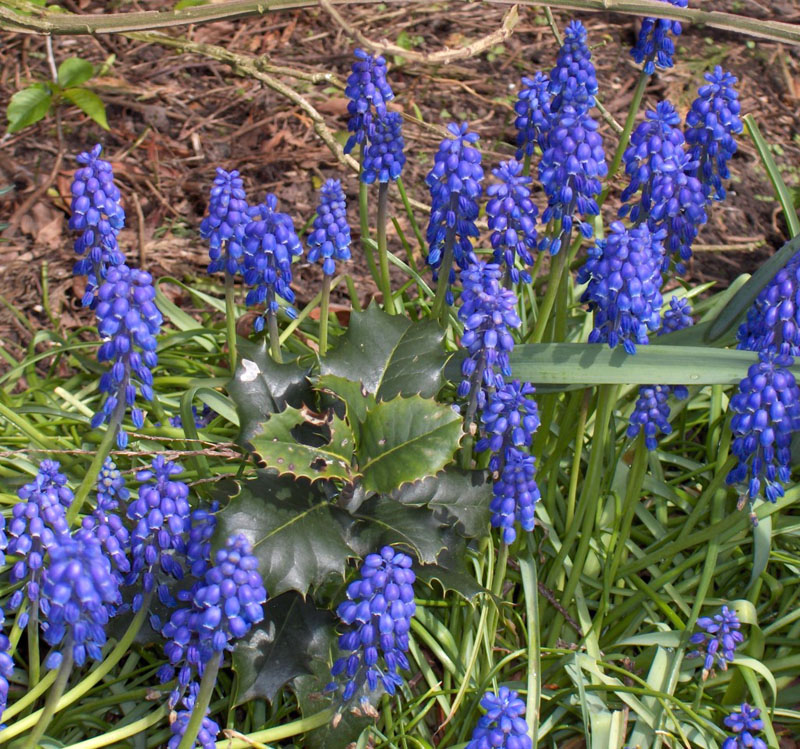
Compact grape hyacinth grows wild in central and southern Europe, where it flowers in spring in grassland, on slopes and in open woodland. It is a small bulb of 10–20 cm, with a few narrow leaves and, in April–May, short, dense spikes of almost round, bright blue bells with a white rim. It is more compact and less invasive than the better-known Armenian grape hyacinth, which makes it ideal for a rock garden, an edge, a pot or a small garden. Bees and bumblebees find nectar and pollen in it early in the year. The white form ‘Album’ is lovely among blue spring flowers.
Light
Sun or partial shade
preferably some sun
Moisture
Normal
no wet feet
Legal basis
Sand, loam or clay
neutral to chalky
Hardiness
Fully hardy
down to -25 °C
Size
0.15 m
tall, 0.08 m wide
Flowering
April–May
| Height | 0.15 m |
|---|---|
| Native to Belgium | No, planted |
| Good for bees, butterflies and birds | Yes, for bees |
| Poisonous to people and pets | Not known to be poisonous |
| Flowering | April–May |
Identify
Compact grape hyacinth: how do you recognise it?
- Habit
- Small bulb 10–20 cm tall and 5–8 cm wide, forming dense clumps after a few years.
- Leaves
- Two to four narrow leaves that widen slightly towards the tip; they die back in June.
- Flower
- Short, dense spike of small, almost spherical bells with a narrowed mouth and a white-toothed rim, in April–May.
- Colour
- Bright sky blue; the top flowers are paler. The form ‘Album’ is pure white.
- Bulb
- Small, round bulb of 1–2 cm with a thin, pale tunic, which forms offsets.
Flowering: April–May · Plants: September–November
In your garden
Why grow it?
- Bright blue flower spikes in April and May, at the same time as tulips and late daffodils.
- Compact and tidy: it spreads less than Armenian grape hyacinth and fits a small garden or rock garden.
- An early source of nectar and pollen for bees and bumblebees.
- Naturalises quietly in grass, under shrubs and along edges, and comes back every year.
- Easy in a pot or trough, on its own or as underplanting for tulips.
- Fully hardy and easy to look after.
Compact grape hyacinth: where does it grow best?
- Sun to partial shade; it flowers most freely in sun. Under deciduous shrubs it gets enough light in spring.
- Sand, loam or clay, neutral to chalky; it is less happy in acid, peaty soil.
- Moist but well-drained soil: in waterlogged ground the bulbs rot.
- Plant 5–8 cm apart, in groups of at least 10–20 bulbs or as a ribbon along a path.
- Light
- Sun and partial shade
- Soil type
- Sand, loam or clay
- Acidity
- Neutral or chalky
- Moisture
- Normal
- Size
- 0.15 m tall, 0.08 m wide
- Hardiness
- Hardy (to -25 °C)
Goes well with
- Daffodil: Small yellow daffodils beside the blue: a classic spring combination.
- Tulip: Plant the grape hyacinths as a blue carpet between or under the tulips.
- Primrose: Pale yellow flowers in the same sun or partial shade.
- Forget-me-not: Soft blue clouds that follow on nicely in May.
Maintenance
Compact grape hyacinth: when and how to plant it?
Plant in September–November.
- Plant in September–November, preferably early, so the bulbs root before winter.
- Loosen the soil and, in heavy clay, mix in some grit or coarse sand for better drainage.
- Set the bulbs 7–10 cm deep, pointed end up.
- Keep 5–8 cm between bulbs; for a natural look, plant them in loose, irregular groups.
- Firm the soil and water if the ground is dry.
- In a pot: use potting compost with some sand, plant the bulbs close together and make sure there is a drainage hole.
Care
- Watering
- Not normally needed. In a pot or in a dry spring, water until flowering is over.
- Feeding
- Needs little. A thin layer of compost in autumn or after flowering is enough.
- Foliage
- Let the leaves die back naturally after flowering: this is how the bulb builds up strength. In grass, only mow once the leaves are yellow.
- Spent flowers
- Cut off the spikes if you do not want it to self-seed; leave them if you want it to naturalise.
- Dividing
- Every 3–4 years, lift crowded clumps in summer and divide them: it will flower more freely again.
Tip: Leave the leaves after flowering until they turn yellow and divide the clumps every 3–4 years: that way it keeps flowering freely every spring.
Compact grape hyacinth: when to prune it?
When: Compact grape hyacinth is not pruned. At most you cut off the faded spikes in May and clear the dead leaves in June.
How:
- Cut faded flower stems just above the leaves in May if you do not want seedlings.
- Leave them if you want it to self-seed in grass or under shrubs.
- Only clear the leaves once they are fully yellow or brown.
- In grass: only mow once the leaves have died back, usually in June.
Caution: Do not cut or mow the leaves too early: while they are green, the bulb is building up strength for next year’s flowers.
Propagation
- Offsets
- Lift a crowded clump in June–July, once the leaves have died back, separate the bulbs and replant them in September–October. Small bulbs flower after a year or two.
- Seed
- It self-seeds. You can also sow ripe seed in summer or autumn in a pot left outdoors; seedlings flower after two to three years.
Compact grape hyacinth: how does it get through the winter?
Hardy to −25 °C.
- Fully hardy, to about −25 °C: in Belgium it stays in the ground without protection.
- Wet soil in winter is more dangerous than frost: make sure drainage is good.
- In a pot: stand the pot against a wall and on pot feet, so water can drain away and the bulbs do not freeze solid.
Diseases and pests
- Bulb rot: Bulbs fail to come up or are soft and brown, because the soil is too wet. Replant in a better-drained spot or work sand into the soil.
- Few flowers: Too much shade, crowded clumps or leaves cut off too early. Divide, replant in a lighter spot and leave the leaves in place.
- Virus: Yellow streaks or patches on the leaves and distorted flowers. It cannot be cured: dig up affected plants and put them in the household waste, not on the compost heap.
- Slugs: In a wet spring they eat the leaves and flowers. Pick them off in the evening.
Through the year
- March: Leaves and flower buds appear. Watch for slugs.
- April: In flower: bright blue spikes. Plenty of bees.
- May: Flowering ends. Cut off faded spikes or leave them for seed.
- June: Leaves turn yellow. Only now mow the grass. Lift and divide crowded clumps.
- July: Dormant. Store lifted bulbs cool and dry until autumn.
- September: Plant bulbs 7–10 cm deep.
- October: Plant bulbs in edges, grass and pots.
- November: Plant the last bulbs. Move pots against a wall.
Use
Good for wildlife
- Bees
- Nectar and pollen for honeybees and wild bees.
You and this species
Did you know?
- The species name botryoides means ‘like a bunch of grapes’, from the Greek botrys. The English name grape hyacinth refers to the shape of the spike too.
- The genus name Muscari comes from the Greek word for musk, after the scent of some species.
- In grape hyacinths the top flowers of the spike are often smaller, paler and sterile.