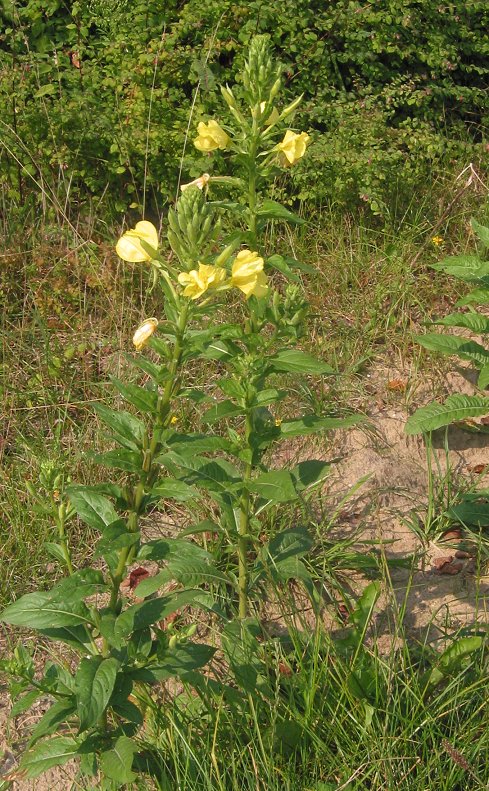
Photo: Rasbak at Dutch Wikipedia, CC BY-SA 3.0 · source

Annual · Onagraceae
Large-flowered evening primrose
Oenothera glazioviana
In other languages: Grote teunisbloem (Nederlands) · Onagre à sépales rouges (Français)
Large-flowered evening primrose is a biennial that probably arose in Europe from North American evening primroses and now grows wild in Flanders along roads and railways. In the first year it forms a rosette of leaves, in the second it sends up a sturdy stem of 1.5 m, often with red dots and with red-striped sepals on the buds. From June to September it opens large, soft yellow cup-shaped flowers of 6–8 cm at the top, which are lightly scented in the evening and attract moths. It is much taller and bigger-flowered than the common evening primrose, and self-seeds freely.
Caution: It self-seeds freely and can quickly take over a whole corner of a small garden or a tidy border. Cut off the seed pods or pull up seedlings early if you want to avoid that.
Light
Full sun
warm and bright
Moisture
Dry to normal
no wet feet
Legal basis
Sand or loam
any pH
Hardiness
Fully hardy
down to -25 °C
Size
1.5 m
tall, 0.5 m wide
Flowering
June–September
| Height | 1.5 m |
|---|---|
| Native to Belgium | No, planted |
| Good for bees, butterflies and birds | Yes, for bees and butterflies |
| Poisonous to people and pets | Not known to be poisonous |
| Flowering | June–September |
Identify
Large-flowered evening primrose: how do you recognise it?
- Habit
- Biennial. A leaf rosette in the first year; in the second a sturdy, upright, sometimes branched stem 1.5 m tall and 50 cm wide.
- Foliage
- Lance-shaped to oval, 10–25 cm, with a pale midrib; the edge is slightly wavy and the leaves hairy.
- Flower
- Soft yellow, 6–8 cm, with four petals and a cross-shaped stigma; opens in the evening and fades the next day. June to September.
- Bud
- The buds have red-striped sepals, which fold back as the flower opens.
- Roots
- A taproot; the plant dislikes transplanting, so sow in place.
Flowering: June–September · Harvest and fruit: March–November · Sowing: April–June
In your garden
Why grow it?
- Large, soft yellow flowers of 6–8 cm that open in the evening and have a light scent.
- Moths and bees visit the flowers; later the seeds feed birds.
- Very drought-tolerant and suited to sandy, poor soil.
- Little work: no fertiliser, hardly any watering and almost no pruning.
- An imposing, upright 1.5 m plant that adds height to a wild or natural border.
Large-flowered evening primrose: where does it grow best?
- Full sun for the richest flowering and the sturdiest stems.
- Well-drained sandy or loamy soil, acid to chalky; it tolerates poor soil, but not wet ground.
- Dry to moderately moist; very drought-tolerant.
- Space 50 cm apart. Put it at the back, since it grows to 1.5 m and self-seeds.
- Light
- Sun
- Soil type
- Sand or loam
- Acidity
- Not fussy
- Moisture
- Dry or normal
- Size
- 1.5 m tall, 0.5 m wide
- Hardiness
- Hardy (to -25 °C)
Goes well with
- Viper’s bugloss: Blue flowers that match the soft yellow evening primrose, even on dry soil.
- Larkspur: Blue spikes that contrast with the big yellow cups.
- Ornamental grasses: Soft stems around the tall, upright stems.
- Wild marjoram: Low, aromatic and attractive to bees and butterflies; fills in the base.
Maintenance
Large-flowered evening primrose: when and how to plant it?
- Sow from April to June straight where it is to grow, in a sunny, well-drained spot.
- Rake the soil fine and sow on the surface: the seed needs light to germinate and is barely covered.
- Firm the seed in lightly and keep the soil moist until it comes up, after 2–3 weeks.
- Thin to about 50 cm between plants.
- In autumn they stand as rosettes; they flower the following year.
Care
- Water
- Only water seedlings at the start. After that it looks after itself, even in dry summers.
- Feeding
- Not needed; fertiliser produces tall, floppy stems.
- Support
- In a windy garden, tie tall plants to a stake, since 1.5 m stems blow over easily.
- Deadheading
- Cut spent flowers if you do not want self-seeding; leave a few for insects, birds and future seedlings.
- Clearing
- Leave the stems standing in winter for insects and birds and remove them at the end of February.
Tip: A biennial with large, soft yellow flowers that you can watch open in the evening. Sow in place in sandy soil; after that it self-seeds freely.
Large-flowered evening primrose: when to prune it?
When: It is not pruned; you remove the stems after flowering, preferably in February.
How:
- Cut stems at the base after flowering, or in February if you leave them over winter.
- Remove spent flowers to limit self-seeding.
- Thin seedlings so they are not too crowded.
- Pull up unwanted seedlings while they are young; it is easy.
Caution: It self-seeds freely and can quickly take over a corner. Cut off the seed pods before they ripen if you want to avoid that.
Propagation
- Sowing
- From April to June in place. Sow on the surface, as the seed needs light to germinate. Germination after 2–3 weeks.
- Self-sowing
- Leave a few spent plants; seedlings come up on their own and flower the following year.
Large-flowered evening primrose: how does it get through the winter?
Hardy to −25 °C.
- Fully hardy, down to about −25 °C: no protection needed in Belgian winters, even as a rosette.
- Leave the stems with seed pods standing: they feed birds and shelter insects.
- A large, deep pot is possible too, provided the soil is well-drained.
Diseases and pests
- Excessive self-seeding: It can take over a corner. Remove seed pods before they ripen or pull up young seedlings.
- Toppling: Tall stems lean over in strong wind or after rain. Tie them to a stake or choose a sheltered spot.
- Powdery mildew: White powder on the leaves, especially in dry weather and dense planting. Give plants space and remove affected leaves.
- Slugs: Young seedlings and rosettes get nibbled. Search for them in the evening or lay a ring of coarse sand.
Through the year
- February: Cut down old stems. Check new seedlings.
- April: Sow in the final position.
- May: Sow. Thin seedlings to 50 cm.
- June: Second-year plants begin to flower. Sow more.
- July: Flowering; evening scent and moths.
- August: Full flower. Remove spent flowers to limit self-seeding.
- September: Last flowers; seed pods ripen.
- October: First-year rosettes stay in place. Seed can be collected.
Use
Edible and useful
- Flowers (June–September)
- The sulphur-yellow flowers open in the evening and wilt the next day: pick them in the evening or early in the morning, from June to September. They taste mild and sweet. Scatter them whole or in strips over a salad or a dessert.
- Leaves (March–May)
- Pick the young leaves of the rosette in spring, from March to May, while they are tender. They are slightly hairy and taste a little sharp and bitter: cook them briefly, like spinach, or add them to soup. Make sure you recognise the rosette: narrow, lance-shaped leaves with a pale midrib.
- Seeds (September–October)
- In September and October the seed capsules ripen along the stem. Cut them off as they turn brown, let them dry in a paper bag and shake out the tiny seeds. You can sprinkle them over bread or crackers before baking, like poppy seeds. Leave a few capsules for the birds.
- Roots (March and October–November)
- Only harvest the root from a first-year rosette, in October and November or still in March, before the flowering stem starts to grow: after that it turns woody. Peel it and boil it in salted water for 15 to 20 minutes; raw it is sharp, with a peppery aftertaste. Cooked, it tastes mild, rather like parsnip. That is how it used to be eaten as a vegetable.
- Storing
- Pick flowers and leaves just before use. The roots keep for a week, unwashed, in the vegetable drawer of the fridge; cooked, they can be frozen. Let the seeds dry for another week and keep them in a closed jar, dry and dark: that way they keep for a year.
Caution: Make sure you recognise the plant, especially the rosette: do not confuse it with the larger rosettes of foxglove, a highly poisonous plant with soft, finely hairy leaves. Only pick in your own garden, not along roads or railways, where evening primrose often grows wild. Eat the root and leaves cooked and in moderation. Only dig up the root in the first year: on a flowering plant it is woody.
Eating and using is at your own risk: see the terms of use.
Recipes
- Pan-fried evening primrose root (Dish · 2 people · 35 min)
- Summer salad with evening primrose flowers (Dish · 4 people · 15 min)
Good for wildlife
- Bees
- Nectar and pollen for honeybees and wild bees.
- Butterflies
- Nectar for butterflies.
You and this species
Did you know?
- The Dutch botanist Hugo de Vries used this plant, then called Oenothera lamarckiana, around 1900 for his studies of mutation.
- The plant probably arose in Europe from North American evening primroses grown in gardens that later escaped.
- The French name refers to the red stripes on the sepals of the buds.