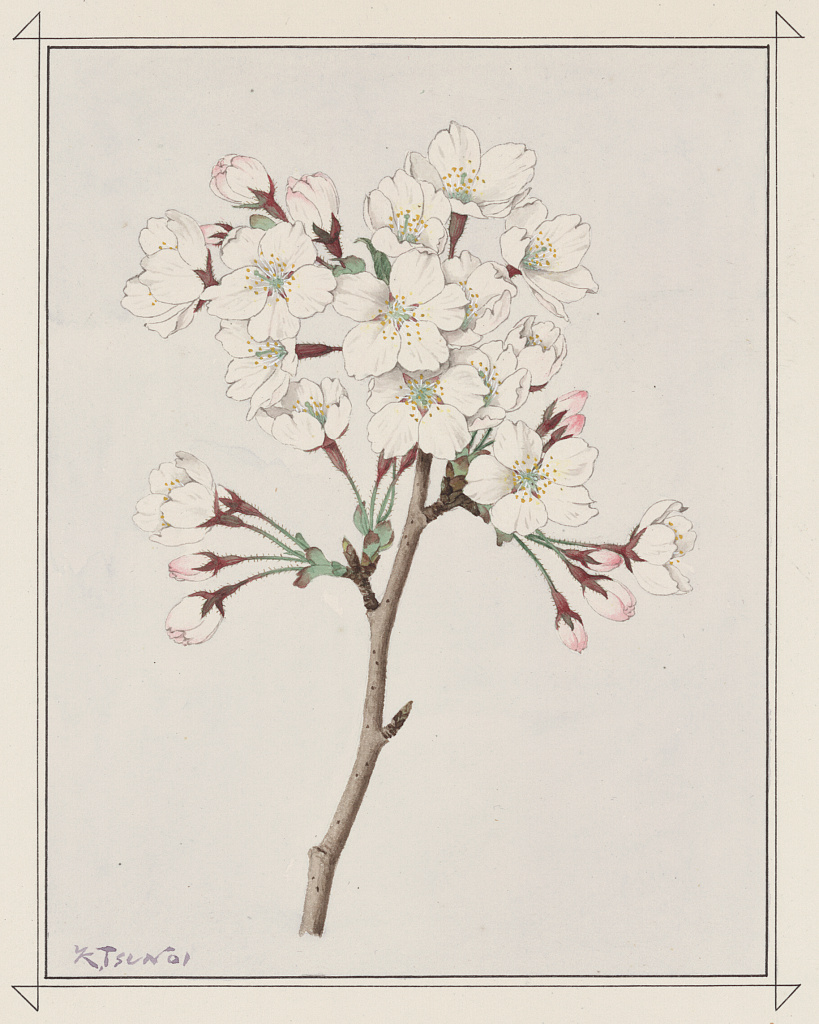
Photo: Tsunoi, Kōkichi, active 1892-1921., Public domain · source

Tree · Rosaceae
Yoshino cherry
Prunus × yedoensis
In other languages: Yoshino-kers (Nederlands) · Cerisier Yoshino (Français)
The Yoshino cherry is a Japanese flowering cherry, a hybrid of two wild cherry species that spread from Tokyo across Japan in the 19th century. It is the classic tree of Japanese cherry blossom, and it is also planted in great numbers around the water in Washington. In late March–early April its broad crown fills with single, pale pink to white flowers before the leaves appear, with a light almond scent. Then come fresh green leaves, small black cherries for the birds and yellow to orange autumn colour. It fairly quickly becomes a tree of 8–12 m, often wider than it is tall.
Light
Full sun
warm and bright
Moisture
Normal
no wet feet
Legal basis
Sand, loam or clay
any pH
Hardiness
Fully hardy
down to -25 °C
Size
10 m
tall, 10 m wide
Flowering
March–April
| Pruning months | July–August |
|---|---|
| Height | 10 m |
| Native to Belgium | No, planted |
| Good for bees, butterflies and birds | Yes, for bees |
| Poisonous to people and pets | Not known to be poisonous |
| Flowering | March–April |
Identify
Yoshino cherry: how do you recognise it?
- Habit
- Tree with a broad, open crown and slightly arching branches; 8–12 m tall and often as wide or wider.
- Leaves
- Oval, toothed, 6–12 cm; unfold after flowering. Yellow to orange in autumn.
- Flowers
- Single, 3–4 cm across, in clusters of three to five; pale pink as they open, later almost white. Flowers in late March–early April, before the leaves.
- Scent
- Light and sweet, with a hint of almond.
- Fruit
- Small, round, black cherries in June; bitter and not worth eating, but loved by birds.
- Bark
- Smooth, grey to reddish-brown, with horizontal bands of breathing pores.
Flowering: March–April · Plants: March–April and October–December · Pruning: July–August
In your garden
Why grow it?
- One of the finest blossom trees: a cloud of pale pink to white flowers in early spring.
- Early nectar and pollen for bees and bumblebees, when little else is in flower.
- A broad, shady crown that is lovely to sit under in summer.
- Small black cherries for the birds and yellow to orange autumn colour.
- Fairly fast-growing and fully hardy.
Yoshino cherry: where does it grow best?
- Full sun for the best flowering and a healthy crown.
- Any ordinary, free-draining garden soil: sand, loam or clay, including chalky soil. Avoid places where water lies.
- Normal moisture; once established it copes with a dry summer, young trees do not.
- Allow 8–10 m: plant at least 5 m from the house and from other trees.
- The roots are fairly shallow; do not plant it right next to a patio or drive.
- Light
- Sun
- Soil type
- Sand, loam or clay
- Acidity
- Not fussy
- Moisture
- Normal
- Size
- 10 m tall, 10 m wide
- Hardiness
- Hardy (to -25 °C)
Goes well with
- Crocus: Purple and white in the grass under the crown, just before the blossom.
- Daffodil: Yellow flowers beneath the pink blossom; they often flower together.
- Grape hyacinth: A blue carpet under the tree in April.
- Forget-me-not: Pale blue clouds beneath the pale pink blossom.
- Barrenwort: Tough ground cover that copes with the dry shade under the crown.
Maintenance
Yoshino cherry: when and how to plant it?
Plant in March–April and October–December.
- Plant from October to December or in March–April, while the tree is dormant and the ground is not frozen.
- Dig a hole twice as wide as the root ball, loosen the bottom and mix in some compost.
- First drive in a stake on the windward side and set the tree beside it.
- Plant it at the same depth as in the nursery; the graft union must stay above the soil.
- Firm the soil, fix the trunk to the stake with a tree tie and give it 20–30 litres of water.
- Keep a 1 m circle around the trunk free of grass and cover it with mulch.
Care
- Watering
- For the first two or three years, a good bucket of water every week in dry spells. An older tree usually looks after itself.
- Feeding
- A layer of compost around the base in March is enough. Too much feed gives long, weak shoots.
- Base of the tree
- Keep the soil around the trunk free of grass and weeds, especially in the first years.
- Stake
- Check the tree tie every spring so it does not cut into the trunk. After two or three years the stake can come out.
- Roots
- Do not dig deeply under the crown; spring bulbs and ground cover are better there.
Tip: Plant spring bulbs in the grass under the crown: they flower before the cherry’s leaves cast shade, and the bees find even more food.
Yoshino cherry: when to prune it?
Pruning months: July–August.
When: Only in summer, in July–August, in dry weather. The wounds then close quickly and the risk of disease is lowest.
How:
- A Yoshino cherry needs little pruning: remove only dead, diseased and crossing branches.
- On young trees, take out branches that are too low or grow too steeply upwards, to create a good open crown.
- Always cut just outside the branch collar, without leaving stubs.
- Remove wild shoots from below the graft and at the base of the trunk as soon as you see them.
Caution: Never prune in autumn or winter: silver leaf and bacterial canker can enter through the wounds. Cherries heal large cuts poorly, so prune little and more often rather than a lot at once.
Propagation
- Grafting
- Nurseries graft or bud it onto a wild cherry rootstock. Seedlings do not resemble the parent, as it is a hybrid.
- Softwood cuttings
- In June, take 10 cm cuttings from young shoots and root them in moist compost under plastic or in a propagator. Success varies, but you get trees on their own roots.
Yoshino cherry: how does it get through the winter?
Hardy to −25 °C.
- Fully hardy, to about −25 °C: no protection is needed in Belgium.
- A late frost during flowering can turn the flowers brown; the tree itself does not suffer.
- On young trees, check the stake and tree tie after storms.
- In a container it only grows well for a few years; it is better planted in open ground.
Diseases and pests
- Silver leaf: Leaves take on a silvery sheen and branches die back. Cut affected branches back to healthy wood in summer and never prune in winter.
- Bacterial canker: Sunken patches oozing gum on the trunk and branches, and small holes in the leaves. Remove affected branches in summer and avoid wounds.
- Blossom wilt: Flowers and shoot tips wilt, turn brown and stay hanging on the tree. Cut them back to healthy wood and clear up fallen flowers.
- Cherry blackfly: Curled leaves at the tips of young shoots in May–June. Ladybirds and birds usually deal with them; if not, hose them off with water.
Through the year
- January: Dormant. Check the stake and tree tie after storms.
- February: Weed the base of the tree.
- March: Flowering starts in late March. Plant. Compost around the base.
- April: Full bloom, busy with bees. Plant.
- May: Leaves unfold. Watch for aphids.
- June: Cherries for the birds. Water young trees in dry spells. Take softwood cuttings.
- July: Prune in dry weather. Water in dry spells.
- August: Prune if still needed. Remove wild shoots.
- October: Autumn colour. Plant.
- November: Plant. Compost fallen leaves or leave them under the tree.
- December: Plant while the ground is not frozen.
Use
Good for wildlife
- Bees
- Nectar and pollen for honeybees and wild bees.
You and this species
Did you know?
- In Japan it is called ‘Somei-yoshino’, after the village of Somei, now part of Tokyo, where nurserymen spread it in the Edo period.
- Almost all Yoshino cherries are thought to have been grafted from one and the same tree. They are genetically identical, which is why they flower almost all at once in the same place.
- In 1912 Tokyo gave the city of Washington thousands of cherry trees, most of them Yoshino cherries.