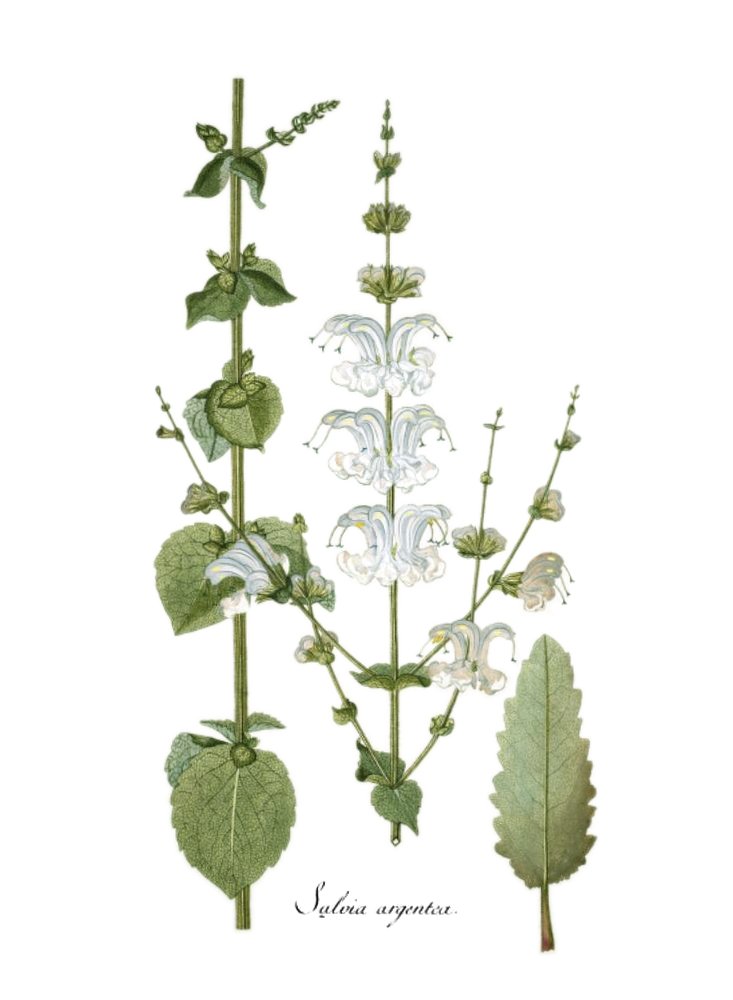
Photo: Nicolás Joseph Jacquin, Public domain · source

Perennial · Lamiaceae
Silver sage
Salvia argentea
In other languages: Zilversalie (Nederlands) · Sauge argentée (Français)
Silver sage grows naturally on dry, rocky mountain slopes in southern Europe, North Africa and western Asia. It is grown mainly for its large, woolly silvery-white rosette of leaves, which catches the eye all season. In June and July tall, branched flower stems appear, with white, sometimes faintly pink-tinged lipped flowers that bees visit. It is a short-lived plant, often grown as a biennial. It needs full sun and very well-drained soil; wet winters are its worst enemy.
Light
Full sun
warm and bright
Moisture
Dry
tolerates drought
Legal basis
Sand or loam
neutral to chalky
Hardiness
Fully hardy
down to -20 °C
Size
0.8 m
tall, 0.6 m wide
Flowering
June–July
| Pruning months | April and June–July |
|---|---|
| Height | 0.8 m |
| Native to Belgium | No, planted |
| Good for bees, butterflies and birds | Yes, for bees |
| Poisonous to people and pets | Not known to be poisonous |
| Flowering | June–July |
Identify
Silver sage: how do you recognise it?
- Habit
- Rosette about 40–60 cm wide, with flower stems of 0.8 m and more in summer; short-lived or biennial.
- Foliage
- Large, oblong and wrinkled; covered in dense, silvery-white woolly hairs. The large foliage is the ornamental part.
- Flower
- White, sometimes faintly pink-tinged lipped flowers in branched panicles, from June to July.
- Hairs
- The woolly hairs protect against sun and drought, but also hold moisture in wet weather.
- Roots
- Deep-rooting and sensitive to wet feet; dislikes being moved.
Flowering: June–July · Sowing: March · Plants: April–May · Pruning: April and June–July
In your garden
Why grow it?
- The large, woolly silver-white foliage is a real eye-catcher and suits grey and silver plantings.
- Drought-tolerant: a good choice for a gravel garden, a rock garden or a warm, dry bed.
- Bees visit the white flowers in June and July.
- Adds structure and colour contrast next to green and purple plants.
- Needs little care if the spot is well chosen.
- The tall flower stems add height and an airy effect.
Silver sage: where does it grow best?
- Full sun: in shade the foliage becomes greener and floppier.
- Very well-drained, poor soil: sand or light loam, neutral to chalky.
- Dry: it needs no extra water, except in the first weeks after planting.
- A warm, sheltered spot, for example in front of a wall or on a slope, stops the foliage staying wet.
- Allow 50–60 cm of space per plant.
- Light
- Sun
- Soil type
- Sand or loam
- Acidity
- Neutral or chalky
- Moisture
- Dry
- Size
- 0.8 m tall, 0.6 m wide
- Hardiness
- Hardy (to -20 °C)
Goes well with
- Lavender: Loves the same dry sun and adds blue-purple next to the silver.
- Ornamental grasses: A fine grass such as fescue gives a natural, airy look.
- Stonecrop: A low, drought-tolerant plant that goes well with gravel.
- Spurge: Green-yellow flowers that contrast nicely with the silver-white foliage.
Maintenance
Silver sage: when and how to plant it?
Plant in April–May.
- Plant in April–May, once the soil has warmed up and the worst frosts are over.
- Choose a spot in full sun and work coarse sand or fine grit into the bottom of the hole for better drainage.
- Set the plant at the same depth as in its pot and never let the rosette sink into wet soil.
- Leave 50–60 cm between plants so the rosette can breathe freely.
- Water occasionally for the first few weeks, then not at all. Spread a gravel mulch around the plant.
Care
- Water
- Only in the first weeks after planting. After that not at all, except in very long hot spells; never water over the rosette.
- Feeding
- Not needed. On rich soil the foliage turns green and floppy.
- Mulching
- A layer of gravel or coarse sand around the rosette keeps the foliage dry; do not use organic mulch.
- Flower stems
- Cut the flower stems off as soon as they appear if you want to keep the rosette longer.
- Tidying
- In April, remove dead or damaged leaves by hand without harming the rosette.
Tip: Give it the driest, sunniest spot with plenty of gravel and cut off the flower stems if you want to keep the silver rosette longer. Protect it from moisture in wet winters.
Silver sage: when to prune it?
Pruning months: April and June–July.
When: In April you clear away dead leaves. In June–July you cut off the flower stems if you want to keep the rosette.
How:
- Carefully remove dead or damaged leaves in April, by hand or with secateurs.
- Cut the flower stems down to the base at the start of flowering (June) if you want to save the rosette.
- If you want the flowers and seed, leave the stems and cut them off after flowering (July).
Caution: Never prune in wet weather and do not cut the rosette itself: wounds in the woolly foliage rot quickly.
Propagation
- Seed
- Sow indoors in March in a tray of free-draining seed compost, barely covering the seed. Prick out and plant out after the last frost (mid-May). Seedlings first form a rosette and often flower only in their second year.
- Moving seedlings
- It self-seeds in gravel and dry soil. Move young seedlings to the desired spot in spring.
Silver sage: how does it get through the winter?
Hardy to −20 °C.
- Hardy down to about −20 °C, but moisture is more dangerous than cold: in wet winters it rots away.
- Lay gravel around the neck of the rosette and make sure water drains away; if necessary plant it on a slope or raised bed.
- In persistent rain you can cover the rosette with an upturned pot or a pane of glass on stones, so air can circulate.
- In a pot: put it under a roof overhang in winter so the compost does not get wet.
Diseases and pests
- Rot from wet: The foliage turns brown and soft at the base. Improve drainage, put gravel around the rosette and protect the plant from prolonged rain.
- Grey mould: Grey mould on the woolly foliage in damp weather. Remove affected leaves and provide air movement.
- Floppy, green foliage: In a spot that is too rich or shady it loses its silver colour. Give it more sun and less feed.
- Dying after flowering: After flowering the rosette may die. Cut the flower stems off early or let seedlings grow to replace the plant.
Through the year
- March: Sow indoors.
- April: Plant. Remove dead leaves.
- May: Plant out after the last frost. Lay gravel around the rosette.
- June: Flowering starts. Cut off flower stems if wished.
- July: Flowering. Cut the stems off after flowering.
- August: Collect seed or let seedlings come up.
- September: Move seedlings. Keep the rosette dry.
- October: Top up the gravel. Remove dead leaves.
- November: Protect the rosette from a wet winter.
- December: Rest. Make sure water drains away.
Use
Good for wildlife
- Bees
- Nectar and pollen for honeybees and wild bees.
You and this species
Did you know?
- The name argentea means ‘silvery’ and refers to the dense silver-white hairs on the leaves.
- With more than 900 species, Salvia is one of the largest genera in the mint family.
- It is often grown as a biennial: in the first year it forms a rosette, in the second it flowers.