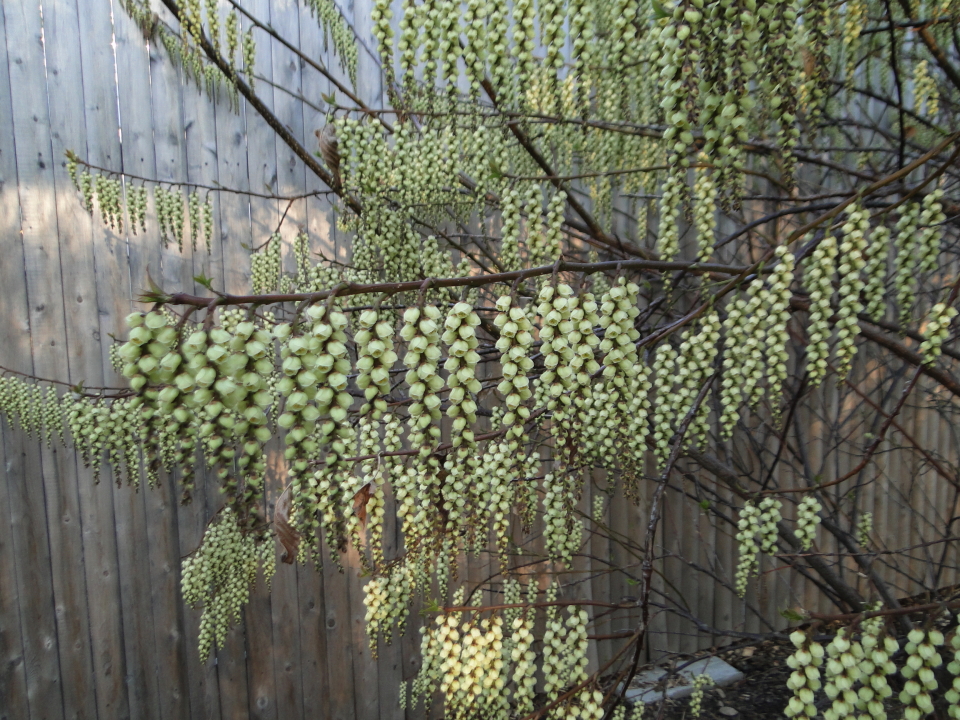
Photo: Lotos leo, CC BY-SA 3.0 · source

Shrub · Stachyuraceae
Early stachyurus
Stachyurus praecox
In other languages: Stachyurus (Nederlands) · Stachyurus (Français)
Stachyurus praecox comes from Japan. It is a wide, loose shrub of 2–3 m that flowers as early as February–March, long before it carries leaves. The flowers hang in long strings of small, pale yellow bells along the bare, red-brown branches. The flower strings are formed in autumn and hang on the branches all winter like green to reddish-brown beads. It is a rare, atmospheric shrub for anyone who wants something special in winter, in a sheltered spot in humus-rich, lime-free soil.
Light
Partial shade
no harsh midday sun
Moisture
Normal
no wet feet
Legal basis
Sand, loam or peat
acid to neutral
Hardiness
Fully hardy
down to -20 °C
Size
2.5 m
tall, 2.5 m wide
Flowering
February–April
| Pruning months | April |
|---|---|
| Height | 2.5 m |
| Native to Belgium | No, planted |
| Good for bees, butterflies and birds | Yes, for bees |
| Poisonous to people and pets | Not known to be poisonous |
| Flowering | February–April |
Identify
Early stachyurus: how do you recognise it?
- Habit
- Wide, loose shrub 2–3 m tall and wide, with an open structure and arching red-brown branches.
- Leaves
- Oval to lance-shaped, 6–12 cm, with a pointed tip and a toothed edge; they appear after flowering.
- Flowers
- Hanging strings 6–10 cm long of small, pale yellow bells, from February to April.
- Buds
- The flower strings form in autumn and hang on the branches all winter as green to reddish-brown beads.
- Roots
- Fibrous and fairly shallow; it likes a cool, humus-rich soil.
Flowering: February–April · Plants: March–April and October–November · Pruning: April
In your garden
Why grow it?
- It flowers from February to April, when almost nothing else is in bloom in the garden.
- The hanging yellow strings are a striking sight on the bare branches.
- An early food source for bees on mild days.
- It grows well in partial shade, where many shrubs flower less.
- The leaves turn yellow in autumn, and the flower buds already decorate the branches all winter.
Early stachyurus: where does it grow best?
- Partial shade, sheltered from cold winds: the early flowers can be damaged by hard frost.
- Humus-rich, well-drained soil: sand, loam or peat, acid to neutral; preferably no lime.
- Evenly moist soil; it tolerates neither long drought nor waterlogging.
- A sheltered corner, against a wall or among other shrubs, is ideal; avoid a frost pocket where cold air collects.
- Allow 2–2.5 m of space all round.
- Light
- Partial shade
- Soil type
- Sand, loam or peat
- Acidity
- Acid or neutral
- Moisture
- Normal
- Size
- 2.5 m tall, 2.5 m wide
- Hardiness
- Hardy (to -20 °C)
Goes well with
- Rhododendron: The same acid, humus-rich soil and partial shade; it flowers later in spring.
- Witch hazel: A winter bloomer in yellow and orange that sits well beside the yellow strings.
- Hellebore: Winter-flowering perennial for under the shrub.
- Snowdrop: Flowers at the same time, right under the branches.
- Ferns: Fresh green under the shrub when its leaves appear later in the season.
Maintenance
Early stachyurus: when and how to plant it?
Plant in March–April and October–November.
- Plant in March–April or in October–November; spring planting establishes most easily.
- Dig a generous hole, twice as wide as the root ball, and mix in leaf mould.
- Set the shrub at the same depth as it stood in its pot and firm the soil lightly.
- Keep 2–2.5 m away from other shrubs.
- Water in well straight away, then weekly in dry spells during the first year.
- Spread a layer of leaf mould or bark around the base.
Care
- Water
- Keep the soil evenly moist, especially in the first year and in dry summers. Rainwater is better than hard tap water.
- Feeding
- In spring after flowering, a layer of compost or an organic fertiliser for acid-loving plants.
- Mulching
- A thick layer of leaf mould or bark keeps the roots cool and moist.
- Frost protection
- Cover young shrubs with horticultural fleece during hard frost in flowering time, and the strings stay beautiful.
- Upkeep
- Little work: remove dead wood after flowering and otherwise leave it alone.
Tip: Plant it in a sheltered spot you can see from a window: in February–March you enjoy the flowers without standing in the cold. Rainwater and leaf mould keep the soil acid.
Early stachyurus: when to prune it?
Pruning months: April.
When: After flowering, in April. It needs very little pruning.
How:
- Remove dead, damaged and weak stems right at the base.
- Shorten overlong stems back to a side shoot to keep the shape.
- Every few years, take out a few old stems to make room for young shoots.
Caution: Do not prune in winter: the flower strings have been on the branches since autumn and you would cut them off.
Propagation
- Softwood cuttings
- In June–July: 8–10 cm cuttings from young shoots in moist, airy cutting compost under plastic. Roots form after 6–8 weeks; be patient.
- Layering
- In spring, bend a low, flexible stem to the ground and pin it down; separate it after a year and replant.
Early stachyurus: how does it get through the winter?
Hardy to −20 °C.
- Hardy down to about −20 °C: in a sheltered spot that is usually no problem in Belgium.
- The flower strings are more tender than the stems: in hard frost in February–March they can be damaged. Cover young plants with fleece then.
- In a pot: stand it in a sheltered spot against a wall and wrap the pot in hessian.
Diseases and pests
- Frost-damaged flowers: Brown, limp strings after frost in February–March. Plant in shelter and cover young shrubs; the shrub recovers by itself.
- Yellow leaves (chlorosis): Yellow leaves with green veins on chalky soil. Use rainwater, work leaf mould into the soil and choose an acid to neutral soil.
- Drought stress: Brown leaf edges and limp foliage in hot summers. Water evenly and lay a mulch.
- Aphids: Sometimes on young shoots. A strong jet of water is usually enough.
Through the year
- February: Flowering begins. Cover young shrubs in hard frost.
- March: Flowering. Plant or transplant. Give compost.
- April: Last flowers. Prune after flowering. Apply mulch.
- May: The leaves appear. Water in dry weather.
- June: Take softwood cuttings. Water in dry weather.
- July: Water in prolonged drought.
- October: Plant. Autumn colour; the flower buds become visible.
- November: Plant. Leaf fall.
- December: Dormant. The flower strings are already on the branches.
Use
Good for wildlife
- Bees
- Nectar and pollen for honeybees and wild bees.
You and this species
Did you know?
- The name Stachyurus comes from Greek: stachys means ‘ear of corn’ and oura ‘tail’, after the long, tail-like flower strings.
- The species name praecox means ‘early’, a reference to its early flowering.
- Stachyuraceae is a small family containing only the genus Stachyurus.