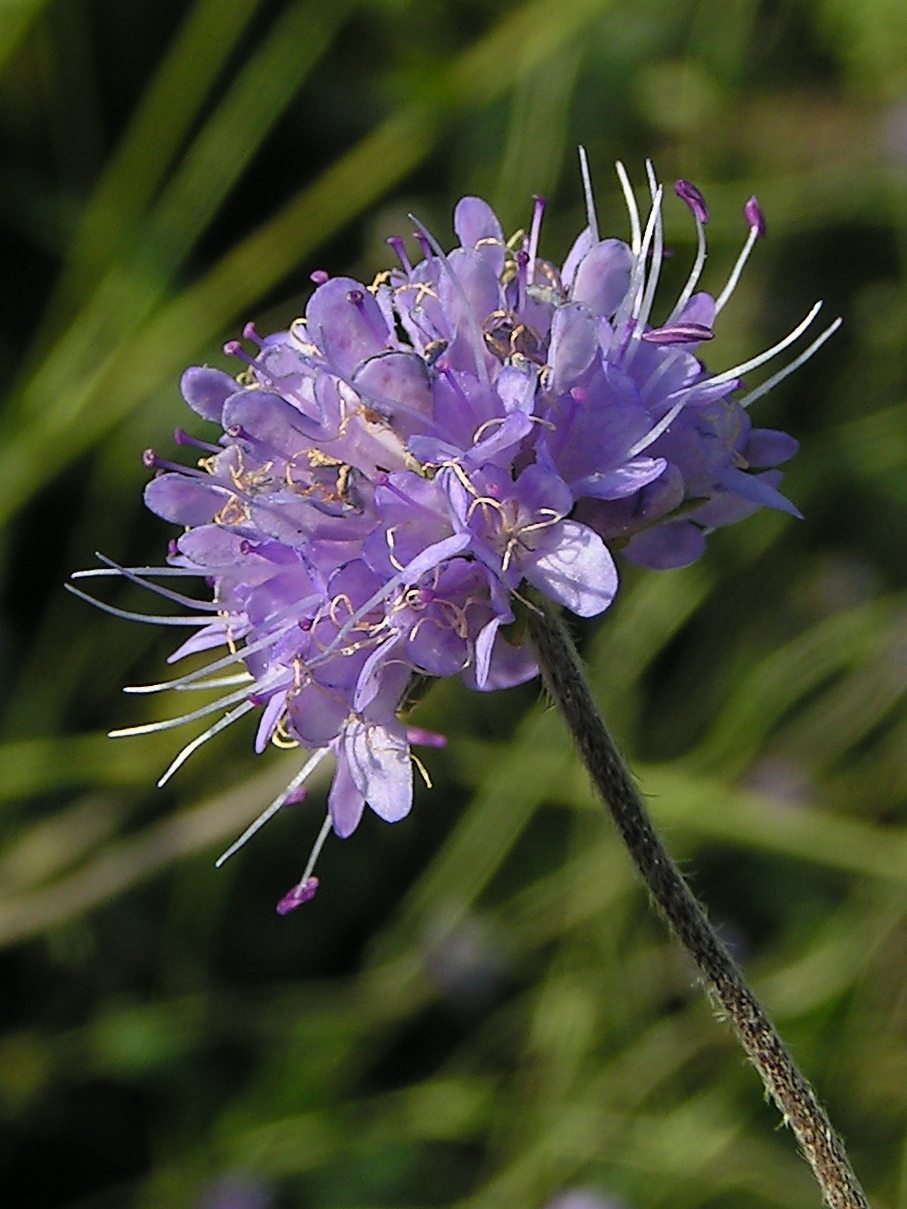
Photo: No machine-readable author provided. Pethan assumed (based on copyright claims)., CC BY-SA 3.0 · source

Perennial · Caprifoliaceae
Devil's-bit scabious
Succisa pratensis
In other languages: Blauwe knoop (Nederlands) · Succise des prés (Français)
Devil’s-bit scabious is a native perennial of damp, nutrient-poor grassland, heath and woodland edges across Europe. It forms a low rosette of undivided, oblong leaves, from which slender, branched stems up to 60 cm tall grow in summer. From August to October these carry round flower heads 1.5–2.5 cm across, violet-blue and studded with protruding stamens. In many areas it has declined as damp hay meadows have disappeared. In the garden it is a star plant for bees, bumblebees and butterflies, in a flowering meadow, a moist border or at a pond edge.
Light
Sun or partial shade
preferably some sun
Moisture
Normal to wet
must not dry out
Legal basis
Sand, loam or peat
acid to neutral
Hardiness
Fully hardy
down to -30 °C
Size
0.6 m
tall, 0.3 m wide
Flowering
August–October
| Pruning months | March |
|---|---|
| Height | 0.6 m |
| Native to Belgium | Yes |
| Good for bees, butterflies and birds | Yes, for bees and butterflies |
| Poisonous to people and pets | Not known to be poisonous |
| Flowering | August–October |
Identify
Devil's-bit scabious: how do you recognise it?
- Habit
- Leaf rosette with slender, branched flower stems up to 60 cm tall; a clump is about 30 cm wide.
- Leaves
- Oblong to lance-shaped, entire and undivided, dark green, in a rosette at ground level.
- Flower
- Round heads 1.5–2.5 cm across, made up of many small tubular florets with four lobes and long protruding stamens.
- Colour
- Violet-blue to lilac; pink and white forms also exist.
- Roots
- A short, thick rootstock that looks as if it has been bitten off.
Flowering: August–October · Plants: March–May and September–October · Pruning: March
In your garden
Why grow it?
- Flowers late, from August to October, when little other nectar is about.
- A star plant for bees, bumblebees, hoverflies and butterflies.
- Native and suited to a flowering meadow, a heath garden or a wet border.
- Grows on moist, acid and poor soil, where many garden plants struggle.
- The round button flowers give an airy, natural look and sit beautifully among grasses.
Devil's-bit scabious: where does it grow best?
- Sun or half shade.
- Sandy, loamy or peaty soil, acid to neutral; poor soil is better than rich.
- Normally moist to wet: ideal in damp grassland, at a pond edge or in a low, wet corner. It does not tolerate drying out well.
- Plant 25–30 cm apart, in small groups among low grasses.
- Light
- Sun and partial shade
- Soil type
- Sand, loam or peat
- Acidity
- Acid or neutral
- Moisture
- Normal or wet
- Size
- 0.6 m tall, 0.3 m wide
- Hardiness
- Hardy (to -30 °C)
Goes well with
- Ragged-robin: Pink, ragged flowers in spring, on the same moist soil.
- Meadowsweet: Creamy plumes in summer, before the devil’s-bit scabious starts flowering.
- Purple loosestrife: Purple spikes in July and August, a second nectar source for butterflies.
- Purple moor-grass: A native grass of wet heath that colours beautifully in autumn.
- Hemp-agrimony: Pink flower heads in late summer, another butterfly magnet for wet soil.
Maintenance
Devil's-bit scabious: when and how to plant it?
Plant in March–May and September–October.
- Plant in March–May or in September–October.
- Do not fertilise the soil: on poor soil it stays compact and is not crowded out by vigorous plants.
- Dig a hole slightly larger than the root ball and set the plant at the same depth as it was in the pot.
- Leave 25–30 cm between plants; in grassland, first open up a gap of about 30 cm in the turf.
- Water in well and keep the soil moist for the first few weeks.
Care
- Water
- Keep the soil moist, especially in the first year and in dry summers.
- Feeding
- Do not feed: in rich soil, grasses and other plants outgrow it.
- Spent flowers
- Leave them: the seed heads look good in winter and the seed falls.
- Mowing
- In a flowering meadow, do not mow while it is in flower. Mow in March and remove the cuttings so the soil stays poor.
- Weeding
- In spring, keep young plants clear of vigorous grasses and weeds.
Tip: Plant it in groups of five or more in a damp patch of grass that you do not mow until March: in late summer you will have a violet-blue cloud full of bees and butterflies.
Devil's-bit scabious: when to prune it?
Pruning months: March.
When: Leave the stems standing over winter and cut them down in March, before new growth starts.
How:
- Cut the old, dried stems back to just above the leaf rosette.
- Leave the seed heads until then: they decorate the winter garden and self-seed.
- In a flowering meadow, mow in March and remove the cuttings.
Propagation
- Seed
- Sow fresh seed outdoors in autumn, in a pot or where it is to grow: it germinates best after a cold winter. Young plants usually flower after one or two years.
- Division
- In March–April or in September, carefully split an older clump into rooted pieces and replant them straight away.
Devil's-bit scabious: how does it get through the winter?
Hardy to −30 °C.
- Fully hardy, to about −30 °C: as a native plant it needs no protection.
- The leaf rosette often stays green at ground level in winter.
- Leave the seed heads until March: they give structure and shelter for insects.
Diseases and pests
- Drying out: Limp, brown leaves and short flowering in a dry summer. Water and choose a moister spot.
- Being crowded out: In rich soil, grasses and vigorous plants outgrow it. Do not feed, remove cuttings and weed around the plant.
- Slugs: Eat young rosettes and seedlings. Pick them off in the evening.
- Floppy stems: In soil that is too rich or shade that is too deep. Do not feed and give it more light, among grasses that support it.
Through the year
- March: Cut down old stems or mow the meadow. Plant.
- April: Plant. Keep young plants clear of vigorous grasses.
- May: Plant. Water in dry spells.
- July: Flower stems grow. Water in dry spells.
- August: Flowering starts: bees and butterflies come to visit.
- September: Full flower. Plant or divide.
- October: Last flowers. Sow fresh seed. Plant.
- November: Leave the seed heads standing for winter.
Use
Good for wildlife
- Bees
- Nectar and pollen for honeybees and wild bees.
- Butterflies
- Nectar for butterflies.
You and this species
Did you know?
- The name devil’s-bit refers to the short, stubby root: according to an old legend, the devil bit it off out of spite.
- It is the food plant of the caterpillars of the marsh fritillary, a rare butterfly.
- Unlike its relative small scabious, it has entire, undivided leaves and florets with four lobes instead of five.