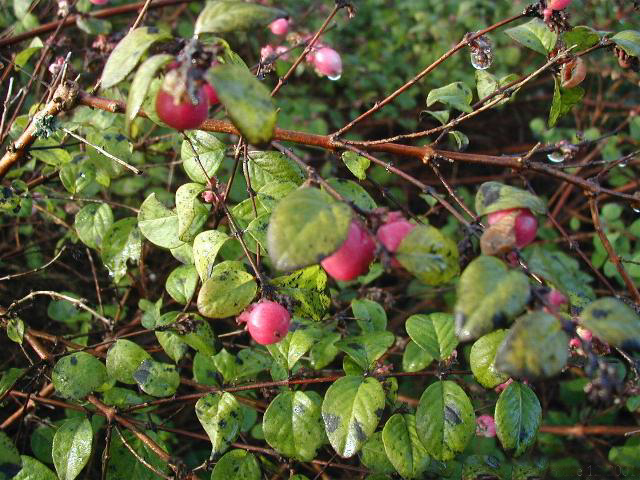
Photo: Sten at da.wikipedia, CC BY-SA 3.0 · source

Shrub · Caprifoliaceae
Chenault coralberry
Symphoricarpos × chenaultii
In other languages: Sneeuwbes (Nederlands) · Symphorine de Chenault (Français)
Symphoricarpos × chenaultii is a hybrid of two American snowberry species, raised in France and named after the nurseryman Chenault. It is a low, spreading shrub about 1 m tall and 2 m wide, with arching stems and small blue-green leaves. In summer small pink flowers appear, followed in autumn by pink to purple-red berries that hang on into winter. The shrub suckers and gradually grows into a dense mat. The cultivar ‘Hancock’ is a strong ground cover for dry shade and awkward corners.
Caution: The berries are poisonous if eaten: keep them away from children and pets (dogs, cats) and do not let children play with them. The shrub spreads strongly by suckers: give it room or contain it.
Light
Sun to shade
not fussy
Moisture
Dry to normal
no wet feet
Legal basis
Sand, loam or clay
any pH
Hardiness
Fully hardy
down to -30 °C
Size
1 m
tall, 2 m wide
Flowering
June–August
| Pruning months | March |
|---|---|
| Height | 1 m |
| Native to Belgium | No, planted |
| Good for bees, butterflies and birds | Yes, for bees and birds |
| Poisonous to people and pets | Yes, take care with children and pets |
| Flowering | June–August |
Identify
Chenault coralberry: how do you recognise it?
- Habit
- Low, spreading shrub about 1 m tall and 2 m wide, with slender arching stems and suckers.
- Leaves
- Small, round to oval, 1–3 cm, opposite; blue-green and densely set on the stems.
- Flowers
- Small, bell-shaped, pink flowers in short spikes, from June to August.
- Fruit
- Pink to purple-red berries in clusters, from late summer, often hanging on into winter.
- Roots
- Forms many suckers, with which it slowly spreads.
Flowering: June–August · Plants: March–April and October–November · Pruning: March
In your garden
Why grow it?
- One of the toughest ground covers for shade and dry soil under trees.
- Pink to purple-red berries that hang on into winter and look good in arrangements.
- Small flowers from June to August that bees love.
- Dense, low growth that suppresses weeds and gives birds cover.
- Hardy, indestructible and undemanding: it tolerates sun and shade, drought and ordinary garden soil.
Chenault coralberry: where does it grow best?
- Sun, partial shade or shade; it also tolerates the dry shade under trees.
- Ordinary garden soil: sand, loam or clay, acid to chalky.
- Dry to normally moist; it is not fussy, even in windy spots.
- Allow 1–2 m of space per plant; about 1 m as ground cover.
- Give it a spot where it can spread, or contain it along lawns and paths.
- Light
- Sun, partial shade and shade
- Soil type
- Sand, loam or clay
- Acidity
- Not fussy
- Moisture
- Dry or normal
- Size
- 1 m tall, 2 m wide
- Hardiness
- Hardy (to -30 °C)
Goes well with
- Red-barked dogwood: The red stems in winter and the pink berries make a lovely winter combination.
- Hosta: Large leaves beside the small foliage, in the same shade.
- Bergenia: Thick, glossy leaves that complement the low shrub.
- Lady’s mantle: A soft, yellow edge at the front of the shade border.
Maintenance
Chenault coralberry: when and how to plant it?
Plant in March–April and October–November.
- Plant in March–April or in October–November, when the soil is neither frozen nor waterlogged.
- Dig a hole twice as wide as the root ball and mix in a little compost.
- Set the plant at the same depth as it stood in its pot and firm the soil well.
- Keep 1–2 m apart, or about 1 m as ground cover.
- Water in well straight away, even if it is raining.
- Spread a layer of compost or bark around the base until the planting has closed up.
Care
- Water
- Weekly in dry spells in the first year. After that it fends for itself, even in dry summers.
- Feeding
- Usually not needed; a layer of compost in spring is enough.
- Mulching
- A layer of bark or compost helps against weeds in the first years, until the shrub has closed up.
- Suckers
- Lift suckers at the edge every year where you do not want them.
- Upkeep
- Remove dead or damaged stems; otherwise it asks little.
Tip: Put it where nothing else wants to grow, such as the dry shade under trees. Lift the suckers at the edge every year to keep it within bounds.
Chenault coralberry: when to prune it?
Pruning months: March.
When: Late February to March, before the new shoots start.
How:
- Cut dead, weak and crossing stems right at the base.
- An oversized or bare shrub can be cut back in March to 15–30 cm above the ground; it regrows quickly.
- Keep the edges in shape by cutting off or lifting suckers.
- Do not cut off the berries before winter if you want to leave them.
Caution: The berries are poisonous if eaten: keep them away from children and pets (dogs, cats). The shrub suckers freely and can spread strongly: give it room or contain it.
Propagation
- Division or suckers
- In spring or autumn, lift a rooted piece from the edge and plant it elsewhere; this almost always works.
- Hardwood cuttings
- In October–November: 20–25 cm lengths of firm, ripe wood pushed into open ground; they root during the following year.
- Softwood cuttings
- In June–July: 8–10 cm cuttings from young shoots in moist cutting compost under plastic.
Chenault coralberry: how does it get through the winter?
Hardy to −30 °C.
- Fully hardy, down to about −30 °C: in Belgium it never needs protection.
- The berries often hang on into winter and look lovely with frost on them; prune only in March.
- In a pot: wrap the pot in hessian and stand it in a sheltered spot so the roots do not freeze.
Diseases and pests
- Powdery mildew: White powder on the leaves, especially in dry summers or in a dense, stuffy shrub. Leave space, keep it airy and cut out affected shoots.
- Leaf spot: Brown spots on the leaves in damp weather. Clear fallen leaves and dead wood; the shrub usually recovers by itself.
- Unwanted spread: The suckers creep into lawn and border. Lift them and bury a 30 cm edging.
- Few berries: Too much shade or a hard-pruned shrub. Move it to a lighter spot and do not prune hard every year.
Through the year
- March: Prune: remove dead wood, cut the shrub back if needed. Give compost.
- April: Plant or transplant. Apply mulch.
- May: Lift suckers at the edge. Water young plants.
- June: Flowering begins. Take softwood cuttings.
- July: Flowering. Water in dry weather.
- August: Flowering. The berries start to colour.
- September: Pink to purple-red berries. Cut off suckers.
- October: Plant. Take hardwood cuttings.
- November: Plant. Leave the berries in place.
- December: Dormant. The berries stay on the stems.
Use
Edible and useful
Not edible. The white or pink berries of snowberry are mildly poisonous: a few cause vomiting and diarrhoea in children, and in pets too. Children love popping them, but they should not be eaten. If any is swallowed, call a poison centre (in Belgium 070 245 245) or your doctor at once.
Good for wildlife
- Bees
- Nectar and pollen for honeybees and wild bees.
- Birds
- Berries, seeds or insects as food, or a place to nest.
You and this species
Did you know?
- Symphoricarpos comes from the Greek symphorein, ‘to bear together’, and karpos, ‘fruit’, after the berries that sit in tight clusters.
- This shrub is a hybrid of two American species, raised in France and named after the nurseryman Chenault.
- The berries often hang on the stems far into winter, long after the leaves have fallen.