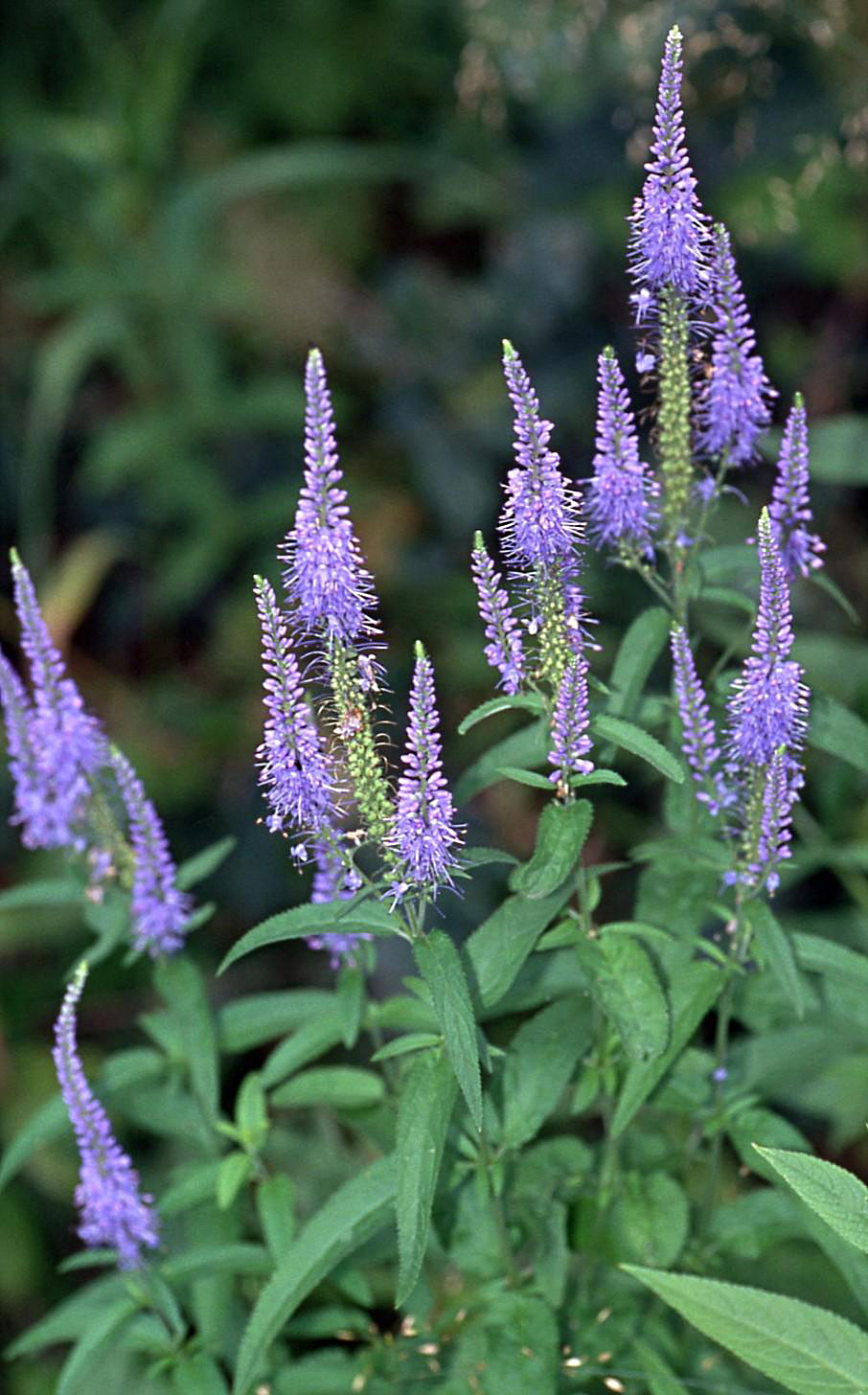
Photo: Christian Fischer, CC BY-SA 3.0 · source

Perennial · Plantaginaceae
Garden speedwell
Veronica longifolia
In other languages: Lange ereprijs (Nederlands) · Véronique à longues feuilles (Français)
The garden speedwell grows wild in damp meadows and along riverbanks in Europe and northern Asia. It is a sturdy perennial with upright stems and lance-shaped, sharply toothed leaves. From July to September, long, dense spikes full of lilac-blue flowers form at the tips, opening from the bottom upwards. Pink and white garden forms also exist. It is a popular cut flower and a reliable, low-maintenance plant for the moist border or the edge of a pond. Bees and butterflies are happy visitors.
Light
Sun or partial shade
preferably some sun
Moisture
Normal to wet
must not dry out
Legal basis
Loam, clay or peat
any pH
Hardiness
Fully hardy
down to -30 °C
Size
0.9 m
tall, 0.4 m wide
Flowering
July–September
| Pruning months | March |
|---|---|
| Height | 0.9 m |
| Native to Belgium | No, planted |
| Good for bees, butterflies and birds | Yes, for bees and butterflies |
| Poisonous to people and pets | Not known to be poisonous |
| Flowering | July–September |
Identify
Garden speedwell: how do you recognise it?
- Habit
- Sturdy perennial 70–100 cm tall and 40 cm wide, with upright, sparsely branched stems from a dense clump.
- Leaves
- Lance-shaped, 5–10 cm, sharply toothed, dark green; opposite or sometimes in whorls of three.
- Flowers
- Small flowers in dense spikes 20–30 cm long, from July to September.
- Colour
- Lilac-blue; pink and white cultivars also exist.
- Roots
- A fibrous root system with short runners, easy to divide.
Flowering: July–September · Plants: March–May and September–October · Pruning: March
In your garden
Why grow it?
- Flowers from July to September with long blue spikes, when many other perennials have finished.
- Attracts bees and butterflies, even in late summer.
- A lovely, long-lasting cut flower for a bouquet.
- Good for moist soil and for the edge of a pond.
- Low maintenance: one pruning a year and the occasional division.
Garden speedwell: where does it grow best?
- Sun to light partial shade: it flowers best in full sun.
- Humus-rich, moist to wet soil: loam, clay or peat; acid to chalky.
- Normal to moist soil is also fine; it must not stay dry for long.
- Allow 40 cm per plant; in groups of three or five it looks its best.
- Light
- Sun and partial shade
- Soil type
- Loam, clay or peat
- Acidity
- Not fussy
- Moisture
- Normal or wet
- Size
- 0.9 m tall, 0.4 m wide
- Hardiness
- Hardy (to -30 °C)
Goes well with
- Garden phlox: Pink and white panicles in the same sun and moist soil.
- Daylily: Trumpet flowers in warm shades next to the blue spikes.
- Helenium: Warm yellow and orange tones against the cool blue.
- Meadowsweet: Frothy white plumes in the same moist border.
Maintenance
Garden speedwell: when and how to plant it?
Plant in March–May and September–October.
- Plant in March–May or in September–October, when the soil is neither frozen nor waterlogged.
- Dig a hole twice as wide as the root ball and mix in compost.
- Set the plant at the same depth as in its pot and firm the soil well.
- Space plants 40 cm apart.
- Water in generously straight away and spread a layer of leaf-compost mulch around the base.
Care
- Water
- Keep the soil moist; in dry summers water generously every week, otherwise the foliage droops and flowering disappoints.
- Feeding
- A spade of compost or organic fertiliser in spring is enough.
- Mulching
- A layer of leaf compost in spring keeps the soil cool and moist.
- Support
- On rich or windy ground a plant support can keep the tall spikes upright.
- Dividing
- Divide the clump every 3–4 years in spring to keep it vigorous.
Tip: Divide the clump every few years and replant the young, rooted pieces: this keeps it vigorous. Cut the main spikes for a bouquet; the side shoots then flower on.
Garden speedwell: when to prune it?
Pruning months: March.
When: In March, before the new shoots start to grow; in between, you can cut the main spikes back after flowering.
How:
- Cut last year’s dried stems down to just above the ground.
- During flowering, cut the main spikes for a bouquet: the side shoots then often keep flowering.
- In autumn, leave a few stems standing as winter decoration and shelter for insects and birds.
Propagation
- Division
- In spring or in September: cut the clump with a spade into pieces with roots and shoots, and replant straight away.
- Cuttings
- In April–May take cuttings of 8–10 cm from young shoots in moist cutting compost; they root within a few weeks.
- Seed
- Sow seed of the species outdoors in spring; cultivars do not come true from seed.
Garden speedwell: how does it get through the winter?
Hardy to −30 °C.
- Fully hardy, to about −30 °C: no protection is needed in Flanders.
- Leave the faded stems standing until March; they protect the crown and shelter insects.
- In a pot: put it in a sheltered place and never let the pot dry out or stand in water.
Diseases and pests
- Powdery mildew: White powder on the leaves, especially at the end of summer in dry weather. Water, leave space and cut off affected leaves.
- Slugs: Nibbled young shoots in spring. Collect them in the evening and scatter coarse bark around the clump.
- Flopping spikes: On rich or windy ground the tall spikes sag. A plant support or less feeding helps.
- Drought: Drooping foliage and short flowering in dry weather. Mulch and water generously.
Through the year
- March: Cut back to just above the ground. Add compost. Plant or divide.
- April: Plant. Apply mulch. Take cuttings.
- May: Plant. Fit supports. Take cuttings.
- June: Water in dry weather. Buds appear.
- July: Flowering begins. Cut for a bouquet.
- August: Full flower. Water in dry weather.
- September: Late flowers. Plant or divide.
- October: Plant. Leave the stems standing.
- November: Rest.
- December: Rest.
Use
Good for wildlife
- Bees
- Nectar and pollen for honeybees and wild bees.
- Butterflies
- Nectar for butterflies.
You and this species
Did you know?
- In the wild, the garden speedwell grows in damp meadows and along riverbanks in Europe and northern Asia.
- Many garden cultivars are crosses between this plant and the spiked speedwell (Veronica spicata).
- DNA studies moved the genus Veronica from the figwort family to the plantain family.