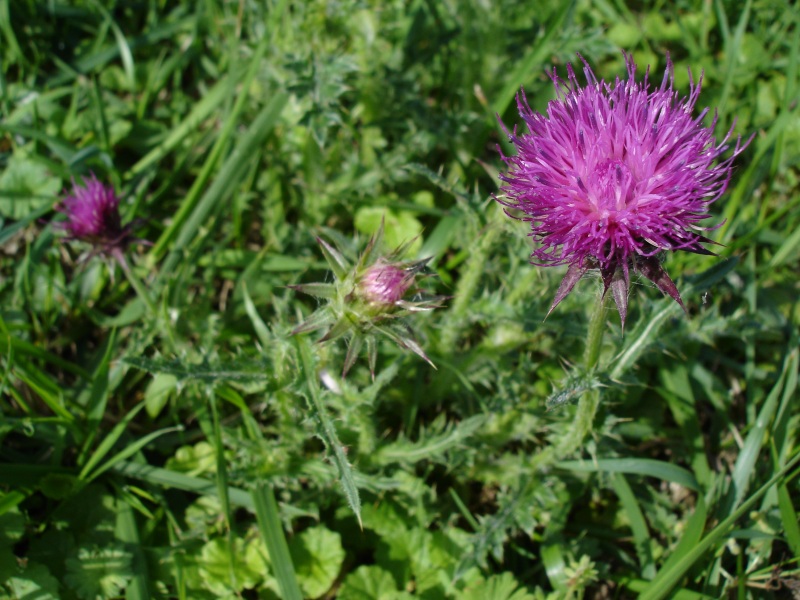
Photo: Bouba at fr.wikipedia, CC BY-SA 3.0 · source

Herbaceous plant · Daisy family (Asteraceae)
Musk thistle
Carduus nutans
In other languages: Knikkende distel (Nederlands) · Chardon penché (Français)
Grows wild in Belgium.
Musk thistle is a native, biennial thistle with large, reddish-purple flower heads that clearly nod, as if looking at the ground. It grows in sunny, dry and open places: verges, dykes, embankments, waste and disturbed ground, dunes and grazed grassland. In Belgium it is not common; you mainly see it on chalky soil and in the coastal dunes. You recognise it by the large, solitary heads, 3–6 cm across, surrounded by broad, bent-back, spiny bracts, on a long, almost bare stalk. Bumblebees, bees and butterflies visit the flowers, and goldfinches love the seed.
Light
Full sun
warm and bright
Moisture
Dry to normal
no wet feet
Hardiness
Fully hardy
down to -25 °C
Size
1 m
tall, 0.5 m wide
Flowering
June–September
| Pruning months | August–October |
|---|---|
| Height | 1 m |
| Native to Belgium | Yes |
| Flowering | June–September |
Identify
How to recognise it
- Habit
- Biennial: in the first year a flat leaf rosette, in the second an upright, little-branched stem of 30–100 cm, sometimes taller. Underground a thick taproot.
- Leaf
- Deeply lobed, with strong, yellowish spines along the edge; dark to greyish green. The leaf base runs down the stem as a spiny wing.
- Stem
- With spiny wings, but the top part below the flower head is wingless, woolly and curves over, so the flower nods.
- Flower
- In June–September usually one large, nodding head of 3–6 cm per branch, reddish purple, rarely white. Around the head are broad, lance-shaped, spine-tipped bracts, often purplish and bent back.
- Fruit
- A small nut with a white pappus of simple, unfeathered hairs that blows away on the wind.
- Confused with
- Welted thistle has much smaller heads in clusters, which do not nod. Spear thistle and the other Cirsium thistles have feathery pappus hairs; spear thistle has upright heads and leaves ending in a long, spear-like spine.
Flowering: June–September · Pruning: August–October
In your garden
Why grow it?
- Large, nectar-rich flower heads that attract bumblebees, wild bees, hoverflies and butterflies such as the painted lady and the peacock.
- Painted lady caterpillars feed on thistle leaves, including this species.
- In late summer goldfinches and other seed-eaters pick the ripe heads apart.
- A striking, sculptural plant for a dry, sunny wildlife garden, with a faint musky scent.
- In winter the dry stems and heads give shelter to small insects.
Musk thistle: where does it grow best?
- In the wild: dry verges, dykes, embankments, dunes, waste and disturbed ground, quarries and grazed grassland.
- Full sun; in shade it grows weak and flowers poorly.
- Dry, free-draining soil, preferably chalky or sandy; moderately rich soil is no problem.
- In the garden: a sunny, wild corner, a dry bank or the back of a border, where you do not have to brush past it.
Goes well with
- Viper’s bugloss: Blue flowers for bees in the same dry, sunny spot.
- Great mullein: Tall yellow spires on the same dry, poor soil.
- Wild marjoram: A low, fragrant butterfly magnet at the foot of the thistle.
- Wild mignonette: Pale yellow spikes for wild bees on dry, chalky soil.
- Bird’s-foot trefoil: Yellow flowers and a food plant for blue butterflies, low between the rosettes.
Maintenance
Musk thistle: when and how to plant it?
- Buy seed from a nursery specialising in native plants. Never dig up plants from the wild.
- Sow in September–October or in March–April where it is to flower, about 1 cm deep, on an open, bare patch.
- Thin the seedlings to 40–50 cm apart, as the rosettes grow wide.
- Move it as little as possible: the taproot dislikes being disturbed. Plant out pot-grown plants while young, in autumn or spring.
- Water only until the seedlings are established.
- Sow again the second year, so there are flowering plants every year.
Care
- Water
- Not needed once established: it copes extremely well with drought.
- Feeding
- Not needed; poor, open soil is ideal.
- Limiting self-seeding
- If you do not want too many seedlings, cut off some of the spent heads before they turn fluffy. Leave a few for the goldfinches.
- Open ground
- Seedlings germinate best on bare patches. In dense turf it disappears after a few years.
- Neighbours
- If there are fields or pastures nearby, cut off most heads before the seed is ripe.
- Gloves
- Wear sturdy gloves and long sleeves for any work on the plant.
Tip: Let a few heads ripen every year and watch closely in August: goldfinches come to pick them apart. Cut off the rest if you do not want thistles everywhere.
Pruning and mowing
Pruning months: August–October.
When: After flowering, in August–October; the plant dies by itself after setting seed.
How:
- Let some of the heads ripen: goldfinches eat the seed.
- Cut off the other spent heads before they turn fluffy if you want fewer seedlings.
- Remove the dead plant in autumn, or leave a few stems until spring for overwintering insects.
- You can pull out the taproot of the dead plant or leave it to rot in place.
Caution: Always wear sturdy gloves: the spines are sharp and break off easily in the skin.
Propagation
- Seed
- Sow where it is to flower in autumn or early spring. The seed germinates readily on bare soil; the plant flowers the following year.
- Self-seeding
- Let a few heads ripen: in an open, sunny garden it self-seeds.
Musk thistle: how does it get through the winter?
Hardy to −25 °C.
- The first-year rosette stays green and flat against the ground all winter.
- Fully hardy in our climate.
- The dead stems with empty heads stay standing well into winter; birds search them for seed and insects shelter in the dry parts.
Diseases and pests
- Too many seedlings: Cut off most heads before the seed is ripe and dig out unwanted rosettes in spring with a weeding tool.
- Spines: Do not plant it along paths, next to a patio or near a play area.
- Aphids: Sometimes on stems and buds. Ladybirds and parasitic wasps usually keep them in check.
- Gone after a year: That is normal: it is a biennial. Let it seed and keep some bare ground.
Through the year
- March: Sow where it is to flower. Rosettes start growing again.
- April: Dig out unwanted rosettes.
- May: The flowering stem shoots up.
- June: Flowering begins. Bumblebees and butterflies on the flowers.
- July: Full flower. Cut off spent heads if you want fewer seedlings.
- August: Seed ripens; goldfinches pick the heads apart.
- September: Last flowers. Sow for next year.
- October: Clear dead plants or leave a few stems for insects.
- December: Rosettes dormant; dry stems still standing.
You and this species
Did you know?
- The scientific name of the goldfinch, Carduelis carduelis, comes from ‘carduus’, the Latin word for thistle.
- In North America, Australia and New Zealand, musk thistle was introduced and is regarded as a troublesome weed of pastures.
- The English name ‘musk thistle’ refers to the faint musky scent of the flowers.