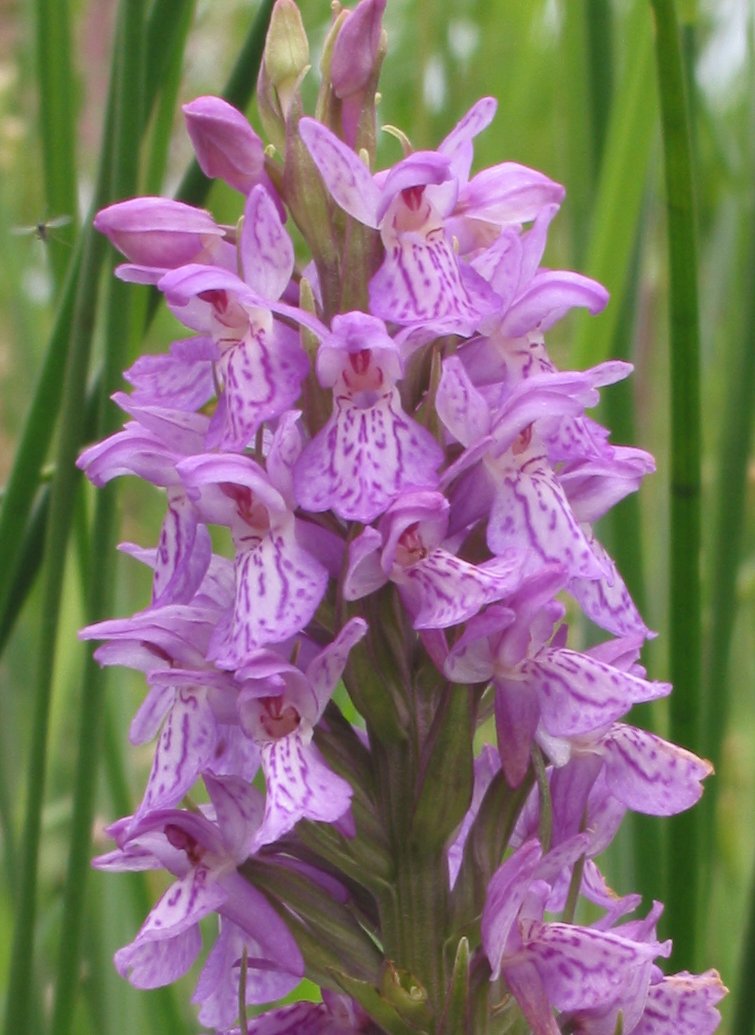
Photo: Rasbak at Dutch Wikipedia (Original text: nl::nl:Gebruiker:Rasbak), CC BY-SA 3.0 · source

Herbaceous plant · Orchid family (Orchidaceae)
Southern marsh-orchid
Dactylorhiza praetermissa
In other languages: Rietorchis (Nederlands) · Orchis négligé (Français)
Grows wild in Belgium.
The southern marsh-orchid is a sturdy native orchid of wet grassland, dune slacks, marsh and ditch edges and bare, wet ground such as pumped-up sand in port areas. In Belgium it grows mainly in the north of the country, in the dunes, the polders and the river valleys; it is fairly rare there, but can be plentiful in places. You recognise it by the dense, cylindrical spike of purplish-pink to purple flowers in June–July, the thick, hollow stem and the broad, dull grey-green leaves, which are usually unspotted. It is a true pioneer: on new, wet and poor ground it can appear in hundreds within a few years. Like all wild orchids, it is protected.
Caution: Protected species: like all wild orchids, the southern marsh-orchid must not be picked or dug up. Only buy nursery-raised plants from a specialist grower. Wild plants that are dug up almost always die anyway.
Light
Sun or partial shade
preferably some sun
Moisture
Normal to wet
must not dry out
Hardiness
Fully hardy
down to -25 °C
Size
0.5 m
tall, 0.2 m wide
Flowering
June–July
| Pruning months | September |
|---|---|
| Height | 0.5 m |
| Native to Belgium | Yes |
| Flowering | June–July |
Identify
How to recognise it
- Habit
- Perennial orchid, 20–60 cm tall, sometimes taller, with a thick, hollow stem. Underground there are hand-shaped, divided tubers.
- Leaf
- Broad, lance-shaped leaves, dull grey-green and usually unspotted; the tip is not hooded. There is also a form with small, ring-shaped spots on the leaves.
- Flower
- In June–July a dense, cylindrical spike of many purplish-pink to purple flowers. The lip is broad, fairly flat and shallowly three-lobed, with fine dark dots and short dashes in the centre. The bracts are long and often tinged purple; the spur is thick and cone-shaped.
- Fruit
- Elongated capsules with thousands of dust-like seeds that the wind can carry a long way.
- Roots
- Two hand-shaped, divided tubers and a few thin roots, which live together with fungi in the soil.
- Confused with
- Common spotted-orchid has a solid stem, spotted leaves and a pale, deeply three-lobed lip. Early marsh-orchid has flesh-pink flowers, a narrow lip with folded-back sides and upright, yellowish-green leaves with a hooded tip. Broad-leaved marsh-orchid flowers earlier, in May–June, and usually has spotted leaves. Hybrids, especially with common spotted-orchid, are frequent.
Flowering: June–July · Pruning: September
In your garden
Why grow it?
- A robust orchid with dense, purple spikes in June–July: an eye-catcher in a wet hay meadow or beside a pond.
- A pioneer that quickly colonises new, wet and poor ground: it shows that nature restoration works.
- Bumblebees and bees visit the flowers, even though they get no nectar: the orchid attracts them with colour and shape.
- Part of species-rich wet grassland, together with ragged-robin, greater bird’s-foot-trefoil and marsh marigold.
- One of the easier native orchids for a wet wildlife garden, if you buy nursery-raised plants and keep the soil poor.
Southern marsh-orchid: where does it grow best?
- In the wild: wet, poor to moderately rich grassland, dune slacks, marsh and ditch edges, mown reedbeds and bare, wet ground such as pumped-up sand, quarries and derelict industrial land.
- Sun to light partial shade.
- Damp to wet soil, chalky to slightly acid: sand, loam, clay or peat. It tolerates slightly richer soil than many other orchids, but no fertiliser.
- In the garden: on the sunny bank of a pond, in a strip of wet meadow or in a bog bed that does not dry out in summer.
Goes well with
- Ragged-robin: Pink, ragged flowers in May–June on the same wet soil.
- Greater bird’s-foot-trefoil: Small yellow flowers in summer, popular with bumblebees and bees.
- Greater yellow-rattle: A semi-parasite on grasses: it holds back the grass and keeps the meadow open.
- Purple loosestrife: Purple spikes in July–August along the wet edge; it flowers after the orchid.
- Marsh marigold: Golden-yellow flowers in early spring, long before the orchid blooms.
Maintenance
Southern marsh-orchid: when and how to plant it?
- Only buy southern marsh-orchids from a specialist nursery that raises them from seed; never take them from the wild.
- Choose a sunny spot that stays moist all year, such as the wet bank of a pond or a damp meadow. Do not add fertiliser or compost.
- Plant in September–October or in March, at the same depth as in the pot, keeping the root ball intact: it holds the soil fungi.
- Plant a small group 20–25 cm apart among low-growing plants, not in dense grass or among rampant marsh plants such as common reed.
- Water with rainwater if the soil threatens to dry out in spring.
- Never dig up plants from the wild: wild orchids are protected and plants that are dug up almost always die.
Care
- Water
- Keep the soil moist, especially in April–June; in dry weather, water with rainwater.
- Feeding
- Never: fertiliser makes grasses and tall herbs too vigorous, and they crowd out the orchid.
- Mowing
- Mow once a year in September, after seed set, and remove the cuttings.
- Competition
- Keep common reed, soft rush, brambles and young willow and alder in check, so light reaches the plants.
- Patience
- Plants do not flower every year. Seedlings need several years before they flower.
Tip: Give the southern marsh-orchid a spot on the sunny, shallow bank of a pond, where the soil always stays wet but the plant does not stand in water, and mow every September, removing the cuttings: that way you mimic the hay meadow it loves.
Pruning and mowing
Pruning months: September.
When: No pruning. Mow in September, after seed set.
How:
- Leave the spent spikes until the capsules are brown and open.
- Then mow short and remove the cuttings, to keep the soil poor.
- Mark the plants with a stick so you do not mow them by mistake.
- Pull up young willow, alder and brambles before they start to cast shade.
Caution: Do not mow over the plants in May–August: you would lose that year’s flowers and seed, and the plant could not properly build up its tuber for the following year.
Propagation
- Seed
- In the wild it spreads by dust-like seed that the wind carries a long way and that only germinates with the right soil fungus. That is why it sometimes appears spontaneously in newly created wet habitats. Let the capsules ripen; in a good spot new plants appear after a few years.
- Laboratory
- Nurseries sow orchids in a laboratory on a nutrient medium. This does not work at home, and division is not recommended.
Southern marsh-orchid: how does it get through the winter?
Hardy to −25 °C.
- After seed set the plant dies back above ground and overwinters as a tuber.
- Hardy; it copes well with water standing on the ground in winter, as in dune slacks.
- In April the new leaves appear.
Diseases and pests
- Encroachment: Common reed, soft rush, brambles and willow overgrow the spot. Mow every year, remove the cuttings and clear woody seedlings.
- Drying out: When the water table is low or the spring is dry, it declines. Keep the spot wet and water with rainwater.
- Enrichment: Fertiliser, compost or nutrient-rich water make grasses and tall herbs too vigorous. Always remove the cuttings.
- Slugs: They eat young shoots and buds. Check in the evening in spring and remove them.
- After the pioneer stage: On new, bare ground it sometimes appears in huge numbers, but it disappears again as the vegetation closes in. Mowing every year and removing the cuttings keeps the spot open for longer.
Through the year
- March: Plant nursery-raised plants. Check that the soil is moist.
- April: The first leaves appear. Watch out for slugs.
- May: The flower spike grows. In dry weather, water with rainwater.
- June: Flowering. Look and photograph, do not pick.
- July: Last flowers; the capsules ripen.
- August: The wind disperses the seed.
- September: Mow and remove the cuttings. Plant nursery-raised plants.
- October: Remove young willow, alder and brambles.
You and this species
Did you know?
- Praetermissa means ‘overlooked’: the southern marsh-orchid was only described as a separate species in 1914 and until then had been confused with related orchids.
- Because its dust-like seed travels far on the wind, the southern marsh-orchid sometimes appears in large numbers on freshly pumped-up sand or wet industrial land, far from other sites.
- It hybridises easily with the common spotted-orchid; the hybrid is often more vigorous than both parents.