Photo: Jeffdelonge at French Wikipedia, CC BY-SA 3.0 · source

Herbaceous plant · Carrot family (Apiaceae)
Sea-holly
Eryngium maritimum
In other languages: Blauwe zeedistel (Nederlands) · Panicaut maritime (Français)
Grows wild in Belgium.
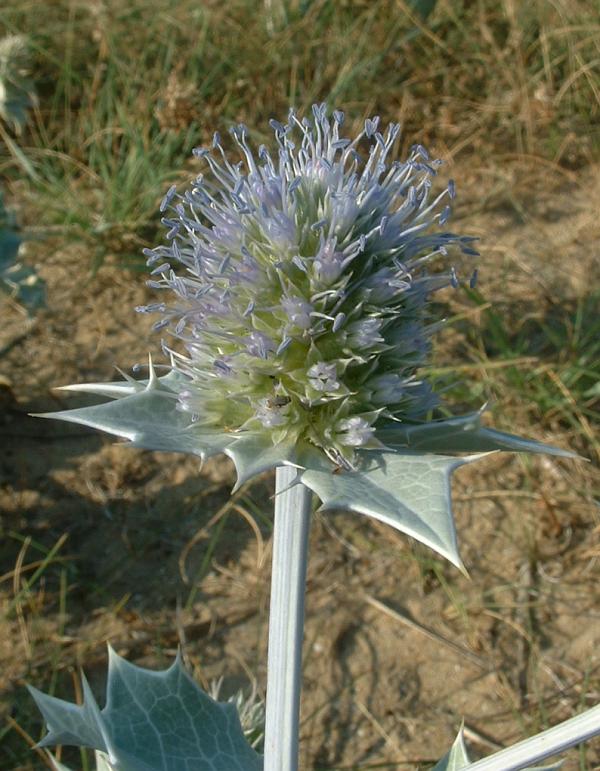
Sea-holly is a native perennial of the coast and, despite its looks, not a true thistle but a relative of carrot and parsley. It grows on the foredunes, in young dunes and on the upper beach where sand builds up, and is rare in Belgium. You can recognise it at once by its stiff, blue-grey, spiny leaves with a white waxy bloom and its round, steel-blue flower heads from July to September. Thanks to its long taproot it copes with dry, salty sand and even with being buried by blowing sand. It is a rich nectar source for bees, bumblebees and butterflies, and in the garden a striking plant for a sunny sand or gravel bed.
Caution: A rare species of the coastal dunes: never pick or dig it up in the wild and keep to the paths in the dunes. Buy plants or seed from a nursery. The leaves are very spiny: wear gloves and do not plant it along a path where children play.
Light
Full sun
warm and bright
Moisture
Dry
tolerates drought
Hardiness
Fully hardy
down to -20 °C
Size
0.4 m
tall, 0.4 m wide
Flowering
July–September
| Pruning months | March |
|---|---|
| Height | 0.4 m |
| Native to Belgium | Yes |
| Flowering | July–September |
Identify
How to recognise it
- Habit
- Perennial, widely branched plant, 20–50 cm tall and about as wide, entirely blue-grey and stiff.
- Leaf
- Thick, leathery and covered in a white waxy bloom; rounded to palmately lobed, 5–12 cm, with a wavy, pale margin full of sharp spines.
- Flower
- From July to September round heads 1.5–3 cm across of small steel-blue flowers, surrounded by broad, spiny, blue-grey bracts.
- Fruit/Seed
- Small, scaly paired fruits that ripen between the dry bracts.
- Roots
- A long, fleshy taproot that can go down more than a metre; that is how the plant finds water in dry dune sand.
- Look-alikes
- True thistles, such as spear thistle, belong to the daisy family, with purple flower heads and green leaves. Field eryngo grows inland, is greener and has whitish-green flowers. Garden species such as flat sea-holly (Eryngium planum) have greener, hardly spiny basal leaves.
Flowering: July–September · Pruning: March
In your garden
Why grow it?
- Blue-grey leaves and steel-blue flowers: one of the most beautiful and recognisable plants of our coast.
- A rich source of nectar in July–September for honeybees, wild bees, bumblebees, hoverflies and butterflies.
- Remarkably tough: it tolerates drought, salt, sea wind and full sun, where many other plants scorch.
- The dry flower stems stay attractive for a long time and are good for dried arrangements.
- A piece of dune nature in your garden, using nursery plants instead of plants from the wild.
Sea-holly: where does it grow best?
- In the wild: foredunes, young dunes and the upper beach with wind-blown sand, always in full sun.
- It tolerates salt, sea wind, drought and burial by sand, but not shade or wet soil.
- In the garden: full sun and very free-draining, poor soil: sand, gravel or a very sandy mix, chalky to neutral.
- Ideal in a gravel garden, a sunny rock garden, a coastal garden or a large, deep pot of sand and gravel.
Goes well with
- Sea kale: Another coastal plant with blue-grey leaves and white flowers in May–June.
- Marram grass: The dune grass par excellence, for a natural dune look.
- Burnet rose: A low native dune shrub with creamy white flowers and black hips.
- Biting stonecrop: A low, yellow-flowered succulent that grows in the same dry sand.
- Viper’s-bugloss: Blue flowers and lots of bees on the same dry, sunny soil.
Maintenance
Sea-holly: when and how to plant it?
- Buy plants or seed from a nursery specialising in native plants. Never dig up plants in the dunes: they are rare, and with their long taproot they do not survive transplanting anyway.
- Sow fresh seed in autumn in deep pots of sandy compost and leave them outside: the seed needs a cold period and germinates in spring.
- Plant young plants in April–May with the root ball intact, so the taproot is not damaged.
- Allow 40–50 cm between plants and mix plenty of sand or fine gravel into heavy soil.
- Water during dry spells for the first few weeks; after that, not at all.
- Choose the final spot straight away: older plants do not like being moved.
Care
- Watering
- Only after planting. An established plant draws water from deep down and tolerates long droughts.
- Feeding
- Not needed and even harmful: on rich soil it becomes floppy and short-lived.
- Drainage
- Wet feet in winter are its worst enemy. A layer of gravel around the base keeps the crown dry.
- Competition
- Keep the surroundings open and low: tall grass and rank vegetation crowd it out.
- Gloves
- Wear sturdy gloves when weeding and tidying: the leaf edges are very prickly.
Tip: Plant it on a small mound of sand or among gravel: the drier and poorer the soil, the more compact and sturdy the plant stays.
Pruning and mowing
Pruning months: March.
When: Leave the stems all winter and cut them back in March.
How:
- Leave the spent flower heads in autumn: they look good and the seed can ripen.
- In March, cut the dry stems off at the base before the new leaves emerge.
- To dry the flowers, cut stems in full flower and hang them upside down in a dry, airy place.
Caution: Wear sturdy gloves: the spines are sharp, even when the plant is dry.
Propagation
- Seed
- Sow fresh seed outside in deep pots in autumn; it germinates after winter. Plant seedlings out in their first year, before the taproot gets too long.
- Root cuttings
- In winter, insert 5–8 cm pieces of taproot upright in a pot of sandy compost. Only take them from plants in your own garden.
Sea-holly: how does it get through the winter?
Hardy to −20 °C.
- The above-ground parts die back in autumn; the dry, silvery stems often stand into winter.
- Hardy to about −20 °C, provided the soil is free-draining.
- In wet, heavy soil the taproot rots in winter.
Diseases and pests
- Root rot: On wet or heavy soil. Plant in a sandy, free-draining spot or on a raised bed.
- Slugs: They sometimes eat young leaves in spring. Older plants with tough, spiny leaves are hardly affected.
- Short-lived: On soil that is too rich it grows fast but disappears after a few years. No fertiliser and plenty of sand.
- Transplanting fails: Because of the long taproot, a moved plant rarely establishes. Choose the right spot from the start.
Through the year
- March: Cut back the dry stems.
- April: Plant. Seedlings from autumn sowing appear.
- May: New blue-grey leaves. Plant out young plants.
- July: Flowering begins. Lots of bees and butterflies.
- August: Full flower. Cut stems for drying.
- September: Last flowers, seed ripening.
- October: Sow fresh seed in deep pots and leave them outside.
- November: Leave the dry stems as winter decoration.
You and this species
Did you know?
- Despite its looks it is not a thistle but a member of the carrot family, related to carrot, parsley and fennel; its ‘umbels’ are contracted into small balls.
- In England the roots were once candied and sold as sweets called ‘eringoes’; Shakespeare mentions them in The Merry Wives of Windsor.
- The thick leaf skin and white waxy bloom protect the plant from drying out in sun, wind and salt.