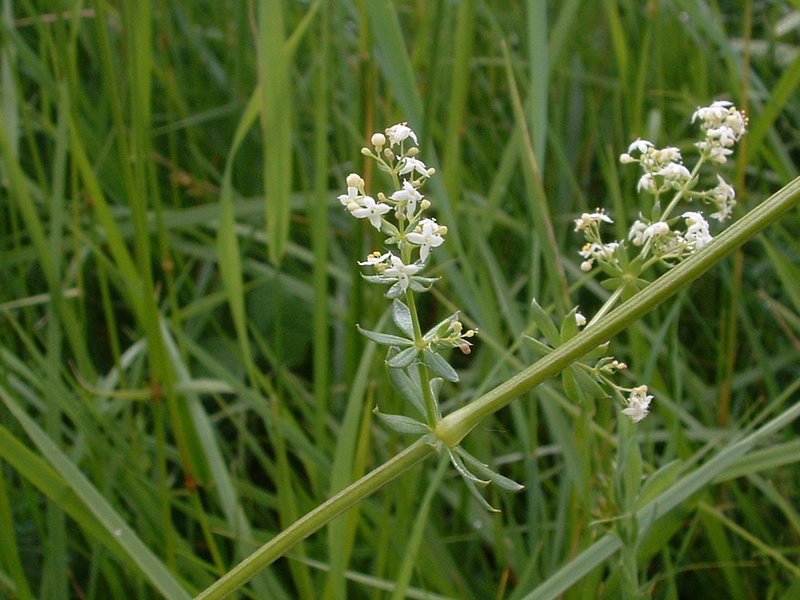
Photo: Wikimedia Commons, CC BY-SA 3.0 · source

Herbaceous plant · Bedstraw family (Rubiaceae)
Hedge bedstraw
Galium mollugo
In other languages: Glad walstro (Nederlands) · Gaillet mollugine (Français)
Grows wild in Belgium.
Hedge bedstraw is a perennial of the bedstraw family that covers verges, dykes and grasslands in summer with a cloud of tiny white flowers. It is common throughout Belgium, especially in hay meadows, rough verges, along hedges and woodland edges, on moderately rich, often slightly chalky soil. You can recognise it by its square, smooth stems with whorls of six to eight narrow leaves and by its large, loose sprays of white, four-petalled flowers with a faint honey scent. The stems often sprawl or lean on other plants. It matters for moths: the caterpillars of the hummingbird hawk-moth and the elephant hawk-moth feed on bedstraws.
Light
Sun or partial shade
preferably some sun
Moisture
Dry to normal
no wet feet
Hardiness
Fully hardy
down to -30 °C
Size
0.8 m
tall, 0.6 m wide
Flowering
June–September
| Pruning months | March and September |
|---|---|
| Height | 0.8 m |
| Native to Belgium | Yes |
| Flowering | June–September |
Identify
How to recognise it
- Habit
- Perennial of 30–100 cm, with sprawling to ascending stems or stems leaning on other plants; forms loose mats.
- Leaf
- In whorls of 6–8, narrowly lance-shaped, 1–2.5 cm, with a single vein and a tiny bristle tip; the edge feels slightly rough.
- Flower
- Large, loose sprays of white flowers of 2–3 mm with four pointed lobes, from June to September; faintly honey-scented.
- Fruit/Seed
- Small, hairless paired fruits of 1–1.5 mm, finely wrinkled and black when ripe.
- Stem
- Square, smooth and hairless or slightly hairy, a little swollen at the nodes; not sticky.
- Look-alikes
- Cleavers clings to your clothes with hooked bristles on its stems, leaves and fruits and has only a few flowers. Lady’s bedstraw has yellow flowers and very narrow, rolled leaves. Marsh bedstraw grows on wet ground and has blunt leaves in whorls of 4–6.
Flowering: June–September · Pruning: March and September
In your garden
Why grow it?
- Food plant for hawk-moth caterpillars, such as the hummingbird hawk-moth and the elephant hawk-moth.
- Its honey-scented flowers attract hoverflies, small flies, little beetles and solitary bees.
- Flowers for a long time, from June to September, filling a flower meadow or wild border with an airy white haze.
- Tough and undemanding: it grows on dry to moist soil, in sun or partial shade.
- A typical plant of flowery verges and dykes, where it goes well with oxeye daisy, knapweed and wild carrot.
Hedge bedstraw: where does it grow best?
- In the wild in hay meadows, rough verges, on dykes, along hedges, woodland edges and railway banks.
- Sun to partial shade; it flowers most freely in full sun.
- Dry to moist, moderately rich soil: loam, clay or sand, ideally slightly chalky.
- In the garden it suits a flower meadow, a wild border or the foot of a hedge, where it can scramble up between other plants.
Goes well with
- Oxeye daisy: Large white flowers in the same flower meadow, for bees and hoverflies.
- Common knapweed: Purple heads for butterflies and bumblebees, on the same poor verge soil.
- Wild marjoram: A fragrant mint-family plant for dry, chalky soil, loved by butterflies.
- Wild carrot: White umbels that complete the airy look of a flowery verge.
Maintenance
Hedge bedstraw: when and how to plant it?
- Buy plants from a native plant nursery or sow your own; never dig up plants from the wild.
- Sow in September–November outdoors or in a tray left outside: the seed needs a cold spell and germinates in spring.
- Scatter the seed on the surface and press it in; cover with at most a thin layer of sand.
- Plant pot-grown plants in March–April or October, 40–50 cm apart or scattered through the grass of a flower meadow.
- Water during dry spells for the first few weeks; after that it is no longer needed.
Care
- Watering
- Only in the first year during drought. After that it copes, even in dry summers.
- Feeding
- Not needed: on poor soil it stays more compact and the other flowers hold their own better.
- Mowing
- In a flower meadow, mow once or twice a year: in September and possibly at the end of June. Remove the cuttings.
- Spreading
- It spreads by creeping stems and can smother its neighbours. Pull or cut back over-long stems in July.
- Letting it seed
- In a meadow, let the sprays ripen before the September cut so that it can self-seed a little.
Tip: Grow hedge bedstraw between sturdy plants such as knapweed and oxeye daisy: it leans on them, does not flop and fills the gaps with a white cloud.
Pruning and mowing
Pruning months: March and September.
When: Mow or cut back in September after flowering, or leave the stems standing and clear them in March.
How:
- In a meadow: mow in September at 5–10 cm height and remove the cuttings.
- In a border: cut the stems back after flowering if they flop over other plants.
- Leave some stems standing over winter as shelter for insects and cut them down to just above the ground in March.
- Do not cut too low around new shoots: the plant regrows from the base in spring.
Propagation
- Seed
- Sow outdoors in autumn; the seed germinates after winter, in March–April.
- Division
- In March or October, split a clump and replant the pieces with roots and shoots straight away.
- Layering
- Creeping stems often root at the nodes: cut off a rooted stem in spring and plant it elsewhere.
Hedge bedstraw: how does it get through the winter?
Hardy to −30 °C.
- The stems largely die back in winter; small green shoots remain at the base.
- Fully hardy, to −30 °C and below.
- Leave some of the dry stems: small insects overwinter in them and between the mats.
Diseases and pests
- Spreading: In a rich border it can smother its neighbours. Pull out creeping stems, cut back in July and do not feed.
- Flopping: The long stems fall over after rain. Let it grow between sturdier plants it can lean on.
- Galls: Small swellings or rolled leaf tips are caused by gall midges and gall mites. Harmless, leave them.
- Mistaken for cleavers: Young plants look like cleavers. Feel them: cleavers sticks, hedge bedstraw does not.
Through the year
- March: Cut back old stems. Plant and divide.
- April: New shoots. Planting is still possible.
- May: Growth. Hawk-moth caterpillars may already be on the plant.
- June: Start of flowering. Possibly a first cut at the end of June in a rich meadow.
- July: Full flower. Cut back over-long stems in the border.
- August: Flowering; the first fruits ripen.
- September: Last flowers. Mow the meadow and remove the cuttings. Sow.
- October: Plant, divide and sow.
- November: Leave some stems standing for insects.
You and this species
Did you know?
- Dried bedstraws were once used to stuff straw mattresses, hence the English name ‘bedstraw’.
- As in madder, a relative, the roots of bedstraws contain a red dye that was once used for dyeing.
- Hedge bedstraw sometimes crosses with lady’s bedstraw. The hybrids have pale yellow flowers, between white and yellow.