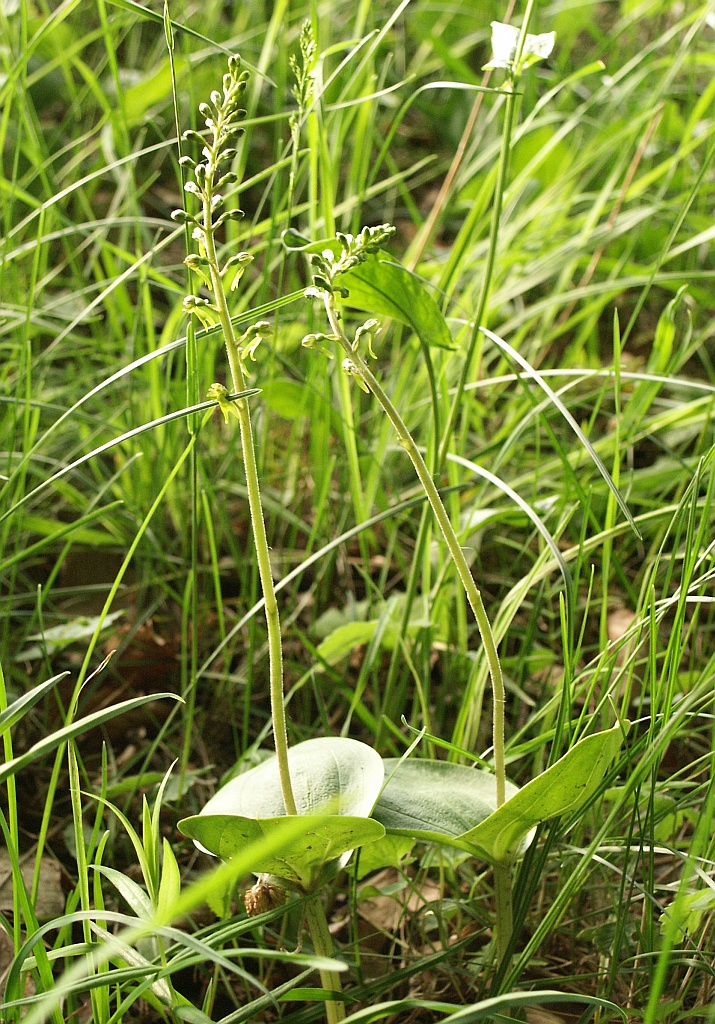
Photo: Wikimedia Commons, CC BY-SA 3.0 · source

Herbaceous plant · Orchid family (Orchidaceae)
Common twayblade
Neottia ovata
In other languages: Grote keverorchis (Nederlands) · Listère ovale (Français)
Grows wild in Belgium.
Common twayblade is one of the most widespread wild orchids in Belgium, but because of its green flowers also one of the least conspicuous. It grows in broadleaved woods, scrub, wooded banks, verges, chalk grassland and dune slacks, on chalky to neutral, moisture-retentive loam or clay. You recognise it by two large, broad, oval leaves that sit almost opposite each other low on the stem, and by a long, narrow spike with dozens of small yellowish-green flowers. Each flower has a long, hanging lip that is split in two at the tip, making it look like a little man. It flowers from May to July, is pollinated by ichneumon wasps, sawflies and small beetles, and like all wild orchids it is protected in Belgium.
Caution: All wild orchids are protected by law in Belgium. Do not pick the flowers and never dig up plants in the wild; only buy plants raised from seed in a nursery.
Light
Sun to shade
not fussy
Moisture
Normal
no wet feet
Hardiness
Fully hardy
down to -25 °C
Size
0.4 m
tall, 0.2 m wide
Flowering
May–July
| Pruning months | August |
|---|---|
| Height | 0.4 m |
| Native to Belgium | Yes |
| Flowering | May–July |
Identify
How to recognise it
- Growth habit
- Perennial orchid of 20–60 cm with a straight stem that is finely glandular-hairy towards the top.
- Leaf
- Two large, broad, oval, stalkless leaves of 5–15 cm, almost opposite each other low on the stem, with clear parallel veins.
- Flower
- A long, narrow spike of 15–80 small yellowish-green flowers. Each has a hanging lip of 7–15 mm, split at the tip into two lobes. From May to July.
- Fruit/Seed
- Small capsules full of dust-fine seed that blows away on the wind. The seed only germinates together with a soil fungus.
- Roots
- A short rhizome with fleshy roots, which live in partnership with soil fungi.
- Confused with
- Lesser twayblade is much smaller, has heart-shaped leaves and grows in mossy conifer woods; in Belgium it is very rare or gone. Before flowering, the two leaves can resemble those of the poisonous lily of the valley, but that has elongated, stalked leaves that emerge from the ground rolled around each other.
Flowering: May–July · Pruning: August
In your garden
Why grow it?
- Ichneumon wasps, sawflies and small beetles lick nectar from a groove in the lip and so carry off the pollen.
- A spectacular pollination trick: when an insect touches the right spot, a drop of glue squirts out in a fraction of a second and sticks the pollen masses onto its head.
- A sign of old, unfertilised grassland or a quiet, chalky woodland edge.
- A long-lived plant: once established, the same plant can return for many years.
- Sometimes appears by itself in a natural garden, an unfertilised lawn or under shrubs: a lovely reward for anyone who lets the soil grow poorer and mows late.
Common twayblade: where does it grow best?
- In the wild in broadleaved and mixed woods, scrub, wooded banks, verges, ditch banks, chalk grassland and damp dune slacks.
- From shade to full sun: it is one of the few orchids that also flowers in fairly dark woods.
- Chalky to neutral soil that stays moist but not wet, mainly loam or clay; unfertilised.
- In the garden in an old, unfertilised wildflower meadow or lawn, under shrubs or in a natural woodland edge on loam or clay.
Goes well with
- Cowslip: Flowers in April–May in the same chalky, unfertilised grassland.
- Quaking grass: An elegant grass with trembling spikelets, typical of poor, chalky grassland.
- Oxeye daisy: White flowers in the same late-mown wildflower meadow.
- Sweet woodruff: Little white stars in the same shady, chalky woodland edge.
- Star-of-Bethlehem: White starry flowers in spring, in the same spots in grass and woodland edge.
Maintenance
Common twayblade: when and how to plant it?
- Never dig up orchids in the wild: they are protected, and dug-up plants almost always die.
- Only buy plants from a specialist nursery that raises them from seed itself. They are rarely for sale, so be patient.
- Plant in September–October or in March–April, in partial shade, in chalky loam or clay that doesn’t dry out, at the same depth as in the pot and without fertiliser.
- Space the plants 15–20 cm apart, mark the spot and water in dry spells during the first year.
- Better still: look after twayblades that turn up by themselves by adjusting your mowing and no longer feeding.
- Be patient: young plants may only produce leaves for a few years before they flower.
Care
- Water
- Only in the first year, during prolonged drought.
- Feeding
- Never. Fertiliser makes the grass too strong and harms the fungi the orchid lives with.
- Mowing
- Only mow from late July or in August, when the seed is ripe, and remove the cuttings.
- Soil
- Don’t dig or rake around the plants: that way you spare the roots and the soil fungi.
- Fallen leaves
- In a woodland edge, leave the leaves on the ground; they keep the soil cool and moist.
Tip: If you find twayblades in your lawn or meadow, only mow that spot in August and remove the cuttings: that way they can set seed and the soil grows poorer.
Pruning and mowing
Pruning months: August.
When: Mow in August, after the seed has set; in woodland or under shrubs nothing is needed.
How:
- Leave the flower stems standing until the capsules are brown and split open.
- Then mow at 5–10 cm and remove the cuttings after a few days of drying.
- Never pick or cut the flowers: without seed the plant will eventually disappear.
Caution: Never mow between April and late July where twayblades grow: you would lose leaves, flowers and seed.
Propagation
- Seed
- In nature the dust-fine seed blows away and only germinates with the right soil fungus. Sowing it yourself almost never works; nurseries propagate orchids in the laboratory.
- Rhizome
- An established plant sometimes slowly forms a small group. Leave such clumps undisturbed: moving them often fails.
Common twayblade: how does it get through the winter?
Hardy to −25 °C.
- After setting seed the plant dies back above ground; it overwinters underground with its rhizome and a bud.
- The dry flower stems with empty capsules sometimes stay standing into winter.
- Fully hardy; in April the two new leaves appear.
Diseases and pests
- Slugs: In spring slugs eat young leaves and flower buds. Lure them under a plank or pick them off in the evening.
- Mowing too early: Mowing in May or June removes flowers and seed. Only mow in August.
- Rank growth: On fertilised or neglected ground, grass, bramble and nettles overgrow the plant. Mow every year and remove the cuttings.
- Doesn’t reappear: Orchids sometimes skip a year and stay underground. Don’t dig and wait a year.
Through the year
- March: Don’t feed or dig where twayblades grow.
- April: The two leaves appear. Watch out for slugs.
- May: The flower spike rises; first flowers.
- June: Full flowering. Watch the ichneumon wasps and little beetles on the flowers.
- July: The seed ripens. Don’t mow yet.
- August: Mow and remove the cuttings.
- September: Plant nursery-raised plants.
- October: Plant. The plant is resting underground.
You and this species
Did you know?
- In 1862, in his book on the pollination of orchids, Charles Darwin described how common twayblade glues its pollen onto insects with a lightning-fast drop of glue.
- The name twayblade means ‘two leaves’; ovata means ‘egg-shaped’, also after the shape of those leaves.
- The plant used to be called Listera ovata. After DNA studies it was placed in the genus Neottia, together with the bird’s-nest orchid, an orchid without chlorophyll whose roots look like a bird’s nest.