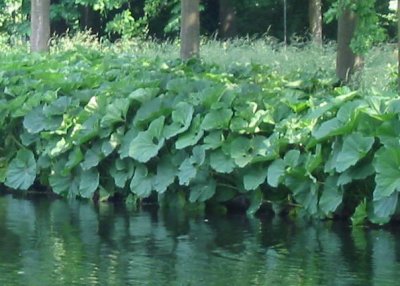
Photo: Ellywa at Dutch Wikipedia, CC BY-SA 3.0 · source

Herbaceous plant · Daisy family (Asteraceae)
Butterbur
Petasites hybridus
In other languages: Groot hoefblad (Nederlands) · Pétasite hybride (Français)
Grows wild in Belgium.
Butterbur is a robust waterside plant with some of the largest leaves of our native flora: round to kidney-shaped, up to 60 cm across or more, on long stalks. You find it along streams and rivers, in wet tall-herb vegetation, wet woodland and ditch banks, locally in extensive stands. In March and April the thick, pinkish-lilac flower spikes appear first from bare ground; the leaves only follow afterwards. For bumblebees and bees it is an important early source of food. Its thick rhizomes bind riverbanks, but in a small garden it soon becomes far too big.
Caution: Butterbur contains pyrrolizidine alkaloids, which can damage the liver: do not eat the plant or use it for tea. Keep an eye on young children and pets. Only plant it where it may spread: once established, the rhizomes are hard to get rid of.
Light
Sun or partial shade
preferably some sun
Moisture
Moist to wet
must not dry out
Hardiness
Fully hardy
down to -30 °C
Size
1 m
tall, 1.5 m wide
Flowering
March–April
| Height | 1 m |
|---|---|
| Native to Belgium | Yes |
| Flowering | March–April |
Identify
How to recognise it
- Habit
- Robust perennial with thick, creeping rhizomes; forms dense stands about 1 m tall.
- Leaf
- Round to kidney-shaped with a heart-shaped base, 30–60 cm across or more, with a toothed edge and a grey-felted underside. Long, hollow, grooved leaf stalks rising straight from the ground.
- Flower
- In March–April, before the leaves: thick spikes of pinkish-lilac flower heads on a scaly stem 10–40 cm tall. Male and female flowers on separate plants.
- Fruit/Seed
- After flowering, the female flowering stems keep lengthening and carry seeds with white fluff.
- Roots
- Thick, fleshy rhizomes that spread far underground.
- Confusion with
- Colt’s-foot has yellow flowers and much smaller leaves. Greater burdock has oval leaves and, in summer, purple, hooked flower heads on a tall, branched stem. Giant butterbur, a garden plant, flowers greenish white.
Flowering: March–April
In your garden
Why grow it?
- Very early nectar and pollen in March–April for bumblebee queens, honeybees and early solitary bees.
- The giant leaves give coolness and shelter to frogs, toads and other waterside animals.
- Its thick rhizomes bind the banks of streams and ponds.
- An impressive foliage plant for a large, wet garden or a pond edge.
- The leaves were once used to wrap butter, hence the English name butterbur.
Butterbur: where does it grow best?
- In the wild: banks of streams and rivers, wet tall-herb vegetation, wet woodland, ditches and damp verges.
- Partial shade to sun, as long as the soil stays wet; in dry sun the leaves wilt.
- Wet to moist, rich soil, preferably clay or loam.
- In the garden: only suitable for a large pond or stream bank, or a wet corner where it may spread.
Goes well with
- Marsh marigold: Yellow flowers in March–April, at the same time as the pink spikes.
- Meadowsweet: Creamy plumes in summer, on the same wet soil.
- Yellow iris: Upright, sword-shaped leaves as a contrast to the round giant leaves.
- Alder: The classic tree of stream banks, with butterbur at its feet.
Maintenance
Butterbur: when and how to plant it?
- Buy a plant from a native-plant nursery, or ask for a piece of rhizome from someone whose patch has grown too big.
- Plant in March or October in wet soil, at least 1 m from other plants.
- Dig in a sturdy root barrier around the planting spot, or plant it where it may spread freely.
- Set the piece of rhizome 5 cm deep and water generously.
- Keep the soil wet throughout the first year.
- Never dig up plants from the wild.
Care
- Water
- Keep wet. In a spot that is too dry, the leaves droop on warm afternoons.
- Feeding
- Not needed; by a stream or pond it finds enough food.
- Spreading
- Every spring, slice off runners outside the intended area with a sharp spade.
- Leaves
- Leave dead leaves in autumn as ground cover; they rot down quickly.
- Neighbours
- Little grows under the giant leaves. Plant neighbours well away.
Tip: Want the flowers without the takeover? Plant butterbur in a large, deep, bottomless container sunk into the pond edge.
Pruning and mowing
When: Not needed. You can leave the dead leaves in place in autumn.
How:
- In summer, feel free to cut away a few leaves if they shade a path or a neighbouring plant.
- Let the leaves die back and rot down in autumn.
- Cut off spent female flowering stems if you do not want seedlings.
Propagation
- Division
- In March or October, cut off a piece of rhizome with a bud and plant it straight away. It takes easily.
- Seed
- Only if male and female plants grow nearby. Scatter fresh seed on wet soil in May.
Butterbur: how does it get through the winter?
Hardy to −30 °C.
- It dies back completely above ground; the thick rhizomes overwinter in the wet soil.
- In late February–March the flower buds appear as thick, pinkish-green clubs.
- Fully hardy, to about −30 °C.
Diseases and pests
- Spreading: The main reason not to grow it in a small garden. Use a root barrier or slice off the edges every year.
- Limp leaves: On warm days or in drought. Wetter soil or more shade helps; the leaves usually recover by evening.
- Slugs: Holes in the young leaves. The leaves are big enough; let hedgehogs, toads and ground beetles do their job.
- Shading neighbours: Low plants disappear under the leaves. Choose neighbours that flower early or are large themselves.
Through the year
- February: The first flower buds push through the soil.
- March: Flowering before the leaves; bumblebee queens on the flowers. Plant or divide.
- April: Last flowers. The first leaves appear.
- May: The leaves unfold. Slice off spreading rhizomes.
- June: Leaves fully grown. Water if the soil dries out.
- August: The leaves droop on hot days; keep the soil wet.
- October: The leaves die back. Plant or divide.
- November: Rest. Leave the leaves where they fall.
You and this species
Did you know?
- Petasites comes from the Greek petasos, a broad-brimmed hat, after the giant leaves.
- In England butter was once wrapped in the cool leaves, hence the name butterbur.
- Male and female flowers grow on separate plants; after flowering, the female stems grow considerably longer to spread their fluffy seeds.