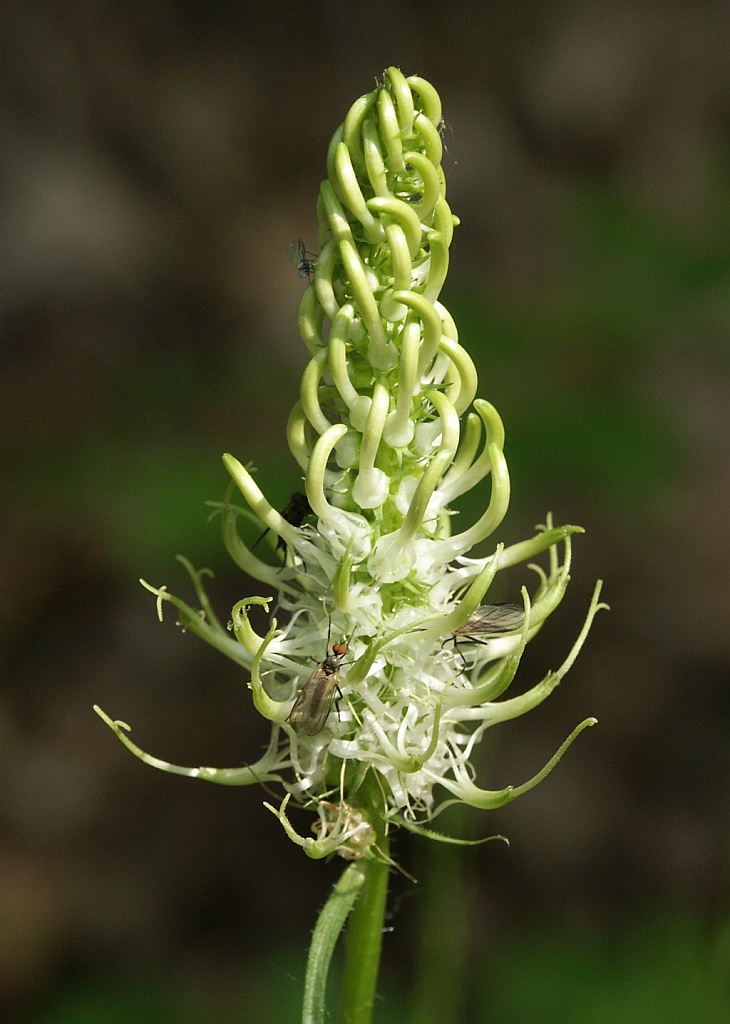
Photo: Wikimedia Commons, CC BY-SA 3.0 · source

Herbaceous plant · Bellflower family (Campanulaceae)
Spiked rampion
Phyteuma spicatum
In other languages: Witte rapunzel (Nederlands) · Raiponce en épi (Français)
Grows wild in Belgium.
Spiked rampion is a graceful perennial of the bellflower family that grows in deciduous woodland and along woodland edges. It is found on humus-rich, moist soil under beech, oak and hornbeam, often in woods on slopes and along woodland streams. In Belgium it is fairly common in Wallonia, especially in the Ardennes and Belgian Lorraine, but rare in Flanders. You can recognise it by its dense, cylindrical spike of creamy white to yellowish-white, curved flower buds that look like little horns, with long, protruding styles. The lower leaves are heart-shaped and scalloped, on long stalks. Bumblebees and solitary bees visit the flowers, and the fleshy root was once eaten.
Caution: Rare in Flanders: do not pick it and never dig it up in the wild. Only buy plants or seed from a native plant nursery.
Light
Partial shade or shade
tolerates little sun
Moisture
Normal
no wet feet
Hardiness
Fully hardy
down to -25 °C
Size
0.5 m
tall, 0.25 m wide
Flowering
May–July
| Pruning months | September |
|---|---|
| Height | 0.5 m |
| Native to Belgium | Yes |
| Flowering | May–July |
Identify
How to recognise it
- Growth form
- Upright perennial of 30–80 cm, with an unbranched stem and a rosette of basal leaves.
- Leaf
- Basal leaves heart-shaped to oval, doubly scalloped, on long stalks. Stem leaves smaller, narrower and stalkless higher up.
- Flower
- Dense, cylindrical spike of 3–8 cm with curved, tubular, creamy white to yellowish-white flowers and protruding styles with two stigmas. Flowers from May to July.
- Fruit/Seed
- Small capsules that open by pores and contain many fine seeds; the spike lengthens in fruit.
- Roots
- A fleshy, thickened root, like a small turnip.
- Confusion with
- Black rampion (Phyteuma nigrum) has dark violet-blue flowers; where the two grow together, hybrids with pale blue flowers sometimes occur. Round-headed rampion (Phyteuma orbiculare) has blue, globular heads and grows in chalk grassland.
Flowering: May–July · Pruning: September
In your garden
Why grow it?
- One of the loveliest flowers of the Walloon broadleaved woods, with a striking creamy white flower spike in May–July.
- Bumblebees, solitary bees and hoverflies visit the flowers for nectar and pollen.
- A characteristic species of old, rich deciduous woodland, showing that a woodland floor has been left undisturbed for a long time.
- Ideal for a shady wildlife garden under deciduous trees, where it flowers after the spring bulbs and woodland flowers.
- The fleshy root and young leaves were once eaten as a vegetable in some regions.
Spiked rampion: where does it grow best?
- In the wild in deciduous woodland, woods on slopes, along woodland streams and at woodland edges, especially under beech, oak and hornbeam.
- Partial to full shade; in full sun it dries out.
- Humus-rich, moist, loamy soil, neutral to slightly acid, that does not dry out in summer.
- In the garden: in a shady border or woodland garden under deciduous trees, or on the north side of a hedge.
Goes well with
- Wood anemone: White spring flowers in March–April, before the rampion gets going.
- Sweet woodruff: A fragrant, white-flowered ground cover of the same woodland floor.
- Solomon’s-seal: Arching stems with white bells in May, for the same shade.
- Yellow archangel: Yellow lipped flowers for bumblebees in spring, under deciduous trees.
- Columbine: Blue to violet flowers at the woodland edge, at the same time.
Maintenance
Spiked rampion: when and how to plant it?
- Buy plants from a native plant nursery; never dig them up in the woods.
- Plant in March–April or September–October in groups of 3–5, 25–30 cm apart.
- Work some leaf mould into the soil: it wants a humus-rich, moist soil as in a wood.
- You can also sow it: put fresh seed in pots outdoors in autumn. The seed needs winter cold to germinate in spring.
- Sow the fine seed thinly, press it in and do not cover it. Grow the seedlings on in pots for the first year and plant them out in autumn.
- Water until the plants are established and protect the young shoots from slugs in spring.
Care
- Water
- In the first year during dry spells. After that not needed in a moist, shady spot.
- Feeding
- Not needed; a layer of leaf mould in autumn is enough.
- Leaf litter
- Leave fallen leaves where they lie: they keep the soil moist and humus-rich, as in a wood.
- Peace and quiet
- It dislikes disturbance. Do not rake or dig around the plant, to spare the fleshy root.
- Letting it seed
- Leave the flowering stems until the seed is ripe; this way it gently self-seeds over the years.
Tip: Plant it in a small group under a deciduous tree and leave the fallen leaves in place: this recreates a woodland floor, where it will self-seed after a few years.
Pruning and mowing
Pruning months: September.
When: In September, when the seed is ripe, or leave the stems standing until spring.
How:
- Do not cut off faded spikes straight away: let them set seed first.
- In September cut the withered stems back to just above the ground, or leave them as shelter for insects.
- Do not tidy around the plant: the leaf rosette dies back by itself under the leaf litter in winter.
Propagation
- Seed
- In September–October put fresh seed in pots outdoors; it germinates after winter. Seedlings often only flower after two years.
- Division
- Possible with older clumps in early spring, but not always successful: the fleshy root breaks easily. Lift a generous root ball.
Spiked rampion: how does it get through the winter?
Hardy to −25 °C.
- The top growth dies back in autumn; the fleshy root overwinters in the soil.
- Fully hardy.
- Fallen leaves form a natural blanket that protects the roots and feeds the soil.
Diseases and pests
- Slugs: They eat young shoots and leaves in spring. Check in the evening and attract hedgehogs, toads and ground beetles with a wild corner.
- Drought: In a sunny, dry garden it languishes. Choose a moist spot in partial shade and mulch with leaf mould.
- Patience: Seedlings grow slowly and often only flower after two years. So start preferably with nursery plants.
- Disappearing after digging: Digging or deep raking damages the root. Leave the soil around the plant undisturbed.
Through the year
- March: Plant. New rosettes appear; watch out for slugs.
- April: The flowering stems grow. Keep slugs away.
- May: Flowering begins.
- June: Full flower, with bumblebees visiting.
- July: Last flowers. Seed sets.
- September: Collect seed and sow it in pots outdoors. Cut back stems or leave them. Plant.
- October: Plant. Spread leaf mould around the plants.
- November: Leave fallen leaves where they lie.
You and this species
Did you know?
- The flowers are cleverly built: the petal tips stay joined at the top and form a tube in which the style pushes the pollen out. Only afterwards does the tube split open and the two stigmas spread, which makes self-pollination difficult.
- The name rampion, like the Dutch rapunzel, goes back to the Latin rapum, ‘turnip’, after the fleshy root.
- Phyteuma comes from the Greek phyteuma, ‘plant’ or ‘that which is planted’.