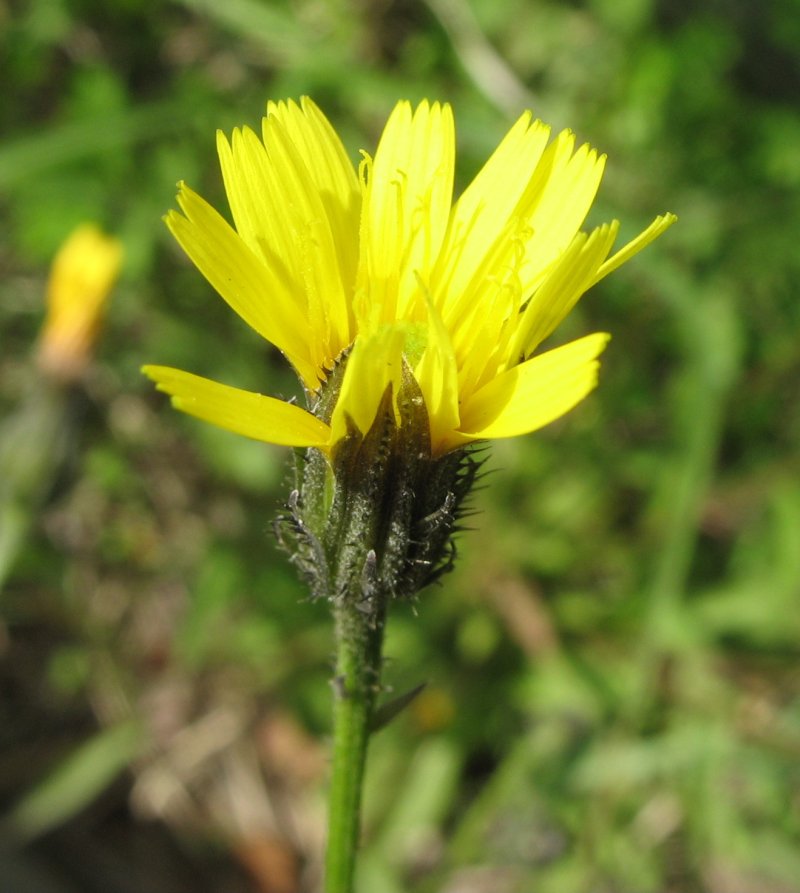
Photo: Sphl, CC BY-SA 3.0 · source

Herbaceous plant · Daisy family (Asteraceae)
Hawkweed oxtongue
Picris hieracioides
In other languages: Echt bitterkruid (Nederlands) · Picride fausse-épervière (Français)
Grows wild in Belgium.
Hawkweed oxtongue is a sturdy, yellow-flowered member of the daisy family found on verges, dykes, railway embankments, in quarries and in dry, rough grassland. In Belgium it is fairly common, especially on chalky and loamy soils and along roads, dykes and railways; on acid sand it is scarcer. You can recognise it by its branched, rough stems with stiff hairs that end in a double hook at the tip, which makes the plant cling to your clothes. It also has lance-shaped, wavy-toothed leaves and many yellow flower heads of 2–3.5 cm, with spreading, dark green outer bracts. It flowers late, from July into October, when it is an important food source for bees and hoverflies.
Light
Full sun
warm and bright
Moisture
Dry to normal
no wet feet
Hardiness
Fully hardy
down to -25 °C
Size
0.8 m
tall, 0.4 m wide
Flowering
July–October
| Pruning months | June and October |
|---|---|
| Height | 0.8 m |
| Native to Belgium | Yes |
| Flowering | July–October |
Identify
How to recognise it
- Growth form
- Biennial to short-lived perennial of 30–100 cm, with a taproot and an upright stem that is much branched towards the top.
- Leaf
- Lance-shaped, 5–20 cm, wavy to toothed and rough-hairy. The lower ones form a rosette; the stem leaves half clasp the stem with their base.
- Hairs
- Stem and leaves bear stiff hairs with a double hook at the tip: the plant feels rough and clings to clothes and fur.
- Flower
- Yellow heads of 2–3.5 cm made up only of ray florets, in a loose, branched cluster. The outer bracts are spreading, dark green and bristly. Flowers from July to October.
- Fruit/Seed
- Slightly curved, transversely wrinkled achenes of 3–5 mm with an off-white, feathery pappus.
- Confusion with
- Bristly oxtongue has leaves with whitish, blister-like warts and large, heart-shaped outer bracts. Hawkweeds have no feathery pappus. Autumn hawkbit and cat’s-ear have a leaf rosette with almost leafless stems; hawkweed oxtongue has leafy stems and hooked hairs.
Flowering: July–October · Pruning: June and October
In your garden
Why grow it?
- Flowers late and for a long time, from July to October, when many other flowers are over: an important late-summer source of nectar and pollen.
- Honeybees, bumblebees, hoverflies and solitary bees visit it, including species that mainly collect pollen from yellow members of the daisy family.
- The fluffy seeds fly off on the wind, and seed-eating birds pick them from the heads in autumn.
- A tough, drought-tolerant species for sunny verges, dykes and rough wildflower meadows on chalky or loamy soil.
- A lovely discovery under a hand lens: the hairs end in a tiny two-pronged anchor.
Hawkweed oxtongue: where does it grow best?
- In the wild on verges, dykes and railway embankments, in quarries, on waste ground and in dry, rough grassland and chalk grassland.
- Full sun.
- Dry to moderately moist, chalky or loamy soil; also on rubble and gravel.
- In the garden: in a sunny, poor wildflower meadow, a dry bank along the drive or a rough edge on chalky soil.
Goes well with
- Chicory: Sky-blue flowers on the same verge, another late bloomer.
- Knapweed: Purple flowers for butterflies and bumblebees in the same rough grassland.
- Wild marjoram: Pink flowers full of bees on the same dry, chalky soil.
- Viper’s-bugloss: Blue flowers, a magnet for bumblebees, on dry, stony ground.
- Wild carrot: White umbels among the yellow heads, all summer long.
Maintenance
Hawkweed oxtongue: when and how to plant it?
- Sow seed of wild origin in September–October or March–April, from a nursery or seed supplier specialising in native plants, or plant pot-grown plants from such a nursery.
- Sow on bare, loosened soil or in gaps in the turf. Press the seed in and barely cover it.
- Keep the soil moist until the seedlings appear; they come up after a few weeks.
- Plant 30–40 cm apart, preferably in small groups, among other flowers of dry grassland.
- Water only until it is established; after that its taproot gets it through dry summers too.
- Never dig up plants from the wild.
Care
- Water
- Not needed; the taproot draws water from deep down.
- Feeding
- Not needed: on poor soil it stays sturdy and flowers freely.
- Mowing
- Mow once late, in October, or twice: in early June and in October. Remove the cuttings. Mowing in July–September cuts off the flowers.
- Spreading
- Self-seeds on bare ground, but stays limited in a dense sward. Dig out unwanted rosettes with their taproot.
- Letting it seed
- Leave some plants standing into autumn so that the seed can ripen.
Tip: Do not mow your verge or wildflower meadow in August: let hawkweed oxtongue flower on until October, and you will have a nectar source when almost everything else is over.
Pruning and mowing
Pruning months: June and October.
When: In October, after flowering; in a wildflower meadow possibly also in early June.
How:
- Mow short in October and remove the cuttings.
- Leave a strip or a few plants standing into winter or spring: the stems shelter insects.
- A cut in early June keeps the plant lower and more compact; it still flowers profusely in late summer.
Caution: Do not mow in July–September: you would cut off the flowers just when insects need them most.
Propagation
- Seed
- Sow on bare ground in September–October or March–April. In a wildflower meadow it also self-seeds.
Hawkweed oxtongue: how does it get through the winter?
Hardy to −25 °C.
- Overwinters as a leaf rosette with a taproot; fully hardy.
- The withered stems with fluffy seed heads stay standing into winter.
- Leave some standing: small insects overwinter in and between the stems.
Diseases and pests
- Aphids: Sometimes many aphids on the stem tips. They attract ladybirds and hoverflies; no control is needed.
- Seedlings in borders: Seedlings sometimes appear on bare soil. Dig out the rosettes while young, with the taproot.
- Hooked hairs: The hairs cling to clothes and fur. This is harmless.
- Disappearing: In a sward that is too rich and dense, or if it is mown during flowering, it disappears. Make the soil poorer and mow late.
Through the year
- March: Sow. Clear old stems.
- April: The rosettes grow. Sowing is still possible.
- June: Optional cut in early June. The flowering stems grow.
- July: Flowering begins.
- August: Full flower, busy with bees and hoverflies. Do not mow.
- September: Flowering and the first seed fluff. Sow.
- October: Last flowers. Mow and remove the cuttings; leave some standing.
- November: Leave stems standing for insects.
You and this species
Did you know?
- Picris comes from the Greek pikros, ‘bitter’, as does the Dutch name bitterkruid: the leaves taste bitter.
- Hieracioides means ‘resembling hawkweed’ (Hieracium), a genus of yellow daisies with which it is easily confused.
- Under a hand lens you can see that the hairs end in two little hooks, like a tiny anchor: this is how the plant clings to fur and clothes.