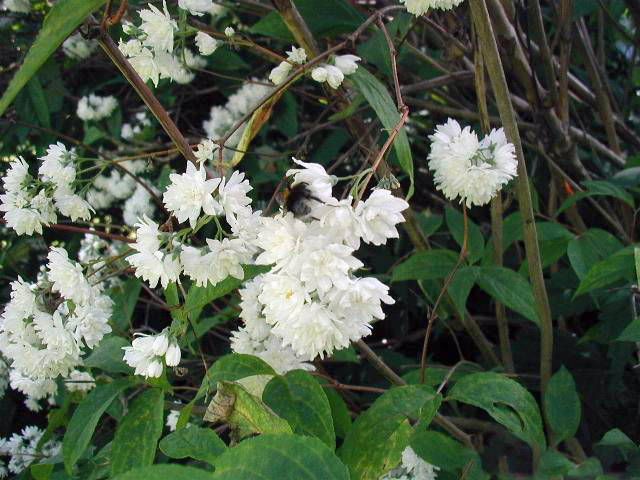
Photo: User:Sten, CC BY-SA 3.0 · source

Pruning guide · Shrub
Deutzia: when and how to prune
Prune a deutzia after flowering, in June–July: every year, cut a few of the oldest stems off at the base, and cut flowered shoots back to a young side shoot.
Deutzia flowers in May–June with clusters of white or pink, star-shaped flowers, on last year’s wood. Like weigela and mock orange, it is therefore pruned straight after flowering, and never in winter. There are compact forms barely a metre tall, such as Deutzia gracilis, and large shrubs up to 2.5 m. Without pruning they become crowded and bare, with lots of old wood and few flowers; with a few old stems removed every year, they stay young.
| Pruning months | June–July |
|---|---|
| Nesting season (15 March–15 August) | Take care in June–July |
| Flowering | May–June |
| Native to Belgium | No, planted |
Deutzia: when to prune it?
Prune after flowering, in June–July, as soon as most of the flowers have faded. The earlier you prune, the longer the new shoots have to grow and form flower buds.
Don’t prune after July: what you would cut off then are the shoots that will flower next spring.
Don’t prune in winter or early spring. Brown shoot tips after a cold night in April are only cut off after flowering: the shrub usually recovers by itself.
Deutzia: how to prune it?
- Recognise the old wood: older stems are thick and much branched, with bark that peels in strips, and they only flower at the top. Young stems are straight and flower best.
- Every year, cut a few of the oldest stems off at the base, about one in five on a mature shrub. Young, free-flowering shoots will then grow up from the base.
- Cut flowered shoots back to an outward-facing young side shoot, so the shrub keeps its loose, gently arching shape.
- Remove dead, weak and crossing stems, to let light into the centre of the shrub. From the cut you will see that older stems are hollow: that is how to tell it from mock orange, which has solid white pith.
- A compact form such as Deutzia gracilis ‘Nikko’ needs little pruning: shorten the flowered twigs after flowering, and take out an old stem every few years.
- Rejuvenate an old, crowded shrub over three years: every year after flowering, take a third of the oldest stems down to the ground.
How much to cut, and how often?
- One pruning a year, after flowering. Simply let a young shrub grow for its first two years.
- Never remove more than a fifth to a quarter of the stems a year: that way the shrub renews itself gradually, without going bare.
- A deutzia in a pot: only shorten the flowered shoots, and take out an old stem every two or three years. Give it a layer of fresh potting compost every spring.
What does it mean for wildlife?
- Pruning in June–July falls in the nesting season (15 March–15 August). Blackbirds, dunnocks and whitethroats sometimes nest in a dense deutzia: look carefully first, as disturbing an active nest is against the law.
- Bees mainly visit the single-flowered forms; double flowers have little to offer insects. So for wildlife, choose a single-flowered deutzia.
- Ladybirds, hoverfly larvae and tits usually deal with the aphids on the young shoots themselves: there is no need to spray.
- Deutzia is not a native shrub. In a border or an informal hedge, plant native shrubs with it, such as guelder rose, common dogwood or dog rose, and put the prunings on a dead hedge: birds, hedgehogs and insects will then find more food and shelter.
Common mistakes
- Pruning in winter, so the flower buds are gone and the shrub hardly flowers in May–June.
- Clipping the shrub into a ball instead of taking old stems out at the base.
- Never removing old wood, so it becomes crowded and bare and flowers less and less.
- Pruning in June–July without checking for nests first.
Caution: Do not prune in winter: it flowers on last year’s wood, and pruning then removes the flowers.
Nearby: related pruning guides
Similar to: Difference from mock orange · Difference from weigela