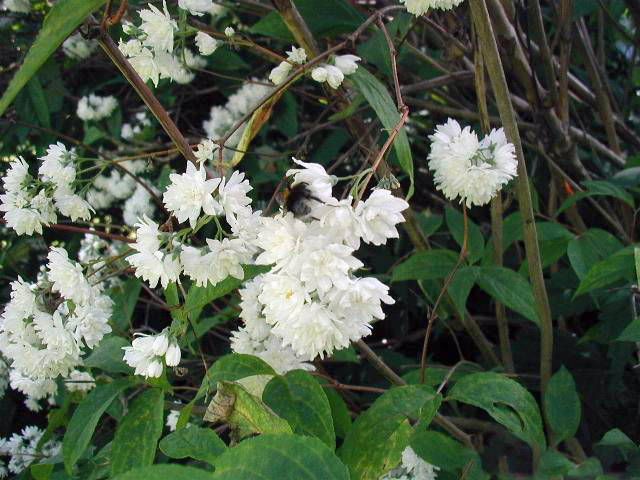
Photo: User:Sten, CC BY-SA 3.0 · source

Shrub · Hydrangea family (Hydrangeaceae)
Deutzia
Deutzia is an easy, free-flowering shrub of 1–2.5 m from East Asia. In May–June it is covered in clusters of white or pink star-shaped flowers, double in some forms. The leaves feel rough as sandpaper, the bark peels in strips and older twigs are hollow. There are compact forms of barely a metre, such as Deutzia gracilis, as well as large shrubs. It grows in sun and partial shade in any good garden soil and flowers on last year’s wood.
Light
Sun or partial shade
preferably some sun
Moisture
Normal
no wet feet
Legal basis
Any garden soil
any pH
Hardiness
Throughout Belgium
no protection needed
Size
1–2.5 m
tall
Flowering
May–June
| Pruning months | June–July |
|---|---|
| Height | 1–2.5 m |
| Native to Belgium | No, planted |
| Poisonous to people and pets | Not known to be poisonous |
| Flowering | May–June |
Identify
Deutzia: how do you recognise it?
- Habit
- Upright, later slightly arching shrub of 1–2.5 m; compact forms stay around 1 m.
- Leaf
- Opposite, 3–10 cm, oval to lanceolate, finely toothed; rough as sandpaper because of star-shaped hairs.
- Bark
- Brown bark that peels in strips; older twigs are hollow.
- Flower
- Clusters of white or pink, five-petalled, often star-shaped flowers (1–2 cm) in May–June; double in some forms.
- Fruit
- Small, globular capsules.
- Difference from mock orange
- Mock orange has larger, four-petalled, strongly scented flowers and solid pith in the twigs.
- Difference from weigela
- Weigela has bell- or trumpet-shaped pink flowers and smooth leaves.
Flowering: May–June · Pruning: June–July
Looks like it, but isn’t
- Mock orange Philadelphus coronarius: larger, four-petalled, strongly scented flowers and solid pith in the twigs. Difference from mock orange
- Weigela Weigela: bell- or trumpet-shaped pink flowers and smooth leaves. Difference from weigela
In your garden
Why grow it?
- Masses of white or pink flowers in May–June.
- Easy: grows in almost any soil, in sun or partial shade.
- Compact forms fit into a small garden or a pot.
- Bees visit the single-flowered forms.
Deutzia: where does it grow best?
- Sun to partial shade; in sun it flowers most freely.
- Any good garden soil that is not too dry, chalky soil included.
- Allow 1–1.5 m width.
- Lovely in a mixed border, as a low informal hedge or at the front of a shrub border; compact forms also in a pot.
- Light
- Sun or partial shade
- Legal basis
- Any garden soil
- Moisture
- Normal
- Size
- 2 m tall, 1.5 m wide
- Hardiness
- Throughout Belgium, no protection needed
Goes well with
- Mock orange: Flowers straight afterwards, with fragrant white flowers: together a white shrub border from May to July.
- Weigela: Pink trumpet flowers in May–June, in the same spot and with the same pruning after flowering.
- Hydrangea: A relative of deutzia; takes over the flowering from June, in partial shade.
Good and bad companions
Goes well with
- Suits the woodland edge or the light shade of: ginkgo, box elder, ash, honey locust, field maple, silver maple
Maintenance
Deutzia: when and how to plant it?
- Plant from November to March; pot-grown plants all year round, except in frost or drought.
- Mix a little compost into the soil and plant at the same depth as before.
- For a low informal hedge: 2–3 plants per metre.
- Water generously after planting and in dry spells during the first year.
Care
- Watering
- In dry spells during the first year; after that only in long, dry periods, and always in a pot.
- Feeding
- A little compost in spring is enough.
- Renewal
- An old, crowded shrub flowers less: thin it out a little every year after flowering.
- In a pot
- Water compact forms in pots regularly and top-dress with fresh compost every spring.
Tip: Choose a form to suit your garden: Deutzia gracilis ‘Nikko’ stays low and wide, ‘Mont Rose’ flowers pink and Deutzia scabra ‘Pride of Rochester’ is a large shrub with double white flowers.
Deutzia: when to prune it?
Pruning months: June–July.
When: After flowering (June–July).
How:
- Every year, cut a few of the oldest branches off at the base; young, free-flowering shoots will replace them.
- Cut flowered shoots back to a young side shoot.
Caution: Do not prune in winter: it flowers on last year’s wood, and pruning then removes the flowers.
Propagation
- Softwood cuttings
- In June–July, take soft to semi-ripe cuttings of 10 cm and root them under plastic.
- Hardwood cuttings
- In autumn or winter, push 20 cm lengths of one-year-old shoots into the ground.
Deutzia: how does it get through the winter?
Hardy throughout Belgium: no protection needed.
- Hardy.
- In spring, young shoots and flower buds can be damaged by late night frosts; a sheltered spot helps.
Diseases and pests
- No flowers: Usually pruned in winter, or too much shade. Prune only after flowering.
- Bare, crowded shrub: Lots of old wood and few flowers. Cut a few old branches off at the base every year.
- Frost damage: Brown shoot tips after a cold night in April. The shrub usually recovers by itself; remove the frosted tips after flowering.
- Aphids: Aphids on the young shoots in spring; natural predators usually deal with them.
Through the year
- March: Planting; add compost.
- April: Watch out for late night frosts on the young shoots.
- May: Flowering begins.
- June: Full flower; then prune: remove old branches.
- July: Last pruning after flowering; take softwood cuttings.
- November: Planting; take hardwood cuttings.
Use
What can you use it for?
- Garden and landscape
- Easy, free-flowering shrub for sun and partial shade; there are compact forms for small gardens.
- For wildlife
- Bees visit the single-flowered forms.
You and this species
Did you know?
- Named after Johan van der Deutz, an Amsterdam alderman who helped to pay for Carl Peter Thunberg’s plant-hunting voyage to Japan.
- Under a magnifying glass you can see tiny star-shaped hairs on the leaf: they make it rough. The species name of Deutzia scabra means ‘rough’, too.
- The hollow twigs help to tell it apart from mock orange, which has solid white pith.