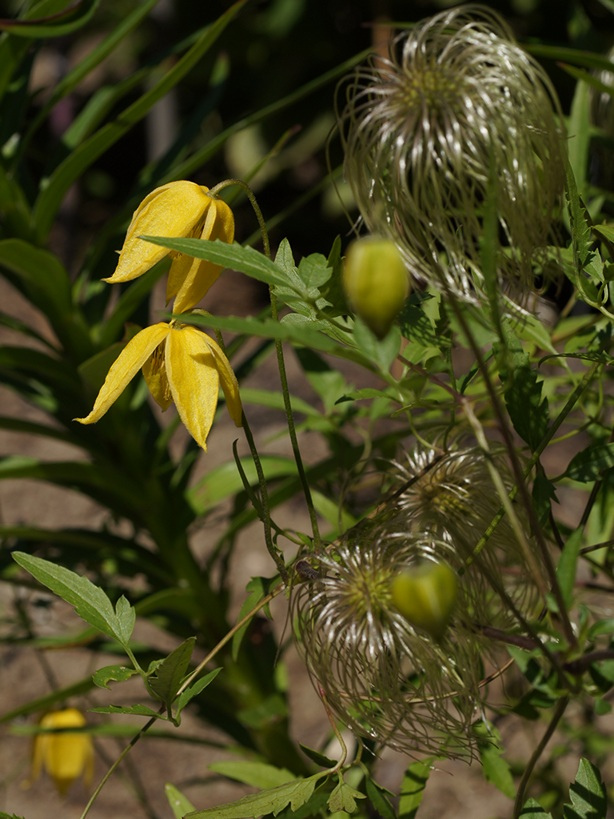
Photo: Tatiana Gerus from Brisbane, Australia, CC BY-SA 2.0 · source

Pruning guide · Climber
Golden clematis: when and how to prune
Clematis tangutica
Prune a golden clematis every year in March, before the new shoots appear: cut all stems back to 30–50 cm above the ground, just above a few fat buds.
The golden clematis (Clematis tangutica) is a vigorous climber up to 4 m, hung from June to September with nodding yellow bells, followed by silvery, fluffy seed heads that stay well into winter. You often see flowers and seed heads at the same time. It flowers on this year’s shoots. That is why you cut it back hard every spring: it costs no flowers at all. Without pruning, it goes bare at the bottom, with the flowers climbing ever higher.
| Pruning months | March |
|---|---|
| Nesting season (15 March–15 August) | Take care in March |
| Flowering | June–September |
| Good for bees, butterflies and birds | Yes, for bees |
| Native to Belgium | No, planted |
| Poisonous to people and pets | Yes, take care with children and pets |
Golden clematis: when to prune it?
Prune every year in March, before the new shoots appear.
Leave the seed heads on all winter: they look lovely with frost, and insects overwinter in them.
Don’t prune in summer: you would cut off the flowering stems.
What else to prune in those months? March
Golden clematis: how to prune it?
- Cut all stems back to 30–50 cm above the ground, just above a few fat buds.
- Remove dead and thin stems completely, carefully pulling them out of the trellis or the shrub in pieces.
- If you want a larger plant, leave a few stems longer: it then flowers earlier and higher, but goes bare at the base.
- Also cut a young plant back to 30 cm in its first spring, so it branches at the base.
- Wear gloves: the sap can irritate the skin, and all parts of the plant are poisonous.
How much to cut, and how often?
- Every year all the stems, back to 30–50 cm above the ground, even on an old plant.
- Or, for a larger plant, everything except a few long stems.
What does it mean for wildlife?
- March falls mostly before the nesting season (from 15 March). If you are late, first check that no blackbird is starting a nest among the dense stems.
- The yellow bells from June to September are visited by bumblebees and bees.
- In spring, birds collect the soft seed fluff for their nests. So leave the seed heads on until March.
- It is a non-native. If you want a native clematis for wildlife, choose old man’s beard, in a spot where it has plenty of room.
Common mistakes
- Not pruning, so it goes bare at the bottom and only flowers at the top.
- Cutting off the seed heads in autumn.
- Working in the sap without gloves.
- Tearing old stems out of the trellis and breaking off the young buds with them.
Caution: Wear gloves when pruning: the sap can irritate the skin. Golden clematis is poisonous: wear gloves and keep clippings away from children, pets and livestock.
Nearby: related pruning guides
Plant profile: Golden clematis · Pruning calendar and basic rules