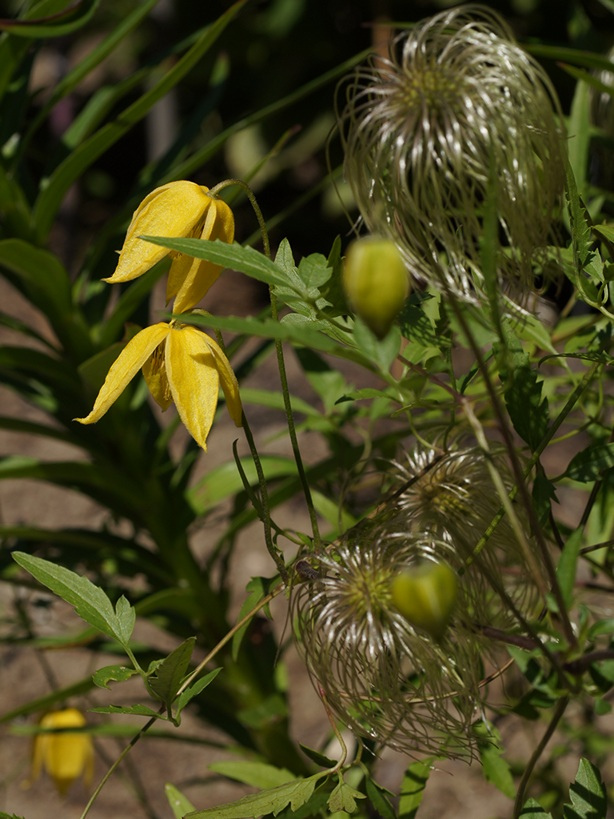
Photo: Tatiana Gerus from Brisbane, Australia, CC BY-SA 2.0 · source

Climber · Ranunculaceae
Golden clematis
Clematis tangutica
In other languages: Gele clematis (Nederlands) · Clématite de Tangut (Français)
Golden clematis comes from the mountains of Central Asia and north-western China. It is a vigorous climber that clings with its leaf stalks and reaches up to 4 m, with pinnate, grey-green leaves. From June to September it is covered in nodding, yellow, bell-shaped flowers, followed by silvery, fluffy seed heads that stay on into winter. You often see flowers and seed heads at the same time. It is fully hardy, easy and flowers on new wood; related cultivars such as ‘Bill MacKenzie’ are widely grown.
Caution: All parts are poisonous if eaten, to people and also to dogs, cats and horses. Keep children and pets away from the plant and its prunings. The sap can irritate the skin: wear gloves when pruning.
Light
Sun or partial shade
preferably some sun
Moisture
Dry to normal
no wet feet
Legal basis
Sand, loam or clay
any pH
Hardiness
Fully hardy
down to -30 °C
Size
4 m
tall, 2 m wide
Flowering
June–September
| Pruning months | March |
|---|---|
| Height | 4 m |
| Native to Belgium | No, planted |
| Good for bees, butterflies and birds | Yes, for bees |
| Poisonous to people and pets | Yes, take care with children and pets |
| Flowering | June–September |
Identify
Golden clematis: how do you recognise it?
- Habit
- Vigorous, deciduous climber 3–4 m tall and about 2 m wide, clinging by its leaf stalks.
- Leaves
- Pinnate, with narrow, toothed leaflets; grey-green.
- Flower
- Nodding, bell-shaped yellow flowers 3–4 cm long, with four thick sepals, from June to September.
- Seed heads
- Silvery white and silky, often alongside the last flowers; they last well into winter.
- Roots
- Fine roots that like to stay cool while the plant climbs into the sun.
Flowering: June–September · Plants: March–May and September–October · Pruning: March
In your garden
Why grow it?
- Flowers for four months, from June to September, when many other climbers have finished.
- Silvery, fluffy seed heads that decorate the plant well into winter.
- Fully hardy and easy: one prune in March is all it needs.
- Bees visit the yellow bells.
- Quickly covers a fence, pergola, trellis or large shrub.
Golden clematis: where does it grow best?
- Sun or partial shade; it flowers best in sun.
- Well-drained soil: sand, loam or clay, slightly acid to chalky. Lime is no problem.
- Dry to ordinary soil; it dislikes wet feet. Keep the base cool with a paving slab, stones or low plants.
- Give it a sturdy trellis, wire mesh, a pergola or a large shrub, and allow 2 m of width.
- Light
- Sun and partial shade
- Soil type
- Sand, loam or clay
- Acidity
- Not fussy
- Moisture
- Dry or normal
- Size
- 4 m tall, 2 m wide
- Hardiness
- Hardy (to -30 °C)
Goes well with
- Italian clematis: Purple or red flowers among the yellow, with the same March prune.
- Climbing rose: The clematis carries on flowering once the roses’ first flush is over.
- Hardy geranium: Keeps the base cool and flowers blue or purple at its feet.
- Lavender: Purple beside yellow, in the same sunny, dry spot.
Maintenance
Golden clematis: when and how to plant it?
Plant in March–May and September–October.
- Plant in March–May or September–October.
- Dig a hole 40 × 40 cm, at least 30 cm from a wall or fence, and mix in compost.
- Plant 5–10 cm deeper than it was in the pot, so there are extra buds below ground.
- Lean the stems towards the support and tie them in loosely.
- Water generously straight away.
- Shade the base with a slab, a few stones or low perennials, and mulch around it.
Care
- Watering
- Regularly in dry spells in the first year. After that only in long droughts, especially against a wall.
- Feeding
- In March, after pruning, compost or an organic fertiliser for flowering plants.
- Tying in
- In spring, weave the young shoots through the support and tie them in; after that it climbs by itself.
- Mulching
- A layer of compost or wood chips in spring keeps the roots cool and moist.
- Seed heads
- Leave them: they look lovely in autumn and winter. They come off with the March prune.
Tip: Cut everything back to 30–50 cm above the ground every March: the plant stays full right to the base and flowers from June to September. Leave the seed heads until then for winter interest.
Golden clematis: when to prune it?
Pruning months: March.
When: Prune every year in March, before the new shoots start: it flowers on this year’s growth.
How:
- Cut all stems back to 30–50 cm above the ground, just above a pair of fat buds.
- Remove dead and thin stems completely.
- For a larger plant, leave a few stems longer: it will flower earlier and higher, but becomes bare at the base.
- Cut a young plant back to 30 cm in its first spring too, so that it branches from the base.
Caution: Wear gloves when pruning: the sap can irritate the skin.
Propagation
- Seed
- Sow fresh seed in autumn in a pot left outdoors; it germinates slowly, often only after winter. It sometimes self-seeds too.
- Cuttings
- In May–June: semi-ripe cuttings with one node and a piece of stem below it, in moist cutting compost under plastic.
- Layering
- In spring, peg a low stem into the soil at a node; sever it after a year.
Golden clematis: how does it get through the winter?
Hardy to −30 °C.
- Fully hardy, to about −30 °C: no protection is needed.
- The silvery seed heads decorate the plant into winter; leave them until the March prune.
- In a pot: choose a large, deep pot and stand it against a wall so the root ball does not freeze.
Diseases and pests
- Slugs: They eat the young shoots in spring. Protect the base or pick the slugs off in the evening.
- Bare base: Bare stems below and flowers only at the top. Cut back to 30–50 cm every March.
- Powdery mildew: White powder on the leaves in a dry late summer. Water in dry spells and allow good air flow.
- Clematis wilt: A stem suddenly wilts completely. Rare in this small-flowered species; cut the stem back to healthy wood and the plant usually regrows.
Through the year
- March: Cut back to 30–50 cm above the ground. Add compost. Planting.
- April: Planting. Tie in young shoots. Watch for slugs.
- May: Planting. Weave shoots through the support. Take cuttings.
- June: First flowers.
- July: Flowering. Water in dry weather.
- August: Flowers and first seed heads.
- September: Last flowers. Planting.
- October: Planting. Silvery seed heads. Sow seed.
- December: The seed heads decorate the winter garden.
Use
Edible and useful
Not edible. All parts of clematis are poisonous: when the plant is damaged it releases protoanemonin, an acrid substance also found in buttercups and anemones. On the skin the sap can cause redness, itching and blisters, especially in people who often prune with bare hands; in the mouth it causes a burning feeling, drooling, vomiting and stomach ache. The acrid, bitter taste puts off most people and animals, but keep small children, dogs, cats, rabbits and guinea pigs away from the plant and the clippings. Horses and other livestock can eat more of it if they reach a clematis over the fence or find the clippings: do not plant it along a field, and never throw the clippings into a field, pen or hutch. Wear gloves when pruning and tying in, and wash your hands afterwards. If any is swallowed, call a poison centre (in Belgium 070 245 245) or your doctor at once.
Good for wildlife
- Bees
- Nectar and pollen for honeybees and wild bees.
You and this species
Did you know?
- What look like petals are actually coloured sepals: clematis has no true petals.
- The silvery plumes are the long, feathery styles on the seeds, which let the wind carry them far.
- The name tangutica refers to the land of the Tangut, a people who once lived in north-western China.