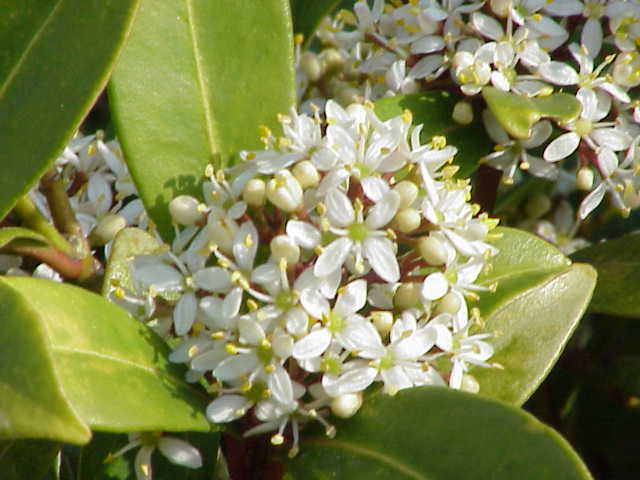
Photo: Kurt Stüber [1], CC BY-SA 3.0 · source

Pruning guide · Shrub
Skimmia: when and how to prune
Skimmia japonica
Hardly prune a skimmia, and if you do, after flowering, in April–May: at most cut back a stray shoot, and the faded flower clusters of male plants.
Skimmia is a low, evergreen shrub for partial shade and acid soil, with red or pink flower buds that give colour all winter and open in spring into small, fragrant white flowers. Female plants bear red berries, if there is a male plant nearby. It grows slowly and keeps a compact shape on its own. So pruning is mainly about not doing it, and certainly not after summer: that would remove the buds that colour the winter.
| Pruning months | April–May |
|---|---|
| Nesting season (15 March–15 August) | Take care in April–May |
| Flowering | March–May |
| Good for bees, butterflies and birds | Yes, for bees |
| Native to Belgium | No, planted |
| Poisonous to people and pets | Yes, take care with children and pets |
Skimmia: when to prune it?
If needed, prune after flowering, in April–May.
Don’t prune after summer: you would cut off the buds that give colour all winter and flower the following spring.
Prune a skimmia in a pot at the same time, and repot it straight away if needed.
Skimmia: how to prune it?
- At most cut back a stray shoot to just above a whorl of leaves.
- Cut off the faded flower clusters of male plants, so the plant stays compact.
- On female plants, leave the faded flowers: that is where the red berries come from.
- Remove dead and brown twigs, and stems hanging over the rim of a pot.
- Wear gloves, and don’t throw the prunings near animals: all parts are poisonous.
How much to cut, and how often?
- Hardly anything: a skimmia often needs nothing for years.
- At most a few stray shoots and the faded flower clusters of male plants.
What does it mean for wildlife?
- April–May falls in the nesting season (15 March–15 August). Hardly anything nests in a low skimmia, but take a look before you cut.
- The fragrant flowers in March–April are one of the first meals for honeybees and bumblebee queens.
- The red berries often hang on all winter and give colour, but they are poisonous to people and pets.
- It is a non-native of little value to native caterpillars. Combine it with native plants for acid soil, such as holly, bilberry or heather.
Common mistakes
- Pruning after summer, so the winter buds and next year’s flowers are lost.
- Cutting off the faded flowers of female plants, so there are no berries.
- Throwing the prunings in with rabbits or guinea pigs.
- Clipping a skimmia into a ball.
Caution: Don’t prune after summer: you would cut off the buds that give colour all winter. Skimmia is poisonous: wear gloves and keep clippings away from children, pets and livestock.
Nearby: related pruning guides
Similar to: Difference from cherry laurel · Difference from Japanese pieris · Difference from Mexican orange blossom