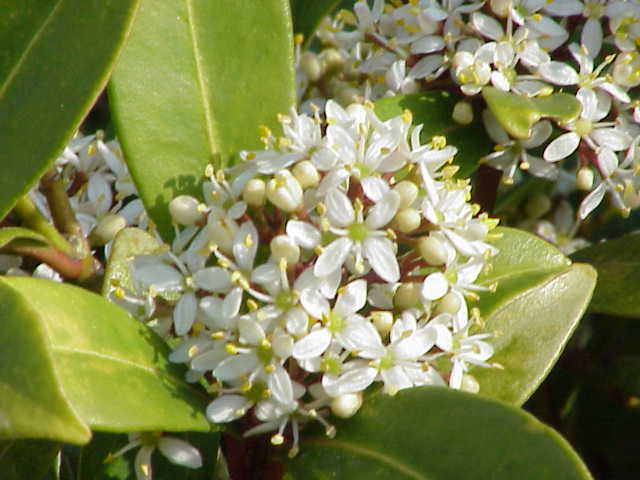
Photo: Kurt Stüber [1], CC BY-SA 3.0 · source

Shrub · Rue family (Rutaceae)
Japanese skimmia
Skimmia japonica · also: Skimmia
Japanese skimmia is a low, evergreen shrub of 0.5–1.5 m with aromatic leaves in rosettes at the shoot tips. From autumn onwards it carries clusters of red or pink flower buds that give colour all winter and open in March–April into small, fragrant white flowers. Female plants bear red berries if there is a male plant nearby. Like rhododendron, it likes partial shade and acid soil, and it looks good in a pot. Be careful: all parts are poisonous, especially the berries.
Caution: All parts are poisonous, especially the red berries, which attract children. Eating them can cause stomach ache, nausea and vomiting. Also keep dogs, cats and rabbits away from the berries and prunings.
Light
Partial shade or shade
tolerates little sun
Moisture
Normal
no wet feet
Legal basis
Acid soil
acid
Hardiness
Throughout Belgium
no protection needed
Size
0.5–1.5 m
tall
Flowering
March–May
| Pruning months | April–May |
|---|---|
| Height | 0.5–1.5 m |
| Native to Belgium | No, planted |
| Good for bees, butterflies and birds | Yes, for bees |
| Poisonous to people and pets | Yes, take care with children and pets |
| Flowering | March–May |
Identify
Japanese skimmia: how do you recognise it?
- Habit
- Low, compact, rounded shrub of 0.5–1.5 m.
- Leaf
- Alternate, in rosettes at the shoot tips, 5–10 cm, untoothed; aromatic when crushed.
- Bark
- Greenish to grey.
- Flower
- Red or pink buds all winter; small, fragrant white flowers in March–April.
- Fruit
- Red berries on female plants (with a male plant nearby); poisonous.
- Difference from cherry laurel
- Cherry laurel is a much larger shrub with big, glossy leaves.
Flowering: March–May · Pruning: April–May
Identify by feature: Evergreen leaves · Red berries
Looks like it, but isn’t
- Cherry laurel Prunus laurocerasus: a much larger shrub with big, glossy leaves. Difference from cherry laurel
In your garden
Why grow it?
- Red or pink buds all winter: colour while the rest of the garden rests.
- Fragrant white flowers in March–April for the first bees.
- Stays low and compact: ideal for a shady border or a pot by the front door.
- Hardly needs pruning.
Japanese skimmia: where does it grow best?
- Partial shade to shade; in full sun the leaves turn yellow and pale.
- Acid, humus-rich, moist but free-draining soil; no lime.
- Allow about 1 m width.
- In a pot: use peat-free ericaceous compost and keep the pot out of harsh sun.
- Light
- Partial shade or shade
- Legal basis
- Acid soil
- Moisture
- Normal
- Size
- 1.5 m tall, 1 m wide
- Hardiness
- Throughout Belgium, no protection needed
Goes well with
- Rhododendron: Likes the same acid soil and partial shade; skimmia fills in at the foot of the larger shrub.
- Japanese pieris: Evergreen for the same spot, with white flower sprays in spring.
- Camellia: Flowers in early spring in the same acid, sheltered partial shade.
Good and bad companions
Goes well with
- Tolerates shade and suits planting under large trees such as: english oak, sessile oak, pin oak, turkey oak, red oak, holm oak
- Like acid soil, just like this plant: heather, rhododendron, raspberry, highbush blueberry, witch hazel, broom, gorse, camellia
Maintenance
Japanese skimmia: when and how to plant it?
- Plant in spring (March–April) or autumn (September–October).
- For berries, put one male plant with a few female ones, or choose a self-fertile form (Skimmia japonica subsp. reevesiana).
- Mix some leaf mould or ericaceous compost into the planting soil and set the root ball at the same depth as in the pot.
- Water after planting, preferably with rainwater.
Care
- Watering
- Keep the soil slightly moist, especially in pots; use rainwater.
- Feeding
- A little ericaceous fertiliser or compost in spring, after flowering.
- Mulching
- A thin layer of pine bark or leaf mould keeps the soil cool and acid.
- Pots
- Every few years in spring, repot into a slightly larger pot with fresh ericaceous compost.
Tip: Put a male ‘Rubella’ with a few female plants: you will then have red buds and red berries all winter.
Japanese skimmia: when to prune it?
Pruning months: April–May.
When: After flowering (April–May).
How:
- Hardly needs pruning; at most, cut back a stray shoot.
- Cut off faded flower clusters on male plants; on female plants, leave the flowers for the berries.
Caution: Don’t prune after summer: you would cut off the buds that give colour all winter.
Propagation
- Cuttings
- In July–August, take 8–10 cm semi-ripe cuttings and insert them in moist, acid cutting compost under glass or plastic; they root slowly.
Japanese skimmia: how does it get through the winter?
Hardy throughout Belgium: no protection needed.
- Hardy in open ground; the buds give colour all winter.
- In a pot the root ball can freeze: stand the pot sheltered against a wall and wrap it in hard frost. Water now and then on frost-free days.
Diseases and pests
- Yellow leaves: Caused by too much sun, lime or waterlogged soil. Move it to partial shade, water with rainwater and use an ericaceous fertiliser.
- No berries: There is no male plant nearby, or your plant is itself male. Add a male plant, or choose a self-fertile form.
- Root rot: In heavy, wet soil or a pot without a drainage hole the plant wilts and dies. Make sure drainage is good.
Through the year
- January: Red buds: winter colour in borders and pots.
- March: Flowering starts: fragrant flowers for the first bees.
- April: Flowering; then prune lightly.
- May: Last month for pruning; feeding and repotting.
- July: Take cuttings; water in dry spells.
- September: Planting.
- October: Berries turn red; new buds appear.
- December: Protect pots from hard frost.
Use
What can you use it for?
- Garden and landscape
- Low winter-flowering shrub for shady spots and pots.
Caution: The berries are poisonous.
Good for wildlife
- Bees
- Nectar and pollen for honeybees and wild bees.
You and this species
Did you know?
- Like rhododendron, it likes partial shade and acid soil.
- It belongs to the rue family, like lemon and orange; you can smell it in a crushed leaf.
- Male and female flowers usually grow on separate plants: only female plants bear berries.
- The name Skimmia is derived from the plant’s Japanese name, miyama-shikimi: ‘mountain shikimi’. In Japan, shikimi is another aromatic shrub.
- Skimmia belongs to the citrus family, like lemon and orange: hence the oil glands and the aromatic smell of its leaves.