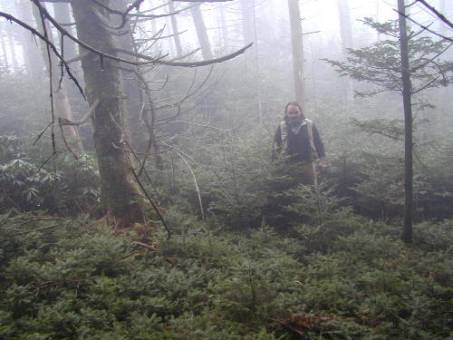
Photo: Wikimedia Commons, Public domain · source

Tree · Pinaceae
Fraser fir
Abies fraseri
In other languages: Fraserspar (Nederlands) · Sapin de Fraser (Français)
Fraser fir comes from the Appalachian Mountains in the south-eastern United States, where it grows only on the highest, cool and misty summits. It is closely related to balsam fir and forms a slender, regular cone with short, soft, dark green needles that are silvery underneath. The needles have a pleasant scent and stay on the branches for a long time, which makes it a popular Christmas tree. The upright, purple cones have protruding, curled-back bracts. In the garden it wants a cool spot with acid, moisture-retentive soil; in a hot, dry place it languishes.
Light
Sun or partial shade
preferably some sun
Moisture
Normal to wet
must not dry out
Legal basis
Sand or loam
acid to neutral
Hardiness
Fully hardy
down to -35 °C
Size
15 m
tall, 5 m wide
| Height | 15 m |
|---|---|
| Native to Belgium | No, planted |
| Poisonous to people and pets | Not known to be poisonous |
Identify
Fraser fir: how do you recognise it?
- Habit
- Narrow, regular cone up to 15 m tall and 5 m wide; moderately fast-growing.
- Needles
- Short (1.5–2.5 cm), flat and soft, dark green with two silvery-white bands underneath; fragrant when crushed.
- Cones
- Upright, 4–7 cm, purple to brown, with protruding, curled-back bracts; they break up on the tree.
- Bark
- Smooth, grey-brown, with resin blisters.
- Roots
- Fairly shallow; sensitive to drought and to wet, poorly drained soil.
Plants: April–May and September–October
In your garden
Why grow it?
- A slender, regular cone shape that takes up little room in width.
- Soft, fragrant needles with a silvery underside.
- Evergreen: structure in the garden all year round.
- A root-balled Christmas tree can, with some care, find a place in the garden afterwards.
- Attractive purple cones on older trees.
Fraser fir: where does it grow best?
- Sun to partial shade; ideally a cool spot with some afternoon shade.
- Acid to neutral, humus-rich soil: sand or loam. It dislikes lime.
- Moisture-retentive but well drained: not a hot, dry south side and no standing water.
- Allow 4–5 m of space around the tree.
- Light
- Sun and partial shade
- Soil type
- Sand or loam
- Acidity
- Acid or neutral
- Moisture
- Normal or wet
- Size
- 15 m tall, 5 m wide
- Hardiness
- Hardy (to -35 °C)
Goes well with
- Rhododendron: Likes the same acid, moist soil.
- Holly: Glossy green leaves and red berries in winter.
- Birch: White trunks as a light contrast to the dark needles.
- Heather: A low, flowering edging on acid soil.
Maintenance
Fraser fir: when and how to plant it?
Plant in April–May and September–October.
- Plant in April–May or September–October.
- Dig a hole twice as wide as the root ball and mix in leaf mould.
- Set the tree at the same depth as before and loosen the wrapping at the top of the root ball.
- Firm the soil and water straight away with a few full watering cans.
- Spread a mulch of bark or pine needles around the base.
- After the holidays, first stand a root-balled Christmas tree in a cool, sheltered spot outside for a few days; plant it in frost-free weather or in April.
Care
- Water
- For the first two years, water generously every week in dry weather; later too in hot, dry summers.
- Mulching
- Top up the mulch every spring: it keeps the roots cool and moist.
- Feeding
- Usually unnecessary; on poor soil, a little compost or conifer feed in March.
- Christmas tree indoors
- Keep it indoors as briefly as possible, ideally no longer than a week to ten days, in a cool spot away from heating, and keep the root ball moist.
- Leader
- Keep a single leader: remove a competing top shoot.
Tip: A root-balled Fraser fir used as a Christmas tree stands the best chance if it spends no more than a week indoors, kept cool with a moist root ball. Then plant it in a cool spot in acid, moist soil.
Fraser fir: when to prune it?
When: Pruning is not needed: it keeps its cone shape naturally.
How:
- Cut out dead or damaged branches back to healthy wood.
- If two leaders form, keep the stronger one.
- Only cut into young growth that still carries needles; leave bare sections alone.
Caution: Never cut into bare wood: it does not grow new needles there.
Propagation
- Seed
- Sow outdoors in a cold frame in autumn, or in spring after a few weeks of cold in the fridge. Seedlings grow slowly for the first few years.
Fraser fir: how does it get through the winter?
Hardy to −35 °C.
- Very hardy (to about −35 °C): needs no protection in Belgium.
- Late spring frost can sometimes damage the young shoots.
- In a pot or as a root-balled Christmas tree: keep it sheltered and water in frost-free weather.
- After a warm living room, a Christmas tree must get used to the cold gradually: first a few days in a cool garage or porch.
Diseases and pests
- Root rot: Fraser fir is very prone to root rot on wet, heavy soil: the tree yellows and dies back. Plant it in a well-drained spot.
- Adelgids: White, woolly tufts on shoots and trunk. Hose off with water and cut out affected shoots.
- Brown needles: Caused by drought, heat or a spot that is too sunny and dry. Water, mulch and choose a cooler place.
- Christmas tree fails to establish: Often due to too long indoors or a root ball with damaged roots. Keep it indoors briefly, acclimatise it gradually and buy a tree with a genuine, firm root ball.
Through the year
- January: Let a root-balled Christmas tree acclimatise outside in a cool, sheltered spot first.
- March: Top up the mulch.
- April: Planting, including a root-balled Christmas tree.
- May: Planting. Water in dry spells.
- June: Water in dry spells. Check for adelgids.
- July: Water generously in hot weather.
- August: Water in dry spells.
- September: Planting.
- October: Planting. Apply mulch.
- December: As a root-balled Christmas tree: briefly indoors, cool, with a moist root ball.
You and this species
Did you know?
- It is named after John Fraser, a Scottish plant collector who explored the southern Appalachians in the late 18th century.
- In the wild it has declined sharply because of an adelgid introduced from Europe that has killed many trees.
- In the United States it is one of the most widely grown Christmas trees and has often been chosen as the White House Christmas tree.