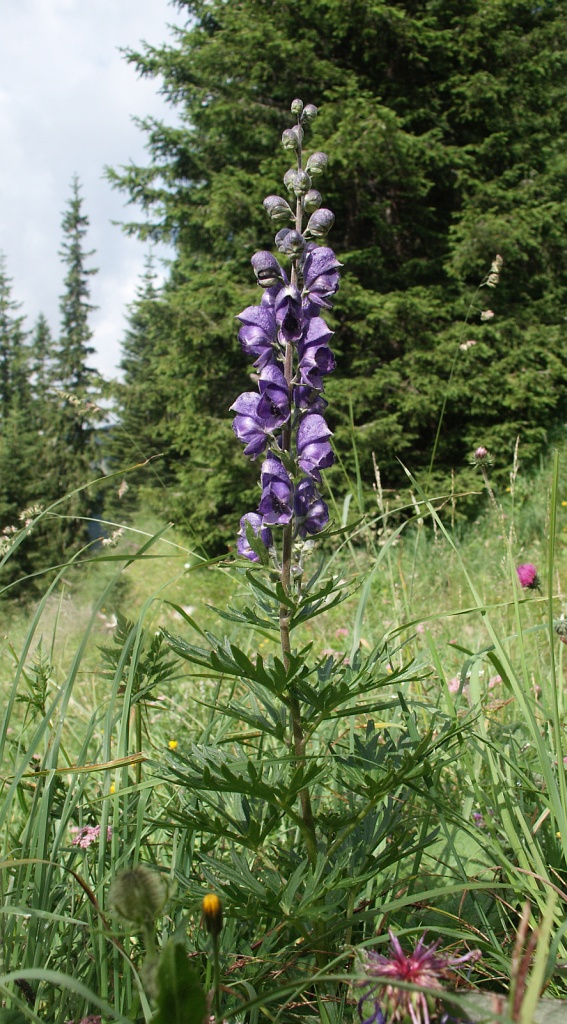
Photo: Bernd Haynold, CC BY-SA 2.5 · source

Perennial · Ranunculaceae
Monkshood
Aconitum napellus
In other languages: Blauwe monnikskap (Nederlands) · Aconit napel (Français)
Monkshood is a sturdy perennial from the mountains of Europe, where it grows in damp meadows, along streams and at woodland edges. It forms a clump of deeply divided, glossy dark green leaves, topped from June to August by upright spikes of deep violet-blue flowers. Each flower has a hood or helmet that resembles a monk’s cowl, hence the name. Gardeners value it as a stately blue vertical in the border, even in part shade, and as a cut flower. There are also varieties with white (‘Album’) and pale pink flowers (‘Carneum’). Be aware, though: it is one of the most poisonous plants in Europe.
Caution: Highly poisonous. All parts, especially the tubers and seeds, contain aconitine, one of the strongest plant poisons. Swallowing even a small amount can be life-threatening for children, adults, dogs, cats and grazing animals such as horses. The poison can also enter through the skin or cuts: always wear gloves. Do not plant it where children play, near the vegetable garden or next to a paddock. If you suspect poisoning, contact the Poison Centre or a doctor immediately.
Light
Sun or partial shade
preferably some sun
Moisture
Normal to wet
must not dry out
Legal basis
Loam or clay
any pH
Hardiness
Fully hardy
down to -35 °C
Size
1.2 m
tall, 0.4 m wide
Flowering
June–August
| Pruning months | August and October |
|---|---|
| Height | 1.2 m |
| Native to Belgium | No, planted |
| Good for bees, butterflies and birds | Yes, for bees |
| Poisonous to people and pets | Yes, take care with children and pets |
| Flowering | June–August |
Identify
Monkshood: how do you recognise it?
- Habit
- Upright clump 1–1.2 m tall and about 40 cm wide, with sturdy stems that are unbranched or only slightly branched.
- Leaves
- Palmate, deeply cut into narrow segments, glossy dark green.
- Flower
- Helmet-shaped flowers of about 2 cm in dense, straight spikes at the tops of the stems, from June to August.
- Colour
- Deep violet-blue; there are also white and pale pink varieties.
- Roots
- Tuberous, turnip-shaped roots; each year a new tuber forms beside the old one. Highly poisonous.
Flowering: June–August · Sowing: October–November · Plants: March–April and September–October · Pruning: August and October
In your garden
Why grow it?
- Deep blue flower spikes from June to August, a colour that is rare in the summer border.
- Also grows in part shade and on heavy, moist clay.
- A good plant for bumblebees: they crawl into the hoods to reach the nectar.
- Straight, slender spikes add height and structure without taking up much room.
- A fine cut flower for a tall arrangement (cut it wearing gloves).
- Fully hardy and long-lived: a clump stays in the same spot for years.
Monkshood: where does it grow best?
- Sun or part shade. In full sun only if the soil always stays moist, otherwise the leaves scorch.
- Fertile, humus-rich loam or clay, acid to chalky.
- Moist to wet: it likes a cool root run and does not tolerate drying out. A spot beside a pond or stream is ideal.
- Plant 40–50 cm apart, in groups of three or more for a good effect.
- Choose a spot where children do not play and pets do not chew, away from the vegetable garden.
- Light
- Sun and partial shade
- Soil type
- Loam or clay
- Acidity
- Not fussy
- Moisture
- Normal or wet
- Size
- 1.2 m tall, 0.4 m wide
- Hardiness
- Hardy (to -35 °C)
Goes well with
- Japanese anemone: Flowers on into autumn, when the monkshood is over, and also likes moist soil.
- Lady’s mantle: A soft, lime-green edging at the front, lovely next to the deep blue.
- Astilbe: Pink or white plumes in the same moist part shade.
- Daylily: Yellow or orange flowers as a warm contrast to the blue.
- Bugbane: Tall white candles in late summer, in the same cool, moist spot.
Maintenance
Monkshood: when and how to plant it?
Plant in March–April and September–October.
- Plant in March–April or September–October; autumn is ideal, as it roots in before winter.
- Wear gloves: the roots and tubers are also highly poisonous.
- Dig a hole twice as wide as the rootball and mix in a few spadefuls of compost.
- Set a potted plant at the same depth as it was in its pot; plant bare tubers just below the surface, about 5 cm deep.
- Water well straight away and keep the soil moist for the first few weeks.
- Spread a layer of leaf mould or compost around the base to keep the soil cool.
Care
- Water
- Water generously in dry spells: drought causes brown leaf edges and fewer flowers.
- Feeding
- Compost or an organic fertiliser in March–April. It likes fertile soil.
- Mulching
- A layer of leaf mould in spring keeps the soil cool and moist.
- Support
- In a windy or too shady spot the stems can flop: put in a plant support in May.
- Safety
- Wear gloves for every job on the plant and wash your hands afterwards.
Tip: Give it a permanent spot at the back of the border, away from play areas and the vegetable patch, and keep the soil moist with a layer of mulch: the leaves then stay attractive all summer. Always wear gloves when handling it.
Monkshood: when to prune it?
Pruning months: August and October.
When: In August, cut back the faded spikes. In October, when the foliage dies down, cut the stems to just above the ground.
How:
- Always wear gloves.
- Cut a faded main spike back to just above the first leaf: the side spikes will then still flower.
- If you let it set seed, it sometimes self-sows; cut off the spikes if you do not want that.
- In autumn, cut all dead stems to just above the ground.
- Never put prunings in a field or in a chicken or rabbit run.
Caution: The sap is poisonous and can be absorbed through the skin or small cuts: never prune with bare hands.
Propagation
- Division
- In March or September–October, every 3–4 years when the clump becomes congested: lift it (wearing gloves) and split it into pieces, each with a few tubers and buds. Replant at once and water.
- Seed
- Sow fresh seed outdoors in October–November in a pot or seed tray. The seed needs a cold spell and germinates slowly and unevenly, often not until spring. Seedlings flower after 2–3 years.
Monkshood: how does it get through the winter?
Hardy to −35 °C.
- Fully hardy, to about −35 °C: no protection needed.
- The top growth dies down in autumn; new shoots appear in March.
- In a pot: stand it against a wall and make sure the compost never dries out completely.
Diseases and pests
- Brown, scorched leaves: Too dry or too sunny. Water generously, mulch the soil and if necessary move it to a cooler spot in part shade.
- Flopping stems: Too much shade, too rich a soil or wind. Put in a support in May and give it more light.
- Powdery mildew: White powder on the leaves in dry summers. Water, do not plant too closely and cut off affected leaves wearing gloves.
- Few flowers: Common in the first year after planting or dividing: it needs time. Dividing helps with old, congested clumps.
Through the year
- March: New shoots. Plant or divide. Add compost.
- April: Plant. Mulch.
- May: Put in supports in windy spots. Water in dry weather.
- June: Flowering starts. Cut flowers wearing gloves.
- July: Full flower. Keep the soil moist.
- August: Cut back faded spikes. Water in dry weather.
- September: Plant or divide.
- October: Cut dead stems down to the ground. Plant. Sow fresh seed outdoors.
- November: Sow in pots outdoors. Leaf mould over the clump.
Use
Edible and useful
Not edible. Monkshood is one of the most poisonous plants in Europe: all parts, especially the root, contain aconitine, which can even be absorbed through the skin. Always wear gloves when cutting back, dividing or picking the flowers, wash your hands afterwards and do not plant it where children play. Never eat it, not as a herb nor as a tea. If any is swallowed, call a poison centre (in Belgium 070 245 245) or your doctor at once.
Good for wildlife
- Bees
- Nectar and pollen for honeybees and wild bees.
You and this species
Did you know?
- The English name monkshood and the Dutch monnikskap both refer to the upper sepal, which hangs over the rest of the flower like a hood.
- ‘Napellus’ means ‘little turnip’ and refers to the tuberous root.
- Bumblebees in particular are strong enough and have long enough tongues to reach the nectar deep inside the hood.