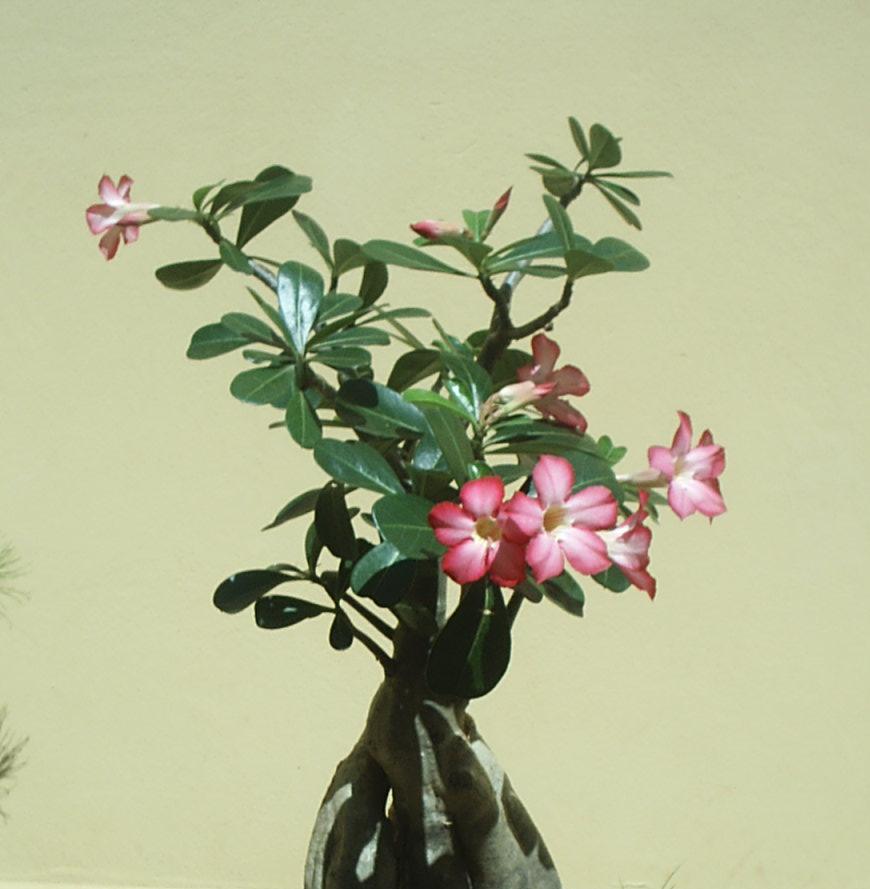
Photo: Wikimedia Commons, Public domain · source

Houseplant · Apocynaceae
Desert rose
Adenium obesum
In other languages: Woestijnroos (Nederlands) · Rose du désert (Français)
The desert rose is a succulent from the dry regions of East Africa and the Arabian Peninsula. It forms a squat little shrub with a strikingly swollen base, the caudex, in which it stores water. Glossy, spoon-shaped leaves sit at the tips of the branches and, from May to September, trumpet-shaped flowers appear in pink, red or white, often with a paler throat. Here it is a houseplant for the sunniest windowsill, which can also spend the summer outdoors in a warm spot. In winter it rests, often drops its leaves and wants to be kept dry. The milky sap is highly toxic: always wear gloves when handling it.
Caution: All parts of the plant, especially the white milky sap, are highly toxic if swallowed; the sap also irritates skin and eyes. Keep the plant out of reach of children, cats and dogs, and wear gloves when pruning and repotting. Wash your hands and tools afterwards.
Light
Full sun
warm and bright
Moisture
Dry
tolerates drought
Legal basis
Potting soil
Hardiness
Houseplant
min. 12 °C
Size
0.8 m
tall, 0.6 m wide
Flowering
May–September
| Pruning months | March–April |
|---|---|
| Height | 0.8 m |
| Poisonous to people and pets | Yes, take care with children and pets |
| Flowering | May–September |
Identify
Desert rose: how do you recognise it?
- Habit
- Succulent shrub or small tree up to 80 cm tall and 60 cm wide in a pot, with a swollen, grey-brown base and thick branches.
- Leaves
- Spoon-shaped to oblong, 5–15 cm, glossy dark green, in rosettes at the branch tips. They drop during the rest period.
- Flower
- Trumpet-shaped, 4–6 cm across, with five broad lobes, from May to September.
- Colour
- Pink to red, often with a white throat; also white, and double or striped in some varieties.
- Caudex
- A thick, water-storing base that grows with the years. Each time you repot, you can raise it a little so it shows off better.
- Sap
- White and highly toxic; it oozes from every wound.
Flowering: May–September · Plants: March–April · Pruning: March–April
In your garden
Why grow it?
- A living sculpture: the thick, gnarled caudex makes every plant unique.
- Large trumpet flowers in pink, red or white, from May to September.
- Needs little water: ideal if you sometimes forget a plant.
- Can live for many years and becomes more beautiful with age.
- Can go outdoors in summer, on a sunny patio.
- Easy to shape by pruning, like a bonsai.
Desert rose: where does it grow best?
- As much sun as possible: a south-facing window or a conservatory is ideal. With too little light it stretches and does not flower.
- Very open, free-draining compost: cactus compost mixed with a third of coarse grit, perlite or pumice.
- Dry: water only when the pot is almost completely dry. Wet feet make the caudex rot.
- Warm: 20–30 °C in the growing season, never below 12 °C in winter.
- From June to September it can go outdoors in a warm, sunny spot sheltered from rain, as long as nights stay above 15 °C.
- Light
- Sunny
- Potting soil
- Cactus compost
- Acidity
- Neutral
- Watering
- Sparingly
- Size
- 0.8 m tall, 0.6 m wide
- Temperature
- Minimum 12 °C
Goes well with
- Madagascar palm: A related succulent with a thick, spiny trunk and the same care.
- Aloe: Fleshy rosettes that are just as fond of sun and little water.
- Cacti: A small group on the same sunny windowsill, with the same dry winter rest.
- Jade plant: An evergreen succulent that stays green in winter beside the bare desert rose.
Maintenance
Desert rose: when and how to plant it?
Plant in March–April.
- Repot in March–April, at the start of the growing season, every two to three years.
- Choose a wide, rather shallow pot with a large drainage hole; terracotta dries out faster and is ideal.
- Put a layer of gravel or clay pebbles in the bottom and fill with cactus compost mixed with coarse grit or perlite.
- Wearing gloves, take the plant out of its pot, shake off the old compost and cut away rotten or dead roots.
- Set the plant at the same depth or slightly higher, so the caudex remains nicely visible.
- Wait a week before watering so damaged roots can dry and heal.
Care
- Watering
- From April to September, water thoroughly as soon as the compost is almost dry. In winter hardly at all, especially once it has dropped its leaves.
- Feeding
- From April to August, once a month with a liquid feed for cacti or flowering plants at half strength.
- Light
- Turn the pot now and then so it grows evenly.
- Moving outdoors
- After winter, let it get used to full sun gradually, or the leaves will scorch.
- Repotting
- Every two to three years in March–April, in fresh, open compost.
Tip: Give it the sunniest spot in your home and keep it dry in winter when it drops its leaves. Wear gloves when pruning and wash your hands afterwards: the milky sap is highly toxic.
Desert rose: when to prune it?
Pruning months: March–April.
When: In March–April, as growth starts. Pruning is not essential but gives a fuller, better-branched plant.
How:
- Cut back over-long branches to just above a node; several new branches usually grow from below the cut.
- Use a sharp, clean knife or secateurs and wear gloves.
- Let the wounds dry and water less for the following week.
- Use healthy tips you have cut off as cuttings.
Caution: The milky sap is highly toxic and irritates skin and eyes. Wear gloves, do not rub your eyes, and wash your hands and tools after pruning.
Propagation
- Seed
- Fresh seed germinates readily at 25–30 °C, laid on the surface of moist seed compost. Seedlings soon form a thick caudex.
- Cuttings
- In summer, cut tips 10–15 cm long, let them dry for a few days and insert them in dry, sandy compost in a warm place. Plants grown from cuttings form a less swollen caudex.
Desert rose: how does it get through the winter?
- Keep it indoors in a bright spot, never below 12 °C: cold combined with wet compost is fatal.
- In winter it rests and often loses some or all of its leaves: that is normal.
- Then give almost no water, at most a little when the caudex starts to wrinkle.
- Do not place it against a cold window or in a draught. In March, when new leaves appear, gradually give more water again.
Diseases and pests
- Caudex rot: A soft, brown or black caudex caused by too much water or cold. Cut out the rotten part back to healthy tissue, let it dry and water less.
- Leaf drop: Yellowing leaves and leaf drop in autumn are normal. In summer they point to too little light, too much water or a sudden change of position.
- Mealybugs: White, woolly tufts in the leaf axils. Remove them with a cotton bud dipped in methylated spirits.
- Red spider mite: Fine yellow speckles and webbing under the leaves in dry, warm air. Spray the leaves regularly with lukewarm water.
- No flowers: Too little sun or no winter rest. Give it the sunniest spot and let it rest dry and a little cooler in winter.
Through the year
- January: Rest. Almost no water, minimum 12 °C.
- February: Rest. Keep bright and dry.
- March: Prune and repot. Gradually give more water as growth resumes.
- April: Repot or prune. Start feeding.
- May: First flowers. Water as soon as the compost is almost dry.
- June: Move outdoors to a warm, sunny spot. Flowering.
- July: Full flower. Feed monthly. Take cuttings.
- August: Flowering. Last feed.
- September: Flowering. Bring indoors before nights turn cool.
- October: Water less. The leaves start to yellow.
- November: Rest. Dry and bright, minimum 12 °C.
- December: Rest. Almost no water.
Use
Edible and useful
Not edible. All parts of desert rose are highly poisonous, especially the white milky sap: it contains cardiac glycosides, compounds that, like those of foxglove, act strongly on the heart, and in Africa it was used as an arrow poison. Swallowing any causes vomiting, stomach ache and diarrhoea and can seriously disturb the heart rhythm; the sap also irritates the skin and eyes. Keep the plant out of reach of children, cats and dogs, also when it spends the summer outdoors. Wear gloves when pruning, taking cuttings and repotting, keep sap out of your eyes and wash your hands and tools afterwards. Call your vet at once if an animal has eaten some. If any is swallowed, call a poison centre (in Belgium 070 245 245) or your doctor at once.
You and this species
Did you know?
- In parts of Africa the milky sap was once used to poison arrowheads.
- The species name obesum means ‘fat’ or ‘plump’, after the swollen base.
- In Thailand and elsewhere in South-East Asia countless varieties are grown, with single, double and even striped flowers.