Photo: Franz Xaver, CC BY-SA 3.0 · source

Perennial · Ranunculaceae
Yellow pheasant’s eye
Adonis vernalis
In other languages: Voorjaarsadonis (Nederlands) · Adonis de printemps (Français)
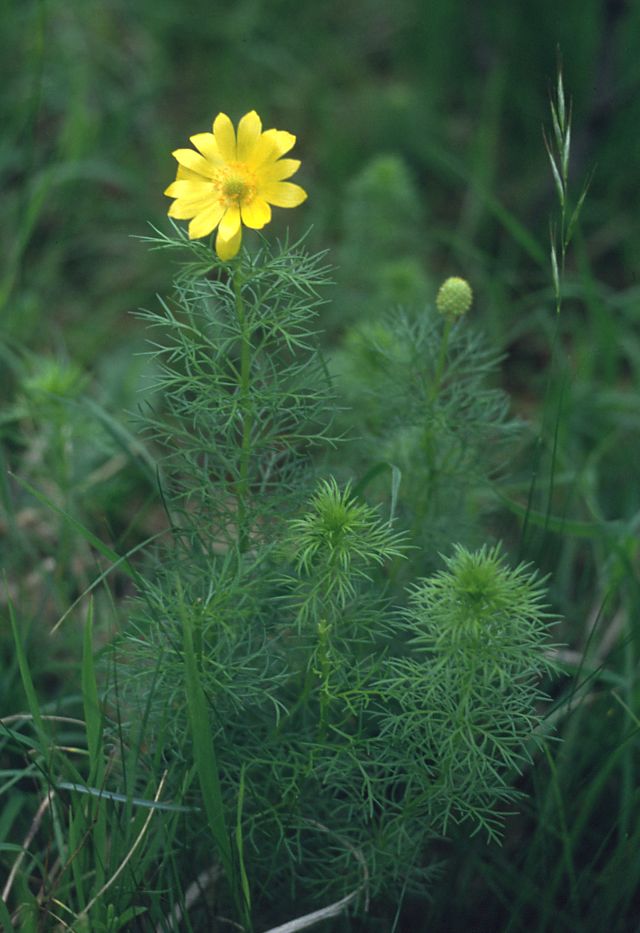
Yellow pheasant’s eye is a small perennial from the dry steppes and chalk grasslands of central and eastern Europe as far as Siberia. From March to May it opens large, glossy golden yellow flowers 4–7 cm across, like little suns above finely divided, fennel-like foliage. The flowers only open in sunshine. It grows very slowly, but once established it can stay in the same spot for decades. After flowering it dies down during the summer, so you will not see it again until the following spring. Gardeners value it as one of the finest early flowers for a sunny rock garden or a border on chalky soil.
Caution: All parts are poisonous. Keep children, dogs, cats and grazing animals such as horses, sheep and rabbits away from the plant, do not let anyone nibble it and wear gloves when handling it.
Light
Full sun
warm and bright
Moisture
Dry to normal
no wet feet
Legal basis
Sand or loam
neutral to chalky
Hardiness
Fully hardy
down to -30 °C
Size
0.3 m
tall, 0.3 m wide
Flowering
March–May
| Height | 0.3 m |
|---|---|
| Native to Belgium | No, planted |
| Good for bees, butterflies and birds | Yes, for bees |
| Poisonous to people and pets | Yes, take care with children and pets |
| Flowering | March–May |
Identify
Yellow pheasant’s eye: how do you recognise it?
- Habit
- Small, compact clump 15–30 cm tall and about 30 cm wide; it dies down in summer.
- Leaves
- Finely divided into thread-like segments, like fennel or dill; fresh green and dense along the stems.
- Flower
- One large, glossy golden yellow flower per stem, 4–7 cm across, with 10–20 narrow petals. From March to May; it only opens in sunshine.
- Fruit
- A small ball of tiny, hairy seeds that ripens in early summer.
- Roots
- A short, thick rhizome with deep, dark roots; it dislikes being moved.
- Growth
- Very slow: a young plant takes years to form a full clump.
Flowering: March–May · Plants: March–April and September
In your garden
Why grow it?
- One of the largest and brightest flowers of early spring, on a plant barely 30 cm tall.
- Early bees and hoverflies find pollen on it when little else is in flower.
- The fine, fresh green foliage stays attractive for weeks after flowering.
- Ideal for a sunny rock garden, a gravel garden or the front of a border on chalky soil.
- Very long-lived and low-maintenance once established.
Yellow pheasant’s eye: where does it grow best?
- Full sun, especially in spring: the flowers only open in sunshine.
- Well-drained sandy or loamy soil, neutral to chalky; on acid soil a little limestone grit helps.
- Dry to moderately moist; it cannot stand wet feet in winter.
- A slope, a raised bed or a rock garden is ideal for drainage.
- Allow 25–30 cm of space and mark the spot: after summer there is nothing left to see.
- Light
- Sun
- Soil type
- Sand or loam
- Acidity
- Neutral or chalky
- Moisture
- Dry or normal
- Size
- 0.3 m tall, 0.3 m wide
- Hardiness
- Hardy (to -30 °C)
Goes well with
- Pasque flower: Purple bells in the same season, in the same sunny, chalky spot.
- Species tulips: Cheerful colours in April; they also like a dry summer.
- Grape hyacinth: Blue spikes that contrast beautifully with the golden flowers.
- Thyme: A low, evergreen mat that covers the empty spot in summer.
- Blue fescue: Grey-blue tufts that give structure all year round.
Maintenance
Yellow pheasant’s eye: when and how to plant it?
Plant in March–April and September.
- Plant in March–April or in September, preferably a pot-grown plant.
- Choose the final spot straight away: it does not like being moved.
- Dig a generous hole and mix heavy soil with coarse sand or fine gravel.
- Set the plant at the same depth as in the pot, with the buds just below the surface, and firm gently.
- Keep 25–30 cm between it and its neighbours.
- Water in moderately and spread a little gravel around the base instead of a mulch.
Care
- Watering
- Only after planting and during long dry spells in spring. In summer, when it dies down, keep it dry.
- Feeding
- Not needed; perhaps a thin layer of fine compost in March.
- Foliage
- Let the leaves die back naturally after flowering: that is how the plant builds up reserves for the next year.
- Weeding
- Weed carefully by hand around the clump; a hoe easily damages the buds.
- Moving
- Best avoided: leave it undisturbed and the clump gets better every year.
Tip: Put a label or a stone next to the plant: after summer it has disappeared completely and you might otherwise dig it up by mistake. Let the leaves die back naturally, because that is how it builds the buds for the next spring.
Yellow pheasant’s eye: when to prune it?
When: It does not need pruning. Only when the leaves have turned completely yellow and dry in summer can you remove them.
How:
- Leave faded flowers if you want to collect seed; otherwise you can snip them off.
- Only cut or pull away the dead foliage once it has withered completely.
- Wear gloves and wash your hands afterwards.
Caution: Do not cut off the green leaves too early: the plant will then flower less the following spring.
Propagation
- Seed
- Sow fresh seed as soon as it ripens, in early summer, in a pot of chalky seed compost left outdoors. It germinates slowly and erratically, sometimes only after a year, and seedlings take several years to flower.
- Division
- Only for a large, old clump, in September: lift it carefully and split it into pieces, each with a bud and plenty of roots. It does not always succeed, so only do it when necessary.
Yellow pheasant’s eye: how does it get through the winter?
Hardy to −30 °C.
- Fully hardy, to about −30 °C: no protection is needed in Belgium.
- Cold is not a problem, wet soil is: make sure drainage is good.
- In a pot or trough: use a very gritty mix and stand it against a wall in winter, out of the worst of the rain.
Diseases and pests
- Slugs: They eat the young shoots and buds in early spring. Pick them off in the evening and spread a layer of sharp grit around the plant.
- Root rot: In wet, heavy soil the rhizome rots in winter. Plant in a well-drained spot or a raised bed.
- Few flowers: Young plants flower sparingly for the first few years, as do plants in too much shade. Patience and a sunny spot are the answer.
- Plant vanished: It dies down naturally in summer. Mark the spot so you do not dig it up or plant something on top of it.
Through the year
- February: The first shoots appear. Keep slugs away.
- March: Flowering begins. Plant.
- April: Full flower. Plant pot-grown plants.
- May: Last flowers. The foliage stays attractive.
- June: Collect seed and sow it straight away.
- July: The leaves turn yellow: let them die back naturally.
- August: Dormant. Mark the spot and keep it dry.
- September: Plant or divide old clumps.
Use
Edible and useful
Not edible. All parts of yellow pheasant’s eye are poisonous: they contain cardiac glycosides, compounds that, like those of foxglove, act strongly on the heart. Swallowing any causes nausea, vomiting and diarrhoea, and in larger amounts a slow or irregular heartbeat. The plant was once used as a heart remedy, but the effective dose is close to the toxic one: never make teas or preparations from it yourself. Keep children, dogs, cats and grazing animals such as horses, sheep and rabbits away from the plant and its trimmings, and wear gloves when working with it. If any is swallowed, call a poison centre (in Belgium 070 245 245) or your doctor at once.
Good for wildlife
- Bees
- Nectar and pollen for honeybees and wild bees.
You and this species
Did you know?
- The name refers to Adonis, the handsome young man of Greek mythology.
- In the wild, yellow pheasant’s eye has become rare and it is protected in many European countries. So only buy nursery-grown plants.
- Once established, a clump can live for decades.