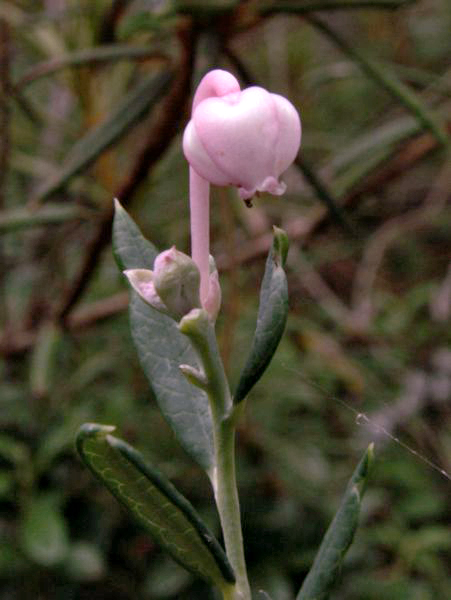
Photo: B.gliwa, CC BY-SA 2.5 · source

Shrub · Ericaceae
Bog rosemary
Andromeda polifolia
In other languages: Lavendelhei (Nederlands) · Andromède à feuilles de polium (Français)
Bog rosemary is a low, evergreen dwarf shrub of raised bogs and wet heath in northern Europe, Asia and North America, and it also grows wild in Belgium. It creeps through sphagnum moss on thin rhizomes, forming loose mats 20–30 cm tall. The narrow, leathery leaves are blue-green with rolled-under edges and whitish undersides, which makes them look a little like rosemary. In May–June small pink to white bells hang in clusters at the tips of the shoots. Well-known cultivars are ‘Blue Ice’, with striking blue-grey leaves, and the compact ‘Compacta’.
Caution: All parts are poisonous. Keep children, cats, dogs and grazing animals such as sheep and goats away from the plant, and wear gloves when pruning. Never take it from the wild: it has become rare in Belgium.
Light
Sun or partial shade
preferably some sun
Moisture
Moist to wet
must not dry out
Legal basis
Sand or peat
acid
Hardiness
Fully hardy
down to -35 °C
Size
0.3 m
tall, 0.5 m wide
Flowering
May–June
| Pruning months | June–July |
|---|---|
| Height | 0.3 m |
| Native to Belgium | Yes |
| Poisonous to people and pets | Yes, take care with children and pets |
| Flowering | May–June |
Identify
Bog rosemary: how do you recognise it?
- Habit
- Low, creeping dwarf shrub 20–30 cm tall and about 50 cm across, with thin, upright shoots.
- Leaves
- Narrow, linear and leathery, with rolled-under edges; blue-green above, whitish below; evergreen.
- Flower
- Small, rounded, nodding bells in clusters at the shoot tips, in May–June.
- Colour
- Pale pink to white, on deeper pink stalks.
- Roots
- Fine, shallow roots and creeping rhizomes; like most heathers it lives in partnership with soil fungi.
Flowering: May–June · Plants: March–April and September–October · Pruning: June–July
In your garden
Why grow it?
- A native plant for a bog garden, heather garden or the wet edge of a pond.
- Blue-green leaves all year round, even in winter.
- Dainty pink bells in May–June.
- Stays low and small: suits a small garden or a large container.
- Grows where few other shrubs survive: acid, wet and poor ground.
Bog rosemary: where does it grow best?
- Sun to light partial shade; in shade the plant becomes sparse.
- Acid, peaty or humus-rich sandy soil, very acid (pH around 4–5) and never chalky.
- Wet to very moist: at a pond edge, in a bog bed or in a heather garden with a high water table.
- Water only with rainwater; tap water often contains lime.
- Plant 30–40 cm apart, in small groups.
- Light
- Sun and partial shade
- Soil type
- Sand or peat
- Acidity
- Acid
- Moisture
- Wet
- Size
- 0.3 m tall, 0.5 m wide
- Hardiness
- Hardy (to -35 °C)
Goes well with
- Cross-leaved heath: Pink bells for the same wet, acid soil.
- Cranberry: A creeping ground cover with red berries for a bog bed.
- Cotton grass: White tufts in spring, in the same wet, acid soil.
- Heather: For the slightly drier edge of a heather garden.
Maintenance
Bog rosemary: when and how to plant it?
Plant in March–April and September–October.
- Plant in March–April or September–October.
- Prepare a planting area with ericaceous compost or heather soil mixed with some sand; on chalky soil this only works in a lined bog bed or container.
- Set the plant at the same depth as in the pot and firm gently.
- Leave 30–40 cm between plants.
- Water in with rainwater and keep the soil constantly moist.
- Mulch with pine needles or fine pine bark to keep the soil acid and moist.
Care
- Watering
- Never let the soil dry out; in dry spells water generously with rainwater.
- Feeding
- Usually not needed. At most a small dose of ericaceous fertiliser in spring.
- Mulching
- Each spring, a thin layer of pine needles or pine bark.
- Weeding
- Remove grasses and tree seedlings, which quickly smother this low plant.
- In a container
- Use a tub with few or no drainage holes, filled with acid compost, and keep it wet.
Tip: Make a bog bed: dig a hole about 40 cm deep, line it with pond liner pierced with a few holes, fill it with acid compost and keep it wet with rainwater. That way you can grow bog rosemary even in a garden with chalky soil.
Bog rosemary: when to prune it?
Pruning months: June–July.
When: Hardly needed. To keep the plant compact, trim lightly after flowering, in June–July.
How:
- Lightly trim spent flower clusters and overlong shoots.
- Remove dead or brown shoots in spring.
- Never cut hard into old wood.
Caution: Wear gloves and clear up the clippings: all parts are poisonous.
Propagation
- Runners
- In spring, detach rooted runners at the edge of the mat and pot them up in acid compost.
- Semi-ripe cuttings
- In July–August, root 3–5 cm cuttings in a mix of acid compost and sand, under plastic.
- Division
- In spring, carefully split a rooted mat into pieces and replant straight away.
Bog rosemary: how does it get through the winter?
Hardy to −35 °C.
- Very hardy, to −35 °C: no protection is needed in Belgium.
- Evergreen: the blue-green leaves stay attractive all winter.
- In a container: make sure the soil does not dry out in sunny, frosty weather and water on frost-free days.
Diseases and pests
- Yellow leaves: Chlorosis from lime or tap water. Water with rainwater and add acid compost or pine needles.
- Brown, dried-out shoots: A sign of drought. Keep the soil constantly wet, especially in summer.
- Overgrown by weeds: Grasses and stronger plants crowd out this low plant. Weed regularly.
- Dwindling in the border: It does not last long in ordinary garden soil. Plant it in a bog bed or a container of acid compost.
Through the year
- January: Rest. Blue-green winter leaves.
- March: Planting. Remove dead shoots.
- April: Planting. Mulch with pine needles.
- May: Flowering begins.
- June: Flowering. Trim lightly after flowering.
- July: Water generously with rainwater in dry spells. Light trim.
- August: Watering. Take semi-ripe cuttings.
- September: Planting.
- October: Planting.
- December: Rest. Water containers on frost-free days.
Use
Edible and useful
Not edible. Bog rosemary is poisonous in all its parts: like rhododendron it contains grayanotoxins, which cause vomiting, dizziness, a slow heartbeat and low blood pressure. Despite its name and its narrow grey-green leaves with rolled edges, it is not rosemary: never use the leaves as a herb or for tea. Especially dangerous to sheep and goats that nibble it. Wear gloves when pruning and clear up the clippings. If any is swallowed, call a poison centre (in Belgium 070 245 245) or your doctor at once.
You and this species
Did you know?
- Linnaeus named the plant during his journey through Lapland in 1732: the little plant on a hummock in the bog reminded him of Andromeda from Greek myth, chained to a rock in the sea.
- Despite the name bog rosemary, it is not related to rosemary but belongs to the heather family.
- In the wild it often grows with sphagnum moss, which keeps the ground acid and wet.