Photo: Wikimedia Commons, CC BY-SA 3.0 · source

Perennial · Asteraceae
Mountain everlasting
Antennaria dioica
In other languages: Rozenkransje (Nederlands) · Pied-de-chat (Français)
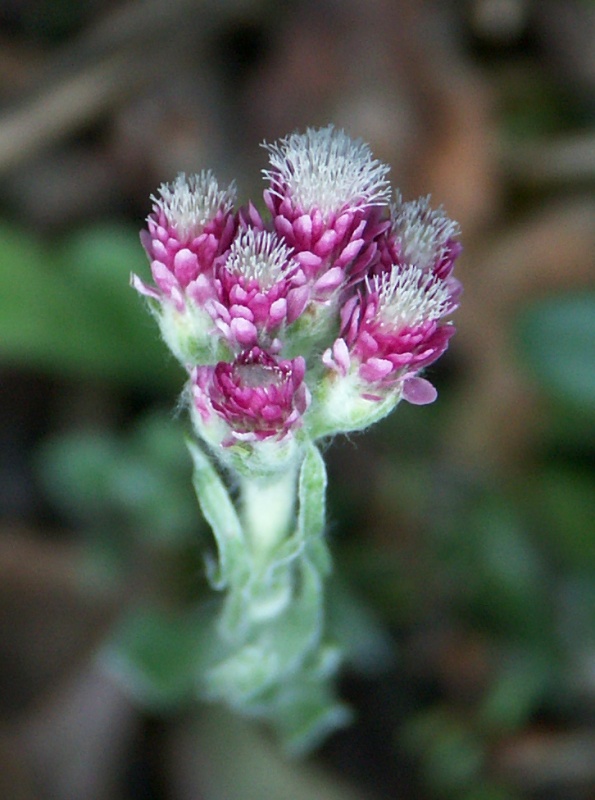
Mountain everlasting is a native, evergreen perennial of heathland, poor grassland and dunes across much of Europe, including Belgium, although it has become very rare in the wild. It forms a low, silver-grey mat of small, felted leaf rosettes that spreads by surface runners. From May to July, little stems 10–15 cm tall carry clusters of small flower heads: white on male plants, pink to rose-red on female ones. Gardeners value it in a rock garden, a heather garden or between stepping stones, on poor sandy soil where little else will grow. A well-known cultivar is ‘Rubra’, with deep pink flowers.
Light
Full sun
warm and bright
Moisture
Dry
tolerates drought
Legal basis
Sand
acid to neutral
Hardiness
Fully hardy
down to -35 °C
Size
0.15 m
tall, 0.3 m wide
Flowering
May–July
| Pruning months | July |
|---|---|
| Height | 0.15 m |
| Native to Belgium | Yes |
| Good for bees, butterflies and birds | Yes, for butterflies |
| Poisonous to people and pets | Not known to be poisonous |
| Flowering | May–July |
Identify
Mountain everlasting: how do you recognise it?
- Habit
- Low, dense mat of leaf rosettes, about 5 cm tall and up to 30 cm wide; flower stems up to 15 cm.
- Leaves
- Small and spoon-shaped, 1–3 cm, grey-green above and silvery white and felted underneath; evergreen.
- Flower
- Small flower heads in dense clusters at the top of the stem, from May to July; white on male plants, pink to rose-red on female plants.
- Separate sexes
- There are separate male and female plants; only female plants set seed.
- Roots
- Shallow, with surface runners that root where they touch the ground.
Flowering: May–July · Plants: March–April and September–October · Pruning: July
In your garden
Why grow it?
- Silver-grey foliage that looks good all year round, even in winter.
- Native and now rare: growing it in your garden helps a threatened species.
- Butterflies and other insects visit the flower heads.
- A tough ground cover for poor, dry sandy soil in full sun.
- The flower heads are everlastings: dried, they keep their shape and colour.
Mountain everlasting: where does it grow best?
- Full sun: in shade the mat becomes sparse and bare.
- Poor, acid to neutral sandy soil; no fertiliser and no compost.
- Dry: it tolerates long droughts, but not wet soil in winter.
- Keep competition away: it cannot cope with grass or tall plants growing over it.
- Plant 20–25 cm apart for a closed mat.
- Light
- Sun
- Soil type
- Sand
- Acidity
- Acid or neutral
- Moisture
- Dry
- Size
- 0.15 m tall, 0.3 m wide
- Hardiness
- Hardy (to -35 °C)
Goes well with
- Heather: The same poor, acid sandy soil: together they make a true heathland garden.
- Wild thyme: A fragrant, flowering mat alongside, also good for bees and butterflies.
- Harebell: Fine blue bells above the silver-grey mat.
- Sheep’s bit: Blue pompons for the same dry, sandy soil.
- Sheep’s fescue: A fine, low grass that suits the heathland feel.
Maintenance
Mountain everlasting: when and how to plant it?
Plant in March–April and September–October.
- Plant in March–April or September–October.
- Loosen the soil and mix heavy or rich soil with plenty of sand or fine gravel; add no compost or fertiliser.
- Set the plant at the same depth as in the pot, certainly no deeper: the rosettes should sit on the surface.
- Keep 20–25 cm between plants.
- Water in moderately and keep the soil slightly moist for the first few weeks.
- Spread a layer of gravel or coarse sand around the plant against rot and weeds.
Care
- Watering
- Only for the first few weeks after planting; after that it copes even in dry summers.
- Feeding
- Never: in rich soil it grows soft and rots more easily.
- Weeding
- Pull grass and weeds out of the mat by hand before they smother it.
- Deadheading
- Snip off the faded flower stems in July for a neat, silver-grey mat.
- Rejuvenating
- If the centre goes bare, every few years take young rosettes from the edge and replant them.
Tip: If you want both white and pink flower heads, plant male and female plants. Buy them in flower so you can see the difference straight away.
Mountain everlasting: when to prune it?
Pruning months: July.
When: After flowering, in July, snip off the faded flower stems. Otherwise it needs no pruning.
How:
- Cut the stems off just above the mat of leaves.
- Leave a few if you want seed or like the dried flower heads.
- In spring, carefully remove any dead rosettes.
Caution: Never cut into the grey mat itself: it grows back only slowly.
Propagation
- Division
- In March–April or September, detach rooted rosettes from the edge of the mat and replant them elsewhere, or grow them on in a pot of sandy compost.
- Seed
- Sow in spring on sandy seed compost and barely cover the seed. For viable seed you need a female plant with a male plant nearby.
Mountain everlasting: how does it get through the winter?
Hardy to −35 °C.
- Fully hardy, to about −35 °C, and evergreen.
- Wet winters are the greatest danger: choose a well-drained spot.
- Remove fallen leaves from the mat so that it does not rot.
- In a pot or trough: use poor, sandy compost with grit and keep it out of the worst of the rain.
Diseases and pests
- Rot: Brown, rotting rosettes after a wet winter. Plant in a well-drained spot and spread grit around the base.
- Overgrown: Grass and weeds grow through the mat. Weed regularly by hand.
- Bare centre: Older mats go bare in the middle. Rejuvenate them by replanting young rosettes from the edge.
- Soft and green: Soil that is too rich or too much shade makes it soft and less silvery. Choose a poor, sunny spot.
Through the year
- March: Plant. Remove dead rosettes.
- April: Plant or divide.
- May: Flowering begins.
- June: Full flower. Butterflies visit the flower heads.
- July: End of flowering. Snip off faded stems.
- September: Plant or divide.
- October: Plant. Clear fallen leaves from the mat.
- November: Remove fallen leaves.
Use
Good for wildlife
- Butterflies
- Nectar for butterflies.
You and this species
Did you know?
- The name dioica means ‘two houses’: male and female flowers grow on separate plants.
- The name Antennaria refers to the bristles of the male flowers, which resemble the antennae of insects.
- The English name cat’s foot and the French pied-de-chat both refer to the soft, woolly flower heads, which look like little cat’s paws.